

The flora of the Canary Islands
Introduction
The Canary Islands boast an extraordinary wealth of
flora, making them one of the world’s leading biogeographical regions and
the foremost in Spain, both in terms of their high number of species and
their origin, variety, ecological range and evolutionary process, which is
still in full swing.
The vascular flora of the Canary
Islands comprises around 2,400–2,500 species, of which around 700 are
endemic, some 100 are shared with other Macaronesian archipelagos, such as
the Azores or Madeira, and around 600 are of Mediterranean-African origin,
with the remainder being introduced species.
However,
the slow but progressive deterioration of natural habitats, the
indiscriminate use of many of these species by humans, and the major changes
the islands’ natural environment has undergone in recent times have had a
negative impact on this remarkable flora, resulting in at least four species
being considered extinct, some 120 being endangered, and many others falling
into the ‘rare’ or ‘vulnerable’ categories.
Owing to its uniqueness, beauty, abundance and evolutionary characteristics,
the flora of the Canary Islands has attracted the attention of many
scientists and naturalists for centuries, who have studied it and made it
known throughout the world. Among them, Alexander von Humboldt stands out;
he is regarded as the father of biogeography. During his stay in Tenerife in
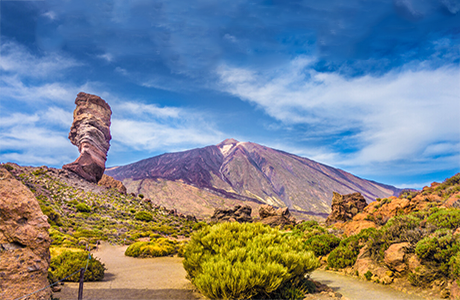
1799, he climbed Mount Teide and identified the stratification of the Canary
Islands’ flora into what are known as vegetation zones. During this
expedition, he discovered the Teide violet (Viola cheiranthifolia) for
science – one of the plants growing at the highest altitudes in the whole of
Spain, and an emblem of the Canary Islands’ high-mountain flora.

Canary Islands: origin and geology
The Canary Islands archipelago lies between latitudes 29° 24' 40'“ N, at
the islet of Alegranza, and 27° 38” 16'' N, at the western tip of the
island of El Hierro; and between longitudes 13° 19' 54'“ W, at the islet
of Roque del Este, and 18° 09” 38'' W, at Roque del Guincho, also on the
island of El Hierro. This places it geographically off the west coast of
Africa, less than 100 km from Cape Juby, in the territory of Western
Sahara.
The total area of the archipelago is 7,447
km², and it comprises seven major islands (Tenerife, La Palma, La
Gomera, El Hierro, Gran Canaria, Lanzarote and Fuerteventura) and six
smaller ones (Alegranza, La Graciosa, Montaña Clara, Lobos, Roque del
Este and Roque del Oeste). Their coastline stretches for a total of
around 1,580 kilometres, and the highest point on the islands is Pico
del Teide on Tenerife, which, at 3,718 m, is the highest geographical
point in the whole of Spain.

The climate in the Canary Islands
Thanks to their subtropical location, the influence of the trade winds
and their maritime setting, the Canary Islands enjoy one of the best
climates in the world, with very gentle variations between the seasons
and between day and night temperatures, particularly along the coast,
meaning that a spring-like climate prevails for almost the whole year.
Rainfall is scarce and temperatures are moderate, averaging around
15–20°C; however, given the archipelago’s complex topography, there is a
wide variety of microclimates that result in climatic differences
between the islands, and even within a single island.
In addition to the influence of the cold Canary Current, which moderates
temperatures, the presence of the Azores High for much of the year, the
arrival of Saharan dust clouds (calimas) several times a year, or the
occasional influx of polar air, the main factor determining the Canary
Islands’ climate is the trade winds, a type of wind blowing from the
east to the north-east at a fairly steady speed of between 20 and 22
km/h; as these winds carry oceanic moisture, they prevent the Canary
Islands from becoming a desert region, as one might expect given their
geographical position off the coast of the Saharan region of the African
continent.

The topography of the Canary Islands
The Canary Islands are characterised by their high mountains relative to
their surface area. As a result of their volcanic origin, their
topography is highly varied; however, with the exception of Lanzarote
and Fuerteventura, all the islands have prominent central peaks. Steep
slopes descend from these peaks, accompanied by deep ravines that reach
down to the sea. This topographical layout, combined with the
characteristics of being an archipelago situated in the subtropical zone
of the Atlantic Ocean, gives rise to a unique and exceptionally
beautiful landscape, with a wide variety of soils, climates and
vegetation.
The predominance of this mountainous
terrain has a significant influence on the atmospheric dynamics of the
Canary Islands. The high peaks act as a veritable barrier to air masses;
when these collide with them, they are forced to rise, causing them to
cool, condense and release moisture on the windward northern slopes of
the islands. Consequently, the mountainous islands are more humid than
the flat ones, and, within the mountainous islands, the north-facing
slopes are more humid than those facing south, which has a significant
influence on the islands’ vegetation.

Vegetation of the Canary Islands
The unique geographical location of the Canary Islands, together with their geological, topographical and climatic characteristics, has led to the development and evolution of an extraordinary vegetation cover, almost unique in the world due to its numerical richness, the high proportion of endemic species, its distribution across very different vegetation zones, depending on the altitude and climatic characteristics of each area, the survival of laurel forests typical of the Tertiary Period and now found in almost no other part of the world, the native diversity of numerous species, and the unique evolutionary process resulting from the isolation of the vegetation, whether due to factors arising from insularity or from the highly varied topography of the Canary Islands. The Canary Islands share a series of floristic elements and plant communities that set them apart from other floras and biogeographical regions of the world, exhibiting levels of plant biodiversity and endemism that make them a major global biodiversity hotspot.
Within the wide variety of species that make up the Canary Islands’ vegetation, a distinction must be made between native species, endemic species and those species that have been introduced by humans since the 14th century, when Europeans first arrived on the islands. The native flora consists of species that are native to the Canary Islands, but not necessarily exclusive to the archipelago, as a large proportion of it is also found in other Atlantic archipelagos: Madeira, the Azores, the Salvajes Islets and, to a lesser extent, the Cape Verde Islands, within a floristic region known as Macaronesia. The endemic flora consists of species that grow only in our archipelago and which, through various evolutionary processes, have gradually adapted to specific habitats in the Canary Islands. The introduced flora comprises those species that were brought to our territory by the first settlers to arrive here, whether intentionally or by chance.

Vegetation zones
One of the main characteristics of the Canary Islands’ flora is its
distribution across altitudinal zones, known as vegetation zones, due
chiefly to climatic conditions, variations in rainfall and temperature –
which are closely linked to the greater or lesser influence of the trade
winds, the orientation of the terrain, and, above all, the altitudinal
profile of each of the islands. These zones are arranged as if they were
strata superimposed one upon the other, from sea level to the summits of
the mountains; they are more varied on the central and western islands,
owing to their greater altitude and more diverse topography, and less so
on the eastern islands due to their limited elevation and higher degree
of geological erosion.
One of the most widely
accepted and recognised classifications today is the one that identifies
six vegetation zones, which, proceeding from sea level to the summit,
are: the infracanarian zone, the dry thermocanarian zone, the humid
thermocanarian zone, the mesocanarian zone, the supracanarian zone and
the orocanarian zone.
The characteristics of the
vegetation landscape in each of these vegetation zones vary according to
the dominant species found in each, which in turn give their names to
the most typical vegetation formations of the Canary Islands’ landscape:
cardonales, tabaibales, sabinares, pinares, codesares, etc.

The origin of the Canarian flora
This is why the most widely accepted
theory regarding the origin of the Canary Islands’ flora is that the
vegetation of our archipelago derives from the European subtropical
flora of the late Tertiary Period, when the great glaciation that
affected the northern hemisphere at that time, whilst in Africa an
intense drought gave rise to the great Sahara Desert, led to the
disappearance of the subtropical climate characteristic of the shores of
the Tethys Sea, which separated the European and African continents, and
was reduced more or less to what is now the Mediterranean Sea.
Towards the end of the Pliocene, many of the species in those continental areas became extinct due to environmental pressures from the cold in the north and the drought in the south; those that were able to do so took refuge on our islands and other Macaronesian archipelagos, such as Madeira and the Azores, where they survived thanks to their oceanic location and considerable altitude, factors which mitigated the extreme temperatures that had caused the extinction of their mainland relatives.

Endemic flora
Owing to their geographical location, climatic, topographical and
edaphic characteristics, and their territorial fragmentation, the Canary
Islands boast a wide variety of habitats that create conditions of
isolation highly conducive to the emergence of numerous new species.
Consequently, whilst accounting for just 1.5 per cent of the total land
area of Spain, the Canary Islands are home to half of the country’s
endemic flora, conferring on our archipelago significant scientific
importance and the status of a national and global ecological reserve.
Of the total of around 2,450–2,500 species that make up the natural
flora of the Canary Islands, the number of endemic species stands at
around 700, representing approximately 25 per cent of all the vascular
flora of the Canary Islands, making our territory one of the oceanic
island regions with the highest concentration of endemic species in the
world.

Solanum vespertilio ssp. doramae
Threatened flora
Owing to their geographical location and their oceanic, climatic and
geological characteristics, the Canary Islands are home to a wide
variety of native plants, a large proportion of which are endemic – that
is to say, they are found only in our archipelago.
However, their small land area of 7,492 km², their geographical
isolation, and their topographical, soil and climatic characteristics –
in addition to the specific characteristics of their flora, such as the
fact that many species only grow in very limited areas – have meant that
many Canarian plants are now at varying degrees of risk. In addition to
these factors, there are others that also contribute to determining the
degree of threat to a species, such as the reduction in its range, the
degradation of its potential habitat, the existence of populations with
low numbers of individuals, the presence of invasive species, etc.

Eschscholzia californica
Introduced flora
The total number of species
introduced to the Canary Islands is not known precisely, but it is estimated
to range between 800 and 1,200, and this number increases every year with
new plants arriving for use in agriculture or horticulture, in addition to
those introduced accidentally amongst goods on ships and aeroplanes, and
even in the clothes or shoes of the millions of people who visit the
archipelago each year. It can therefore be considered that approximately
half of all the plants found in the Canary Islands originate from regions
outside our territory.
The reasons for introducing these species to the
Islands are varied, but they can be divided into two main groups: useful
plants, particularly species used for agricultural production, and
ornamental plants, brought in to decorate and beautify both public spaces
and private properties.


Canariavision
Visual Guide to the Canary Islands
Visualcuba
 Visual Guide to Cuba
Camaravision
 Digital Art Photography