

The total number of vascular plant species in the Canary Islands is estimated at around 2,400–2,500, distributed unevenly across the islands depending on their surface area, climatic and topographical variations, etc. All these species fall into three main categories: endemic species, native species and introduced species.
The unique geographical location of the Canary Islands, together with their geological, topographical and climatic characteristics, has led to the development and evolution of an extraordinary vegetation cover, almost unique in the world due to its abundance, the high proportion of endemic species, and its stratification into different vegetation zones, depending on the altitude and climatic characteristics of each area, the survival of laurel forests typical of the Tertiary Period – which are now found in almost no other part of the world – the native diversity of numerous species, and the unique evolutionary process resulting from the isolation of the vegetation, whether due to factors arising from insularity or from the highly varied topography of the Canary Islands. Consequently, the Canary Islands’ flora possesses a range of floristic elements and plant formations that set it apart from other floras and biogeographical regions of the world, exhibiting levels of plant biodiversity and endemism that make it a major global biodiversity hotspot.
Within the wide variety
of species that make up the Canary Islands’ vegetation, a distinction must
be made between native species, endemic species and species that have been
introduced by humans – those brought by the first settlers and, above all,
those that arrived following the conquest of the Canary Islands by the
Spanish, French and Portuguese.
The endemic
flora consists of species that grow only in our archipelago and which,
through various evolutionary processes, have gradually adapted to specific
habitats in the Canary Islands. The native flora comprises species that are
characteristic of the Canary Islands, but not necessarily exclusive to the
archipelago, as a large proportion of it is also found in other Atlantic
archipelagos: Madeira, the Azores, the Salvajes islets and, to a lesser
extent, the Cape Verde Islands, within a floristic region known as
Macaronesia. Introduced flora comprises those species that were brought to
our territory by the first settlers who arrived here, whether intentionally
or by chance.
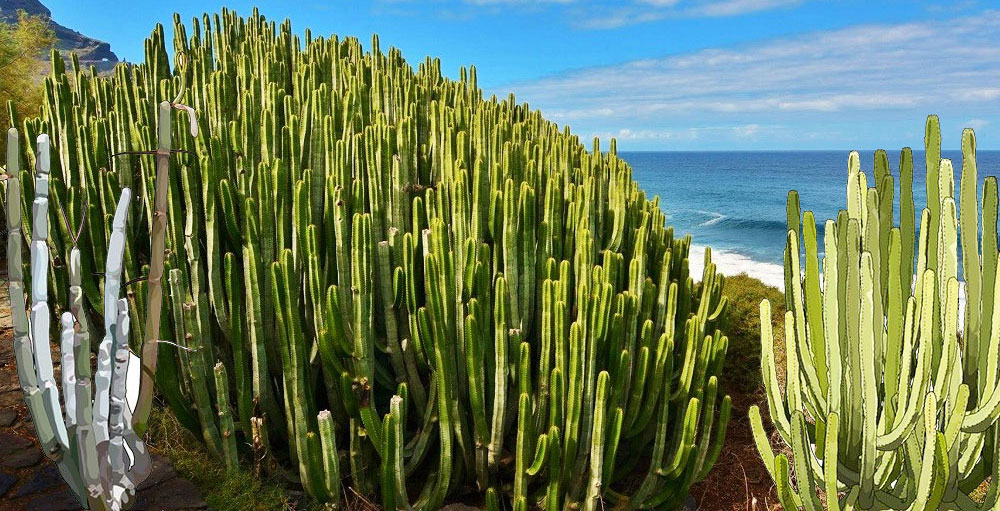
Singularidad de la flora canaria
To understand the
uniqueness and richness of our flora, one must take into account the Canary
Islands’ insular nature and their relative youth from a geological and
natural history perspective. Since the first species arrived in the
archipelago, new ones have gradually developed, shaped by the climatic
conditions and the terrain in which they are found, as well as by the extent
of human intervention in the territory. All these factors have led to a high
degree of biodiversity in the Canary Islands, in terms of both species and
habitats, depending on the environmental conditions found on each of the
seven islands of the archipelago.
Firstly, due
to their isolation, the Canary Islands are a place where, since ancient
times, plant genera and species that have disappeared from other parts of
the planet have been preserved; in those other places, only fossilised
remains are found, buried beneath ancient geological strata. Secondly, the
succession of varied climates—due to sharp contrasts in the terrain that
give rise to numerous microclimates—has led to the formation of different
vegetation zones or small pockets where endemic species, or those of a
purely local nature, thrive.

The current distribution of this important group of plant species across the different islands of the archipelago is highly varied, and is determined more by the geological age, topography and climatic characteristics of each island than by its size. Generally speaking, it is estimated that the island of Tenerife has around 1,470 wild species, Gran Canaria 1,300, La Palma 900, La Gomera 900, Fuerteventura 750, Lanzarote 700 and El Hierro 700. In terms of the number of endemic species, the island of Tenerife also ranks first with around 300, followed by Gran Canaria with 215, La Palma and La Gomera with around 200 each, El Hierro with around 120, Fuerteventura with 78 and Lanzarote with 70.
Origin of the Canarian flora
Owing to their geographical
location and isolation from the continents, the Canary Islands have
preserved plant genera and species which, elsewhere on the planet, are found
only in fossil form, buried beneath ancient geological strata. Most of these
remains are found in the European Mediterranean region and in southern
Russia, and are identical to certain endemic species found today in the
Canary Islands and Madeira, such as the laurel (Laurus novocanariensis), the
barbusano (Apollonias barbujana), the palo blanco (Picconia excelsa) and
many of the Canarian ferns.
That is why the most
widely accepted theory regarding the origin of the Canary Islands’ flora is
that the vegetation of our archipelago derives from the European subtropical
flora of the late Tertiary Period, when the great glaciation that affected
the northern hemisphere at that time, whilst in Africa an intense drought
gave rise to the vast Sahara Desert, led to the disappearance of the
subtropical climate characteristic of the shores of the Tethys Sea, a vast
marine basin that separated the European and African continents, the remains
of which formed the present-day Mediterranean Sea.
Towards the end of the Pliocene, many of the species inhabiting these
continental areas became extinct due to environmental pressures from the
cold in the north and the drought in the south; those that could took refuge
on our islands and other Macaronesian archipelagos, such as Madeira and the
Azores, where they survived thanks to their oceanic location and
considerable altitude, factors which protected them from the extreme
temperatures that had caused the extinction of their continental relatives.

Vegetation zones
One of the main characteristics
of the flora of the Canary Islands is its distribution across altitudinal
zones, known as vegetation zones, due mainly to climatic conditions, the
overall altitude and the orientation of the terrain in the different areas
of each island. These zones are more varied on the central and western
islands, owing to their greater height and more varied topography, and less
so on the eastern islands, as these are much flatter and have suffered a
higher degree of geological erosion.
The
characteristics of the vegetation landscape in each of these vegetation
zones are determined by the dominant species found there, which in turn give
their names to the most characteristic vegetation formations of each zone:
cardonales and tabaibales, juniper thickets, pine forests, codesares, etc.
In accordance with the most widely accepted classification of Canarian
vegetation, five vegetation zones have been identified: infracanario,
termocanario, mesocanario, supracanario y orocanario.
The infracanario zone, also known as the lower or basal zone, lies at altitudes of between 0 and 400 metres, although this varies from one area to another depending on the degree of exposure to the trade winds. It has a desert or semi-desert character, bearing a strong resemblance to the coastal areas of the former Spanish Sahara and Mauritania. It is found in the coastal areas of the southern slopes of all the islands, and is particularly extensive on the islands of Lanzarote and Fuerteventura. The most characteristic species of this zone are the cardón (Euphorbia canariensis) and the tabaibas (Euphorbia balsamifera, Euphorbia aphylla, Euphorbia obtusifolia, etc.).

The termocanario zone, also known as the dry montane zone or juniper zone, lies at an altitude of approximately 500–1,300 metres. It comprises two distinct zones: one characterised by juniper and strawberry-tree thickets, with a Mediterranean character; and the other characterised by laurel forest, with a temperate character due to the presence – particularly in summer – of a sea of clouds formed when the trade winds collide with the mountain slopes on the northern side of the islands.
Some authors include,
between the termocanario and infracanario zones, a transitional bioclimatic
zone situated at an altitude of around 400 or 500 metres. It is a dry area,
but somewhat brighter, more humid and milder than the sub-Canarian zone,
with vegetation characterised by the presence of larger species that are
very typical of the Canary Islands, such as the Canary Island date palm
(Phoenix canariensis) and the dragon tree (Dracaena draco). Although this
zone was once very widespread and extensive, particularly on the central and
western islands, it has been severely altered by human activity and has
practically disappeared.
The mesocanario zone,
also known as the dry montane zone or the Canary Island pine zone, lies
between 1,300 and 2,000 metres and is characterised by extensive forests of
Canary Island pine (Pinus canariensis), which are adapted to lower humidity
than the humid Thermocanarian zone and to colder temperatures. It is found
only on the islands of La Palma, La Gomera, El Hierro, Tenerife and Gran
Canaria.

The supracanario zone lies
at an altitude of over 2,000 metres and is found only on Tenerife and La
Palma, as these are the highest islands in the Canary Islands archipelago.
The climate is dry, with significant temperature fluctuations, both
seasonally and between day and night. The vegetation consists of no trees,
only more or less open scrub, with stocky or cushion-like forms, in which
legumes predominate, particularly broom and codeso. Even so, this zone is
home to many species and is rich in endemic flora.
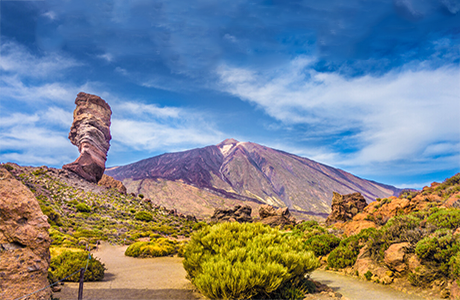
The orocanario zone lies above 3,100 m and is found only on the highest
peaks of Mount Teide, which are almost devoid of vegetation. The climate is
relatively cold and the ground is very rocky. There are no trees in this
zone and practically no shrubs either; only small herbs such as Silene
nocteolens, Stemmacantha cynaroides, Viola cherianthifolia, or Gnaphalium
teideum are found here.
Endemic species in the Canary Islands’ flora
In territories isolated from the continents, as is the case with the Canary Islands, endemism arises when species arriving in this new territory have to evolve separately and entirely independently from their places of origin. When these species become established in their new habitats—where environmental conditions are sometimes very different from those of their continental origin—they must adapt to a greater or lesser extent to the island environment, gradually modifying their morphology and vegetative development until they acquire their own distinctive traits. Depending on the extent of these changes, this will give rise to new varieties or subspecies of their ancestors, and in many cases to entirely new species, with characteristics clearly distinct from those of their original taxon.
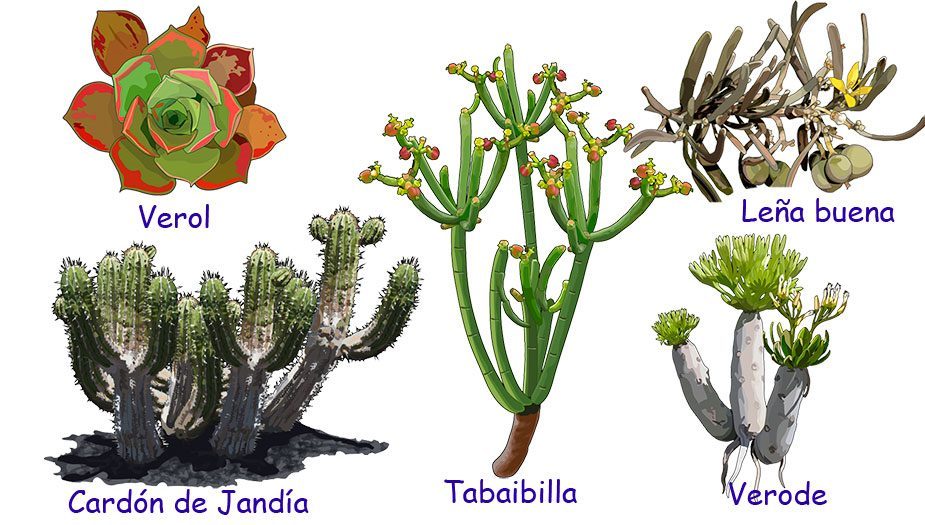
Owing to their geographical location, climatic, topographical and edaphic characteristics, and their territorial fragmentation, the Canary Islands boast a wide diversity of habitats, creating conditions of isolation that are highly favourable to the emergence of new species. Consequently, whilst accounting for just 1.5 per cent of Spain’s total land area, the Canary Islands are home to half of Spain’s endemic flora, a fact which confers upon them significant international scientific importance and the status of a national and global ecological reserve.
Of the total of around 2,450–2,500 species that make up the natural flora of the Canary Islands, the number of endemic species stands at around 700, representing approximately 25 per cent of the archipelago’s entire vascular flora. This makes the Canary Islands the oceanic island region with the highest concentration of endemic species in the world, and makes our flora a site of great scientific and ecological interest, both for scientists and for ecologists, naturalists and all nature lovers.
Of this total, it is estimated that around 600 are species endemic exclusively to the Canary Islands, whilst the remainder are shared with other Atlantic archipelagos more or less close to ours, such as the Azores, Madeira and Cape Verde, which together form a floristic zone with very distinctive characteristics known as the Macaronesian Region.
In terms of relative density, the significance of endemic species in the Canary Islands is reflected in the fact that, within the whole of Europe, the territory with the highest number of endemic species per 100 km² is the island of La Gomera, with 52 per cent, followed by the island of El Hierro, with 46.5 per cent, and the island of La Palma, with 26 per cent. These figures give a clear idea of the great richness and variety of our flora compared with the continental areas of Europe, where territories as vast as France have only around 170 endemic plant species.
Areas of botanical interest
Although virtually the
whole of the Canary Islands is rich in vegetation and numerous species of
unique interest and beauty can be found in every corner of the islands, it
is true that some areas of our archipelago are particularly rich and
interesting from a botanical point of view.
On
the island of Tenerife, the Teno Massif, the Anaga Massif, the Güímar Slope,
El Médano, Aguamansa and Las Cañadas del Teide are particularly noteworthy.
In Gran Canaria, the Tilos de Moya, the Agaete Valley area, Guayedra and
Andén Verde, the Cruz de Tejeda, the Guayadeque Ravine, the Caldera de
Tirajana area, Fataga and Mogán, the Tamadaba Pine Forest, Rincón de
Tenteniguada, Punta de Arinaga, and, in particular, the plant collection at
the Jardín Canario.
On La Palma, the most
interesting areas are Cubo de La Galga, the Los Tilos forest, Barlovento,
Fuencaliente, La Cumbrecita, the Las Angustias ravine, Roque de Los
Muchachos and the peaks of Garafía.

On the island of La
Gomera: the Barranco de la Villa, the Roque de Agando, the cliffs of Agulo
and the Roque Cano in Vallehermoso, the El Cedro forest, the Chorros de
Epina and Arure, Valle Gran Rey, the Barranco de Argaga and Chipude.
On El Hierro: El Golfo, the La Dehesa and El Sabinar areas, El Pinar, and La
Restinga.
On Lanzarote: the cliffs of Famara and
the Malpaís de la Corona.
And on Fuerteventura:
La Oliva and the dunes of the north coast, Gran Tarajal and Matas Blancas,
the Jandía Peninsula and the Pico de la Zarza.
Botanical exploration in the Canary Islands
The archipelago’s relative
proximity to Europe, together with its climate, history and natural
heritage, have made the Canary Islands a prime destination for naturalists,
and particularly for botanists, from the 17th century to the present day.
As far back as classical antiquity, there were
records of certain plant species native to the Canary Islands, and later
references to Canarian endemic species appeared in various works on natural
history. However, it can be said that the scientific study and exploration
of the vegetation of the Canary Islands began in the 17th century. On the
one hand, through the work of Spanish naturalists and botanists such as
Antonio José de Cavanilles, director of the Royal Botanical Garden in
Madrid, and others of Canarian origin such as Manuel de Ossuna, Domingo
Bello and Víctor Pérez González. On the other hand, there was the more
rigorous and scientific study carried out in 1724 by the French botanist
Louis Feuillée during his stay on the island of Tenerife, in which he
compiled an inventory of more than 30 plant species, including drawings of
many of them.
The first botanical survey of the islands was
carried out by Francis Masson, sent by the Royal Botanic Gardens, Kew
(England), who made several trips to the Canary Islands in the 1770s,
sending some plant specimens and seeds to Linnaeus, who classified some of
them, such as the juniper (Juniperus phoenicea), tree heath (Erica arborea),
the cardón (Euphorbia canariensis), the dragon tree (Dracaena draco) and the
bicácaro (Canarina canariensis), although most of his work was sent to the
Royal Botanic Gardens, Kew, where William Aiton, the head gardener,
classified them and introduced them to the scientific community.
Also noteworthy is the visit to the Canary Islands in 1799 by the German
explorer Alexander von Humboldt. During his stay in Tenerife, he climbed
Mount Teide in the company of his colleague, the French botanist A.
Bonpland, discovering for science several unique species found in the high
mountains of Tenerife, such as the iconic Teide violet (Viola
cheiranthifolia). The observations he made during his time on the island
also enabled him to become the first to describe the different zones of
Canarian vegetation according to their altitudinal distribution, thereby
laying the foundations for a new science: phytogeography.

A little later, the
French botanist P. M. A. Broussonet, French consul in Tenerife, undertook
numerous explorations, discovering many species new to science, many of
which were described by leading botanists of the time, such as Cavanilles,
Willdenow and Lamarck.
In 1815, the Norwegian
Christen Smith and the German Leopold von Buch arrived on the islands; von
Buch went on to compile the first catalogue of the islands’ flora following
Smith’s untimely death in the Congo.
However, the
seminal work on the Canarian flora of the 19th century was the *Histoire
naturelle des Îles Canaries*, published in Paris between 1830 and 1850 under
the direction of the naturalists Phillip Barker Webb and Sabin Berthelot,
with contributions from numerous zoologists and botanists. Webb and
Berthelot lived and worked in the Canary Islands for a long time, and their
work—divided into 10 volumes, grouped into 3 tomes—features a remarkable
level of detail in its descriptions and illustrations. The herbarium they
created whilst preparing this monumental work is currently housed at the
University of Florence.
Years later, in 1887,
the *Natural Dictionary of the Canary Islands* was published. Written by the
Canarian naturalist José Viera y Clavijo – a leading figure of the
Enlightenment in the Canary Islands – the work contains interesting notes on
the flora of our islands; he was the first person to suggest the possibility
of creating a botanical garden specifically dedicated to Canarian flora.
During the second half of the 19th century, several European botanists drew
on the preliminary work of Webb and Berthelot and continued the botanical
exploration of the islands, notably Ramón Masferrer, Herman Christ, Carl
Bolle, Francis Masson, Eugène Bourgeau and Oscar Burchard, some of whom were
funded by the leading European botanical gardens and herbaria, where a large
number of Canarian plants were catalogued and named, many from the islands
of Fuerteventura and Lanzarote, which had been the least explored up to that
point. The herbarium specimens collected in the archipelago also served as
an incentive for other naturalists to visit the islands, drawn by the
uniqueness of their flora.

At the beginning of the
20th century, the French botanists and doctors C. J. Pitard and L. Proust
arrived in the Canary Islands. Over a period of five months, they travelled
throughout the archipelago, including the islets, carrying out remarkable
research which was published in Paris in 1908 under the title *Les Îles
Canaries. Flore de’l Archipiel*. In 1913, two botanists from Kew Gardens,
John Hutchinson and Thomas Sprague, visited the islands, and on their return
wrote a series of articles on Canarian plants. In the 1930s, R. Lloyd
Praeger from Dublin devoted his work to the Aeonium group, the most
significant group within the Canary Islands’ endemic succulent flora,
published under the title “An account of the Aeonium group”.
In the second half of the 20th century, the work of forestry engineers Luis
Ceballos and Francisco Ortuño is particularly noteworthy; they published
their research in a major work entitled “Vegetation and Forest Flora of the
Western Canary Islands”. In the 1960s, the works of Kornelius Lems—with his
checklist of the Canarian flora known up to that point—and Johannes
Lid—whose *Contributions to the Canary Islands Flora* is a valuable guide to
the distribution of many species of our flora—are particularly noteworthy.
Special mention must be
made of the work of the Swede Eric R. Sventenius, who lived in the Canary
Islands for some thirty years, carrying out intensive fieldwork and
scientific research into our flora, which took him to every corner of our
islands. He published his findings in numerous works on the subject, the
most notable of which is his *Additamentum ad Floram Canariensem*. In
addition, Sventenius was the first director of the Viera y Clavijo Botanical
Garden, located in Tafira, Gran Canaria, where visitors can see a
magnificent collection of Canarian endemic species, as well as numerous
species from other plant groups.
Following his death
in 1974, the garden was taken over by the English botanist David J.
Bramwell, who broadened the institution’s areas of research and undertook
numerous initiatives aimed at raising awareness of and conserving the flora.
He is best known for publishing, in 1974, his *Wild Flowers of the Canary
Islands* in English – the first compendium of the Canary Islands’ endemic
flora, later translated into Spanish – which has served as a reference work
for all enthusiasts of our islands’ flora.
Also of great note in the 1970s was the work of the German naturalist Günter Kunkel, who carried out various studies on Canarian botany and was the founder and editor of *Cuadernos de Botánica Canaria*, the first journal specialising in Canarian botany. His wife, the illustrator Mary Anne Charlewood, produced numerous, highly detailed drawings of Canarian plants, some of which were published as plates under the title "Flora de Gran Canaria".
Finally, the
establishment of the Faculty of Sciences at the University of La Laguna, and
its Department of Botany – led for over forty years by Wolfredo Wildpret de
la Torre – has provided a decisive boost to botanical studies carried out by
local specialists, and has led to the establishment of lines of research
within each of the groups studying botany: algae, fungi, lichens, bryophytes
and vascular plants. Professor Wildpret de la Torre also founded, in 1970,
the scientific journal "Vieraea", which has become a leading publication in
the natural history of Macaronesia; this is now complemented by *Botánica
Macaronésica*, the journal of the Viera y Clavijo Canarian Botanical Garden.
His lectures have trained a large and distinguished group of local botanists
who carry out remarkable work in research, conservation and the
dissemination of knowledge about the archipelago’s flora, published through
numerous books, journals, monographs and scientific articles.


Canariavision
Visual Guide to the Canary Islands
Visualcuba
 Visual Guide to Cuba
Camaravision
 Digital Art Photography