
Introduced plants
Much of the rich and varied
vegetation of the Canary Islands consists of introduced plants; that is,
species that have not reached our islands by natural means but through human
intervention, whether intentionally or accidentally.
Almost all of these species are highly adaptable and capable of colonising
new territory, and have a high reproduction rate, as they generally have few
environmental requirements.
The total number of
species introduced to the Canary Islands is not known precisely, but it is
estimated to range between 800 and 1,200, and this number is increasing
every year with new plants arriving for use in agriculture or horticulture,
as well as those introduced accidentally amongst goods on ships and
aeroplanes, and even in the clothes or shoes of the millions of people who
visit the archipelago each year. It can therefore be said that approximately
half of all the plants found in the Canary Islands originate from regions
outside our territory.
The reasons for
introducing these species to the islands are varied, but they can be divided
into two main groups: useful plants, particularly species used for
agricultural production, and ornamental plants, brought in to decorate and
beautify both public spaces and private properties.

Tunera (Opuntia maxima)
The first group
comprises plants that were deliberately introduced by humans for
agricultural purposes and which, with very few exceptions, have not become
naturalised. The process began following the Conquest of the Islands, when
many cultivable species began to arrive, some from Mediterranean Europe and
North Africa – including many fruit trees, sugar cane, vines, various
cereals, vegetables, bananas, etc. – and others from the newly discovered
Americas, such as potatoes, maize, sweet potatoes, prickly pears, cactus,
etc. However, these species, which were so beneficial to humans, also
brought with them the seeds of many weeds, such as chickweed, common
ragwort, lamb’s quarters, nettles, poppies, etc., which gradually took over
the cultivated fields as they were abandoned and replaced the native plant
communities.
Many of these early introduced
species have come to be an integral part of the Canarian landscape and are a
common feature of our cuisine, such as fig trees, chestnut trees, mulberry
trees, prickly pear cacti, pear trees, medlar trees, etc. Of all these, the
chestnut tree (Castanea sativa) and the prickly pear cacti (Opuntia maxima,
Opuntia dillenii, Opuntia tomentosa) stand out due to their widespread
presence in the Canary Islands’ natural environment. The chestnut tree,
which was introduced during the Conquest of the Islands, has over time come
to form large woodlands at altitudes above 500 metres, in areas originally
covered by fayal-brezal heathland, which it has gradually replaced.
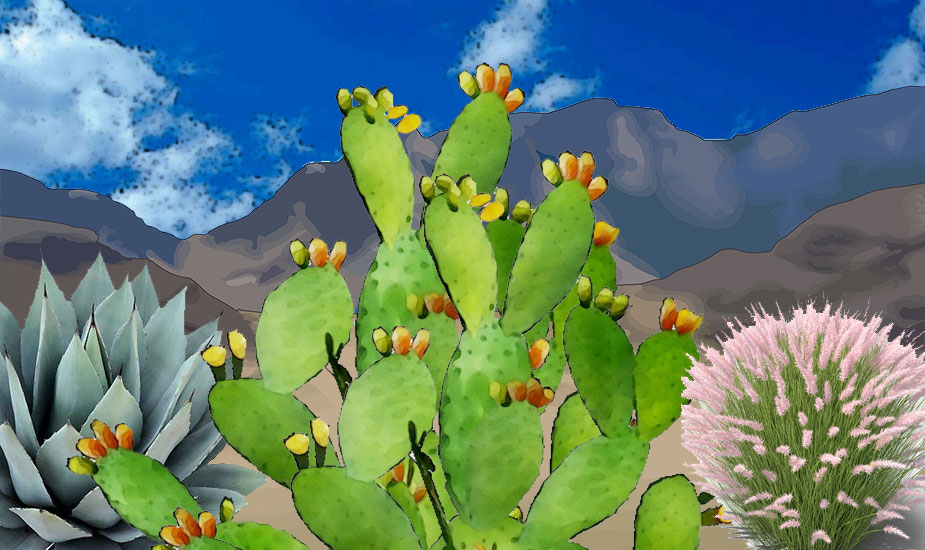
Prickly pear cacti were planted in large numbers on our islands during the
19th century and the early 20th century, with the aim of rearing cochineal
(Dactylopius coccus) on them – an insect that thrives on their fleshy leaves
and from which cochineal, a natural dye that was highly prized at the time,
is obtained. With the discovery of synthetic dyes, cochineal farming came to
an end in the Canary Islands, but prickly pear cacti, which spread rapidly,
now cover vast areas across all our islands, having in some cases become an
invasive species.

Pitera (Agave americana)
The second group comprises
plants intended for cultivation in parks and gardens; these are generally
ornamental species that are more attractive in appearance or in terms of
their flowering than the native species found on our islands. They are
undoubtedly the most widespread, as they are used in many and varied
settings, ranging from large parks and public gardens to the most modest
corners of people’s homes.
Numerous shrubs stand
out for their age, abundance or beauty, such as oleanders (Nerium oleander),
hibiscus (Hibiscus rosa-sinensis), bougainvillea (Bougainvillea spectabilis)
and poinsettia (Euphorbia pulcherrima), as well as beautiful trees such as
acacias, jacarandas, palms, Indian laurels and araucarias, which adorn and
provide shade for the streets and squares of many towns and cities.
Among ornamental plants are also those that were commonly grown in homes and
along country lanes from the late 19th century to the mid-20th century,
featuring low-maintenance species with striking flowers such as Peruvian
heliotrope (Heliotropium arborecens), fragrant heather (Adenandra fragans),
four o’clock flower (Mirabilis jalapa), queen’s cloak (Farfugium japonicum),
tazetta daffodils (Narcissus tazetta), hollyhocks (Alcea rosea), calla
lilies (Zantedeschia aethiopica), Spanish flag (Canna indica), and numerous
species and varieties of geraniums, lilies, calla lilies, dahlias,
carnations, etc.

Bandera española (Canna indica)
Many of the species
introduced to the Canary Islands over the years have ended up spreading
spontaneously and are now found growing wild in almost all our ecosystems.
These include prickly pears, prickly pear cacti, balsam, California poppies,
nasturtiums, as well as the numerous weeds that have spread from cultivated
fields and are now thriving in abandoned vegetable gardens, ruderal areas,
and along the verges of paths and roads, etc.
A special category within introduced plants comprises species which, due to their high invasive potential, end up establishing themselves in their new natural environments to the detriment of the native flora, which they often end up displacing and eliminating; their greatest danger lies in their ability to destabilise ecosystems that have taken millennia to reach equilibrium, as they typically behave as highly aggressive species capable of proliferating rapidly within a short period of time thanks to their highly effective reproduction and dispersal systems, enabling them to invade and irreversibly alter island ecosystems. Once they have become naturalised, they are very difficult to eradicate and can come to completely cover large areas of our archipelago.

Rabo de gato (Pennisetum setaceum)
The number of species considered invasive on our islands varies, and has been rising rapidly in recent years; however, on islands such as Tenerife, more than 70 plants have been classified within this dangerous category. Some of them have been present in our territory for a long time, such as prickly pears, piteras, aloes, geraniums, etc. Others arrived a few decades ago, such as the dreaded cat’s tail (Pennisetum setaceum), although the damage it has caused has been enormous in such a short space of time. And amongst the recent arrivals, several species of cactus stand out, others of the genus Pluchea, such as Pluchea ovalis – an aromatic plant introduced by foreigners near the golf courses and which is now spreading very rapidly across the south of Tenerife – and several species of the genus Chenopodiaceae, such as Maireana brevifolia, which already occupy significant areas in Gran Canaria and Fuerteventura.
Among the oldest are species such as the common reed (Arundo donax), which
competes aggressively with native vegetation, particularly in ravine beds,
where it forms an impenetrable carpet that is highly dangerous in the event
of a fire. Prickly pear cacti (Opuntia maxima, Opuntia dillenii, Opuntia
tomentosa…) and agaves (Agave americana) are now so widespread that their
eradication is virtually impossible, and they have become such an integral
part of the Canarian landscape that many people consider them to be native
species.
Of the most recent species, the one
that has proved most harmful to the Canary Islands’ natural environment is
the rabogato (Pennisetum setaceum), a grass of African origin which was
first introduced for ornamental purposes in the 1940s and has proliferated
to such an extent that it is now established across all the islands of the
archipelago, from the coastal strip to the mid-altitude areas, heavily
invading Gran Canaria, Tenerife and La Palma, and on the latter island even
reaching the Caldera de Taburiente National Park.

Uña de gato (Carpobrotus edulis)
A short list of invasive plant species in the Canary Islands includes the following plants: the prickly pear (Opuntia maxima), the Indian prickly pear (Opuntia dillenii), the common reed (Arundo donax), the agave (Agave americana), cat’s tail (Pennisetum setaceum), gorse (Ulex europaeus), red valerian (Centranthus ruber), pinillo (Crassula lycopodioides), pluchea (Pluchea ovalis), the wild lily (Chasmanthe aethiopica), the cholla (Austrocylindropuntia subulata), the castor oil plant (Ricinus communis), the cat’s ear (Tradescantia fluminensis), the jaragán (Ageratina adenophora), Moorish tobacco (Nicotiana glauca), the California poppy (Eschscholzia californica), the silk tree (Calotropis procera), the Spanish flag (Lantana camara), the Pampas grass (Cortaderia selloana), the cat’s claw (Carpobrotus edulis), etc.
View full list...

Tartaguero (Ricinus communis)


Canariavision
Visual Guide to the Canary Islands
Visualcuba
 Visual Guide to Cuba
Camaravision
 Digital Art Photography