

Endemic flora of the Canary Islands
Endemic species are those
that occur only within a very specific area of a territory; understanding
and protecting them is of great importance, as the disappearance of any one
of them would mean its total extinction, as it does not exist anywhere else
in the world.
Thus, species are considered endemic to the Canary Islands
if they are found only on our islands – whether on a single island or
several of them – and in some cases share their range with archipelagos
close to ours, such as Madeira, the Azores, etc.
Unlike endemic species,
native species are those that are also native to our archipelago – that is
to say, they arrived here in ancient times by natural means – but are also
found in other regions of the world, and are therefore not exclusive to the
Canary Islands.
In territories isolated
from the continents, such as the Canary Islands, endemic species arise when
species arriving in this new territory are forced to evolve separately and
independently from their places of origin for all time. When these species
become established in their new habitats—where environmental conditions are
sometimes very different from those of their continental origin—they must
adapt to a greater or lesser extent to the island environment, gradually
modifying their morphology and vegetative development until they acquire
distinctive traits of their own. Depending on the extent of these changes,
this will give rise to new varieties or subspecies of their ancestors, and
in many cases to entirely new species, with characteristics clearly distinct
from those of their original taxon.

Owing to their geographical
location, climatic, topographical and edaphic characteristics, and their
territorial fragmentation, the Canary Islands boast a wide diversity of
habitats, creating conditions of isolation that are highly favourable to the
emergence of new species. Consequently, whilst accounting for just 1.5 per
cent of Spain’s total land area, the Canary Islands are home to half of
Spain’s endemic flora, a fact which confers upon them significant
international scientific importance and the status of a national and global
ecological reserve.
Of the total of around
2,450–2,500 species that make up the natural flora of the Canary Islands,
the number of endemic species stands at around 700, representing
approximately 25 per cent of the archipelago’s entire vascular flora, making
the Canary Islands one of the oceanic island regions with the highest
concentration of endemic species in the world, and makes our flora a site of
great scientific and ecological interest, both for scientists and for
ecologists, naturalists and all nature lovers.
Of this
total, it is estimated that around 600 species are endemic exclusively to
the Canary Islands, whilst the remainder are shared with other Atlantic
archipelagos more or less close to ours, such as the Azores, Madeira and
Cape Verde, which together form a floristic zone with very distinctive
characteristics known as the Macaronesian Region.

Stemmacantha cynaroides
In terms of relative
density, the significance of endemic species in the Canary Islands is
reflected in the fact that, across the whole of Europe, the area with the
highest number of endemic species per 100 km² is the island of La Gomera,
with 52 per cent, followed by the island of El Hierro, with 46.5 per cent,
and the island of La Palma, with 26 per cent. These figures give a clear
idea of the great richness and variety of our flora compared with mainland
Europe, where territories as large as France have only around 170 endemic
plant species.
Of the total number of species
exclusive to the Canary Islands, some 340 are island-specific endemics,
meaning they are found on only one of the islands. This represents around 60
per cent of all Canarian endemics, and most of them belong to genera which,
to a greater or lesser extent, are also present on the other islands,
clearly indicating that they are descended from common ancestors.
Each island, particularly the oldest ones with the
greatest variety of habitats, is home to a number of unique endemic species,
shared at most with one or two other islands. This is the case, for example,
with the pink cliff mallow (Malva phoenicea) from Tenerife, or the giant
everlasting from La Gomera (Limonium dendroides), which are basal species
within their genera – that is to say, the last remaining representatives of
very ancient lineages. Other notable examples of endemic species include the
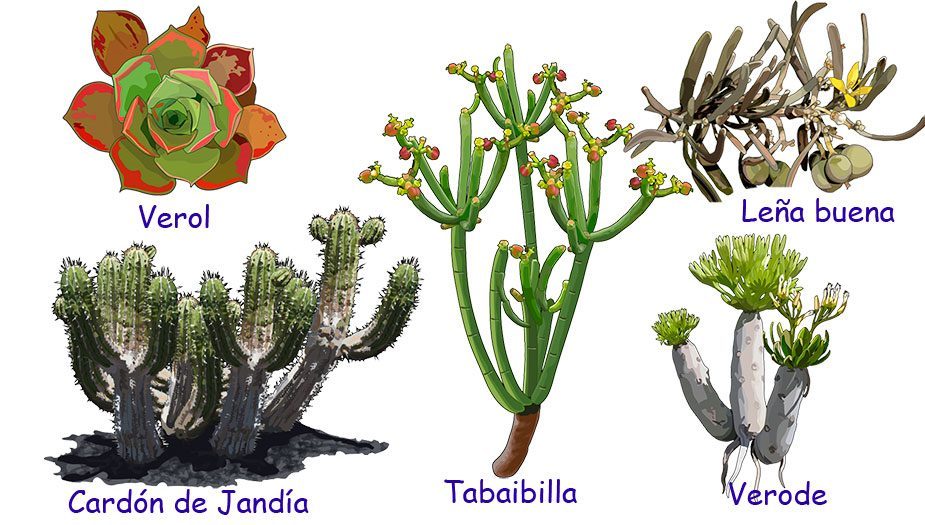
‘amargosa’ (Vieraea laevigata), a genus endemic to Tenerife, and the Jandía
cardon (Euphorbia handiensis), a species closely related to the flora of
North Africa.

Whitania aristata
Another notable aspect
of the phenomenon of plant endemism in the Canary Islands is the existence
of up to twelve genera found exclusively on our islands: Dicheranthus,
Gesnouinia, Dendriopoterium, Rutheopsis, Todaroa, Parolinia, Pleiomeris,
Ixanthus, Allagopappus, Bethencourtia, Gonospermum and Vieraea. Of these,
seven are monotypic, meaning they consist of a single species, such as
Pleiomeris, represented by the ‘delfino’ (Pleiomeris canariensis), or
Ixanthus, whose sole species is the ‘reina del monte’ (Ixanthus viscosus).
Although the exact figures for the number of endemic species vary slightly
depending on the criteria used to identify them, and on the inclusion of new
specimens following recent discoveries, the estimated numbers of endemic
species for each island are as follows: Tenerife just over 120, Gran Canaria
around 100, La Palma around 40, La Gomera around 30, Lanzarote around 20, El
Hierro around 18, and Fuerteventura around 15.

Endemic species
of the Canary Islands
Based on
the distribution of endemic species across the islands of our archipelago,
several groups with common characteristics can be identified: species
endemic to a single island, species endemic to two islands, species endemic
to several islands, and species endemic to all the islands.
Species endemic to a single island
Species endemic to a single island constitute the most significant group of
flora, comprising a total of approximately 410 species. Generally speaking,
these are plants with a very limited distribution within their island, many
of which are found exclusively in a very small area, such as a rock, a
mountain or a ravine. For example, the ‘yesquera’ (Helichrysum gossipinum),
which grows only on the cliffs of Famara in Lanzarote; the Jandía cardón
(Euphorbia handiensis), found exclusively in a limited area of the Jandía
peninsula, in Fuerteventura, or the Teneguía ‘cabezón’ (Cheirolophus
junonianus), whose meagre populations are found around an ancient volcanic
rock formation near the coast of Fuencaliente, on the island of La Palma.

Viola cheiranthifolia
Endemic
species of two islands
Among the
species endemic exclusively to these two islands, particular mention should
be made of the nearly thirty species found only on the islands of Lanzarote
and Fuerteventura, which, as well as being very close to one another, share
similar climatic conditions, and it is believed that their territories may
have been connected during past geological periods. Among these shared
species are the beach chive (Androcymbium psammopnyllum), the Famara
everlasting (Limonium bourgeaui), the Lanzarote ferula (Ferula
lancerottensis) and the white chahorra (Sideritis pumila).
Endemic species are rarer between the other two islands of the archipelago.
These include some species exclusive to La Palma and El Hierro, such as the
‘faro’ (Gonospermum canariense) and the ‘lengua de pájaro’ (Polycarpaea
smithii). A small group of endemic species are exclusive to the island of La
Gomera and the Teno mountain range in Tenerife, such as the ‘pata de
gallina’ (Dicheranthus plocamoides).
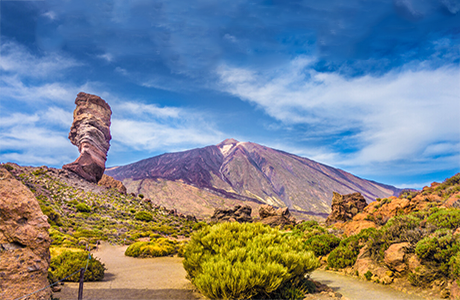
Another notable group within this category comprises several endemic species common to the high-mountain areas of the islands of Tenerife and La Palma, such as the Teide broom (Spartocytisus supranubius) and the Teide catmint (Nepeta teydea). Endemic species shared by Tenerife and Gran Canaria are very rare; these include the sea thistle (Atractylis preauxiana), a small thistle found in coastal areas very close to the sea on the southern slopes of these two islands, whose meagre populations are threatened with extinction.
Endemic species
found on several islands
Species
endemic to more than two islands are very rare. Examples include the
rabbit’s foot (Polycarpacea filifolia), found on Tenerife, Gran Canaria and
La Gomera, and the rilla (Cerastium sventenii) and the Chahorra de monte
(Sideritis canariensis), species shared by the islands of Tenerife, El
Hierro and La Palma.
The central and western islands (Tenerife, Gran
Canaria, La Palma, La Gomera and El Hierro) share certain species associated
with pine forests, such as the amagante (Cistus symphytifolius), mountain
pennyroyal (Bystropogon origanifolius) and the broom (Chamaecytisus
proliferus), or their varieties, such as the tagasaste, which has been
widely used as a forage plant on the island of La Palma.

Arbutus canariensis
Endemic species
found on all the islands
Endemic
species common to the whole of our archipelago are also rare; these include
the verode (Kleinia neriifolia), the sweet tabaiba (Euphorbia balsamifera),
the Canary Island palm (Phoenix canariensis) and the guaydil (Convolvolus
floridus).
Macaronesian
endemics
Macaronesian endemics
are those species that are found in more than one of the archipelagos that
make up Macaronesia, a biogeographical region comprising the Canary Islands,
the Azores, Madeira, Cape Verde and the Salvajes micro-archipelago. A
notable feature of this group is that there is no single endemic species
shared by all these territories; this is mainly due to the significant
climatic differences between the geographical extremes of this region (the
Azores and Cape Verde), as well as the varying degrees of proximity to the
continents of each of these archipelagos.
Endemic species of the Canary Islands,
Madeira and the Azores
These
three archipelagos share a small number of species, linked to the presence
of laurel forests, which in all three have a similar structure and floristic
composition, characterised by common species with varying degrees of
variation amongst them in some cases.
Among these
shared endemic species are the laurel (Laurus novocanariensis), the viñátigo
(Persea indica), the wild orange tree (Ilex perado spp. platyphylla) and the
tilo (Ocotea foetens). Among the shrubs is the well-known and widespread
garitopa (Cedronella canariensis).

Endemic
species of the Canary Islands and Madeira
Among the species found in the laurel forest, the most abundant are those
endemic to both the Canary Islands and Madeira – the two Macaronesian
archipelagos that are closest to one another and share the greatest climatic
similarity. These include, in addition to those mentioned in the previous
section, the barbusano (Apollonias barbujana), the mocán (Visnea mocanera)
and the aderno (Ardisia bahamensis).
Endemic species
of Madeira, the Canary Islands and Cape Verde
Common to these three archipelagos is a group of endemic species which,
whilst not very numerous, is quite significant due to its origin and the
role it plays in the vegetation of these regions. These are primarily trees
associated with the areas in the Canary Islands occupied by thermophilic
forests, such as the dragon tree (Dracaena draco), the marmolán (Sideroxylon
marmulano) and the wild olive (Olea europaea ssp. cerasiformis).
Finally, it should be noted that, to date, no Macaronesian endemics have been found that are unique to the Azores and the Canary Islands.


Canariavision
Visual Guide to the Canary Islands
Visualcuba
 Visual Guide to Cuba
Camaravision
 Digital Art Photography