

The origin of the Canary Islands’ flora
The vascular flora of the Canary Islands comprises some 2,500 species, of which around 700 are endemic, some 100 are endemic species shared with other Macaronesian archipelagos, such as the Azores or Madeira, and around 600 are native species of Mediterranean or North African origin, with the remainder being introduced species. This extraordinary plant biodiversity is divided into two main groups: endemic flora, that is, species exclusive to the Canary Islands, and indigenous flora, also known as native flora, comprising wild plants which, whilst not exclusive to the Canary Islands, have reached the archipelago by natural means and have become established here spontaneously.
This entire flora began to take root on
our islands as they gradually emerged from the ocean floor, over a period
estimated at around 20 million years for the oldest islands, such as
Lanzarote and Fuerteventura, and between 1 and 2 million years for the
youngest, such as La Palma and El Hierro, revealing the remarkable antiquity
of our flora.
It is likely that the first forms
of life to establish themselves during the colonisation process were lichens
and bryophytes, followed by pteridophytes and flowering plants. They reached
these new island territories via spores, fruits and seeds that arrived
through various methods of dispersal: by wind (anemochory), by animals
(zoochory), or carried by ocean currents (hydrochory). Gradually, pioneer
plants colonised the barren landscapes and lava fields of the primitive
islands, where, over the millennia, the combined action of erosive processes
and the biological activity of the growing vegetation gradually created the
first soils and biotopes.

This geological epoch coincides, at least in
part, with the Miocene and Pliocene periods of the Tertiary Era, when the
last major glaciations in the history of planet Earth radically altered the
climate in Europe and North Africa. During this period, the Mediterranean
region formed part of the basin of an ancient ocean, known as the Tethys
Sea, which separated Europe from Africa. In the territories surrounding this
vast subtropical sea, the vegetation must have been very similar in
composition and appearance to our present-day laurel forests.
However, the gradual
southward expansion of the polar regions, with the resulting cooling of the
climate, led to the flora retreating southwards; and almost at the same
time, the area of North Africa now occupied by the Sahara Desert began to
dry out. This left the subtropical flora with nowhere to thrive, trapped
between the increasing cold of the north and the aridity of the south,
leading to a significant extinction of the plant species living in those
territories.
The emerging Atlantic islands were
protected from both types of climatic disasters, the cold from the north and
the aridity of the Sahara, thanks to their oceanic location, which provided
them with considerable protection against these significant climatic
changes. Consequently, many species native to those regions took refuge in
the Canary Islands and other oceanic archipelagos such as the Azores and
Madeira, where most of them survived, losing only some of their more
tropical characteristics. It is likely that the high altitude of most of
these islands served as an additional safeguard against the climate,
enabling plant communities to migrate to higher ground to escape the ravages
of variable climatic conditions, which may also have contributed to the
survival of this extraordinary flora to the present day.

This theory is supported by the discovery, in many locations across that ancient Mediterranean region, of fossils of leaves and fruits from plants identical to species now found only in the Canary Islands, Madeira and the Azores, such as the laurel (Laurus novocanariensis), the barbusano (Apollonias barbujana), the palo blanco (Picconia excelsa) and many Canarian ferns. On the mainland, however, this ancient flora is now represented by just a few species—which have undergone some degree of modification from their primitive forms—that survive in a handful of locations such as southern Spain and western Portugal.
Among those species of European origin that have survived in the Canary Islands, many are important components of our flora as they form an essential part of the laurel forests; these include the ‘loro’ (Laurus novocanariensis), the ‘viñátigo’ (Persea indica), the ‘tiló’ (Ocotea foetens) and the ‘acebiño’ (Ilex canariensis). Other species, native to the Mediterranean, which arrived on the islands in ancient times and form the backbone of the so-called thermophilic forests of the Canary Islands, include the juniper (Juniperus turbinata spp. canariensis), the Atlantic pistachio (Pistacia atlantica), the mastic tree (Pistacia lentiscus), the wild olive (Olea cerasiformis) and the marmolán (Sideroxylon canariense).
Another important group
of Canarian plants has its closest relatives in the arid regions of southern
and eastern Africa or the Arabian Peninsula; they should be regarded as
survivors of an ancient flora that predated the emergence of the Sahara
Desert, which once stretched across the north and east of the African
continent. Among the most interesting in this group are the genera Dracaena,
Campylanthus, Aeonium, Canarina, Parolinia, Euphorbia and Camptoloma.
The remnants of ancient vegetation found today in eastern and northern Africa, as well as studies of fossils and pollen, seem to confirm the existence of tropical and semi-arid vegetation throughout this region, where communities of Euphorbiaceae must have been abundant; many species in the present-day Canarian cardon and tabaiba communities are related to these, such as the cardón (Euphorbia canariensis), the tabaibas (Euphorbia balsamifera, Euphorbia aphylla, Euphorbia obtusifolia…) and the cardoncillos (Ceropegia dichotoma, Ceropegia fusca).

For their part, the pine
forests and high-mountain vegetation of the Canary Islands display typically
Mediterranean characteristics, both in their floristic composition and in
their structure. Something similar occurs in wetland communities, where many
plants are found that may have been introduced recently.
Finally, the flora of the coastal areas, beaches and cliffs, whilst sharing
some similarities with that of the European Atlantic and western
Mediterranean coasts, has closer affinities with that of the coastal regions
of the nearby African continent.
It is therefore estimated that, just as has happened in the archipelagos of the Azores, Madeira and Cape Verde, the Canary Islands have, over millions of years, been subject to the invasion of a large number of plants originating mainly from southern Europe and North Africa, which are thought to be the ancestors of most of our vegetation. Some of these plants have remained largely unchanged since their arrival, whilst others, however, have undergone significant evolutionary change through various processes and strategies, such as adaptive radiation or vicariance.

Adaptive radiation is the
process whereby, starting from an initial species, an evolutionary
development begins that gives rise to new forms – widely differentiated from
the parent species – which go on to occupy vacant niches and habitats,
resulting in a greater or lesser number of new species. In the Canary
Islands, the most striking examples of this process are the genera Aeonium
(bejeques), where the original species that arrived on our islands has
diversified into 28 new species; Argyranthemum (magarzas) into 19; Sonchus
(lettuces) into 29; Echium (tajinastes) into 20; and Sideritis (chahorras)
into 24. These figures are rising, as the discovery and scientific
description of new species and subspecies in this archipelago is an ongoing
and very active process.
In the case of
vicariancy, evolution occurs when geographical isolation is more significant
than selective pressure. This has led to the emergence, on the various
islands of our archipelago, of several species within the same genus, which
more or less occupy the same vegetation zone, but on each island they have
adapted to their distinct bioclimatic conditions and evolved differently in
each case, as has happened with the genera Cheirolophus (cabezones), Crambe
(coles de risco) and Parolinia (damas).
The
combined action of these two processes is what has enabled the Canary
Islands to become a treasure trove of plant biodiversity, boasting a large
number of endemic genera and species exclusive to their territory, and a
considerable number more that are shared exclusively with the other
Macaronesian archipelagos: Madeira, the Azores and Cape Verde. The number of
species endemic to the Canary Islands is currently estimated at around 700,
which appear to have originated from just over a hundred ancient
introductions.

More recently, with the
arrival of the first settlers in the Canary Islands from north-west Africa,
numerous plant species were introduced to the islands. This process began
approximately 2,500 years ago and accelerated significantly from the 15th
century onwards, with the arrival of the first French, Castilian and
Portuguese conquerors. The gradual increase in the Canarian population led
to the introduction, whether intentional or unintentional, of many species
of wild, edible, forage and ornamental plants, originating mainly from the
Mediterranean region and the European Atlantic coast.
Finally, particularly from the mid-19th century onwards, with the
progressive development of shipping and intercontinental travel, a
considerable number of species from Asia, South America, Central America and
other remote regions have been arriving on our islands. Many of these pose a
serious problem for some of our ecosystems due to their aggressive invasive
nature, which is progressively destroying and replacing the original
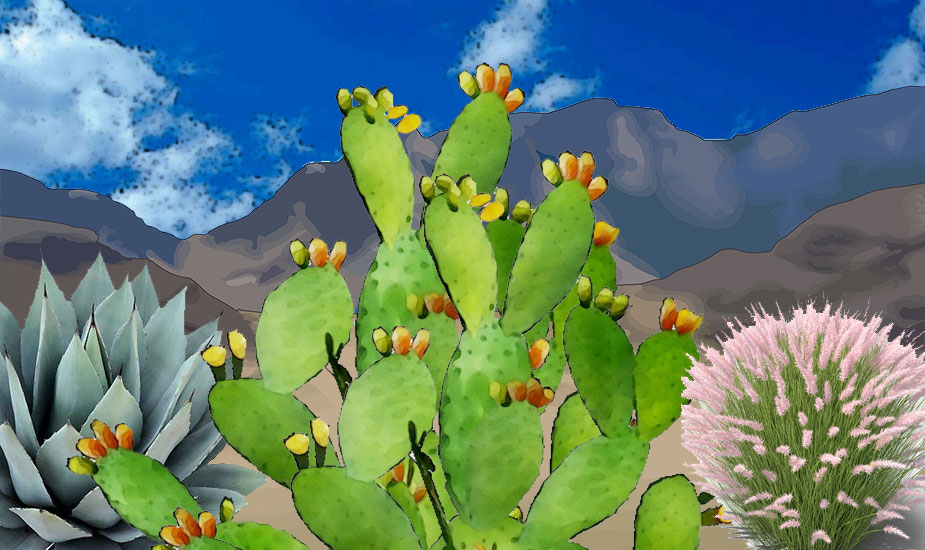
vegetation. This is the case with well-known plants such as cat’s tail
(Pennisetum setaceum), hedidondo or matoespuma (Ageratina adenophora), agave
(Agave americana), prickly pear (Opuntia maxima), red valerian (Centranthus
ruber), etc.
In summary, it can be said that the vascular flora of the Canary Islands as a whole comprises some 2,500 species, distributed unevenly across the different islands depending on their surface area, climatic and topographical variations, etc. All these species are grouped into three main categories: endemic species, native species and introduced species.
It seems clear that the
origin of the endemic and native species lies in the ancient flora that, at
the end of the Tertiary period, populated the territories surrounding the
area occupied by the Tethys Sea in the ancient Mediterranean basin: southern
Europe and North Africa.
The current
distribution of this important group of plant species across the different
islands of the archipelago is highly varied, and is determined more by the
geological age, topography and climatic characteristics of each island than
by its size. Generally speaking, it is estimated that the island of Tenerife
has around 1,470 wild species, Gran Canaria 1,300, La Palma 900, La Gomera
900, Fuerteventura 750, Lanzarote 700 and El Hierro 700. In terms of the
number of endemic species, the island of Tenerife also ranks first with
around 300, followed by Gran Canaria with 215, La Palma and La Gomera with
around 200 each, El Hierro with around 120, Fuerteventura with 78 and
Lanzarote with 70.
These figures are estimates, varying according to the information and criteria applied by each specialist, and depending on the discovery of new species or subspecies that continues to take place in our territory thanks to the intensive and invaluable work of countless botanists, both national and international, and the significant contribution of many people who devote a large part of their time to the study, dissemination and conservation of our flora.


Canariavision
Visual Guide to the Canary Islands
Visualcuba
 Visual Guide to Cuba
Camaravision
 Digital Art Photography