Canary flora > Exotic and ornamental
Tithonia diversifolia

Tithonia diversifolia (Hemsl.) A.Gray
Tree marigold, Mexican sunflower, Japanese sunflower, Nitobe chrysanthemum
Herbaceous or stoloniferous shrub, perennial, erect, 1-4 m high,
abundantly branched, with ribbed and canaliculate stems, smooth or very
slightly hairy.
The leaves, supported by an auriculate and clasping petiole, are generally alternate, ovate to trilobed or pentalobed, with acuminate lobes, entire margin or crenulate towards the apex, 5-20 cm long and 4-10 cm wide, fairly hairy and green on the upper side, greyish green and tomentose on the underside.
The leaves, supported by an auriculate and clasping petiole, are generally alternate, ovate to trilobed or pentalobed, with acuminate lobes, entire margin or crenulate towards the apex, 5-20 cm long and 4-10 cm wide, fairly hairy and green on the upper side, greyish green and tomentose on the underside.
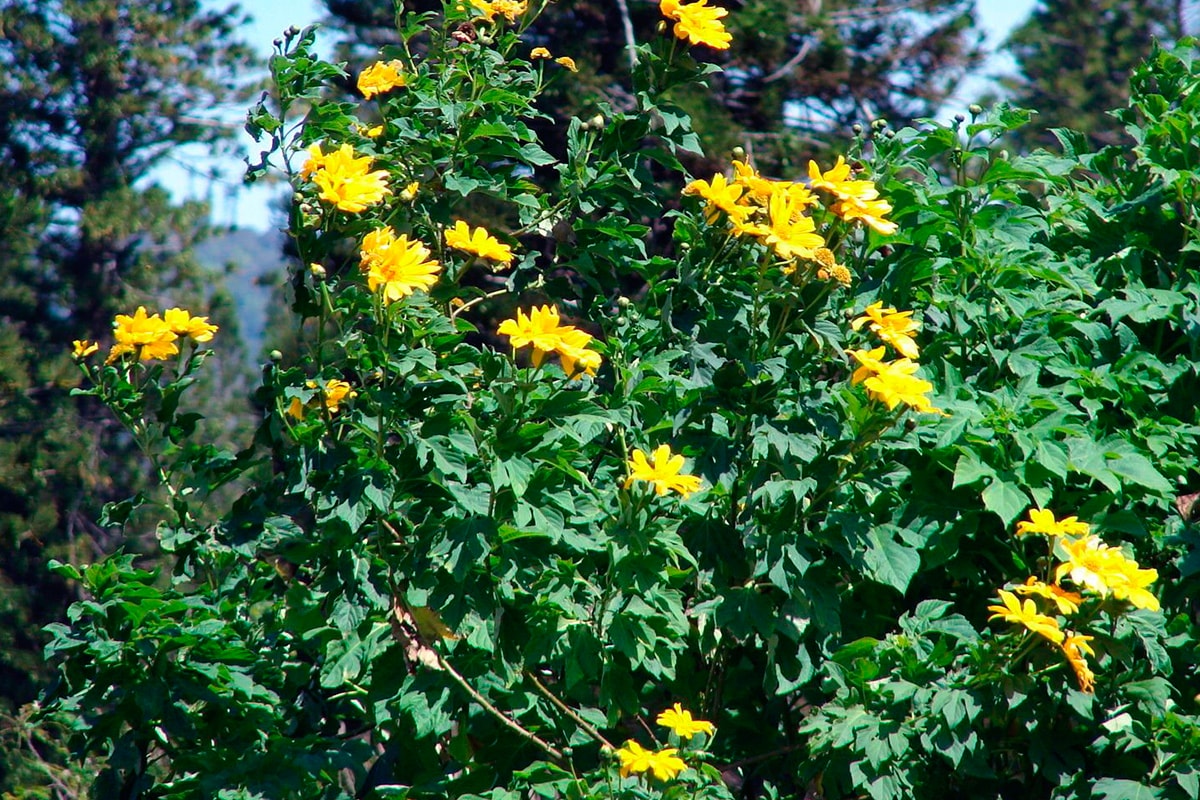
The flowers are arranged in large, intense yellow capitula 8-15 cm in
diameter, solitary, terminal or lateral, long pedunculate, formed by a
hemispherical receptacle surrounded by imbricate bracts arranged in 2-3
rows, the outer ones orbicular and rather leathery, and the inner ones
longer, obovate and membranaceous.
The outer flowers of the flower head, usually between 12-14, are formed by a corolla up to 6 cm long, resembling the petal of a single flower, bright yellow or orange in colour, and with 2-3 teeth at the apex.
The flowers of the inner ring are hermaphrodite, very numerous, with a pentadentate tubular corolla about 8 mm long.
The outer flowers of the flower head, usually between 12-14, are formed by a corolla up to 6 cm long, resembling the petal of a single flower, bright yellow or orange in colour, and with 2-3 teeth at the apex.
The flowers of the inner ring are hermaphrodite, very numerous, with a pentadentate tubular corolla about 8 mm long.

The fruits are achenes about 5-6 mm long, puberulent, and provided with
a scaly pappus that favours their expansion by means of the wind.
It flowers and bears fruit throughout the year, mainly in October and November.
It reproduces by seed and cuttings.
It is a species native to Central America, from where it has spread to many tropical and subtropical regions of the world.
It flowers and bears fruit throughout the year, mainly in October and November.
It reproduces by seed and cuttings.
It is a species native to Central America, from where it has spread to many tropical and subtropical regions of the world.


