Canary flora > Exotic and ornamental
Punica granatum
Punica granatum L.
Pomegranate
The pomegranate tree is a deciduous tree, between 3-5 m high, known for
its showy flowers and appetizing fruits, considered in its regions of
origin as a symbol of vigour and fertility, but also of death and
resurrection.
It has a short trunk, covered with greyish-brown bark that cracks over the years, and abundant branching, which forms a more or less extended crown.
The branches, almost quadrangular in section when young, are hard and thorny, covered with greenish-brown bark.
It has a short trunk, covered with greyish-brown bark that cracks over the years, and abundant branching, which forms a more or less extended crown.
The branches, almost quadrangular in section when young, are hard and thorny, covered with greenish-brown bark.
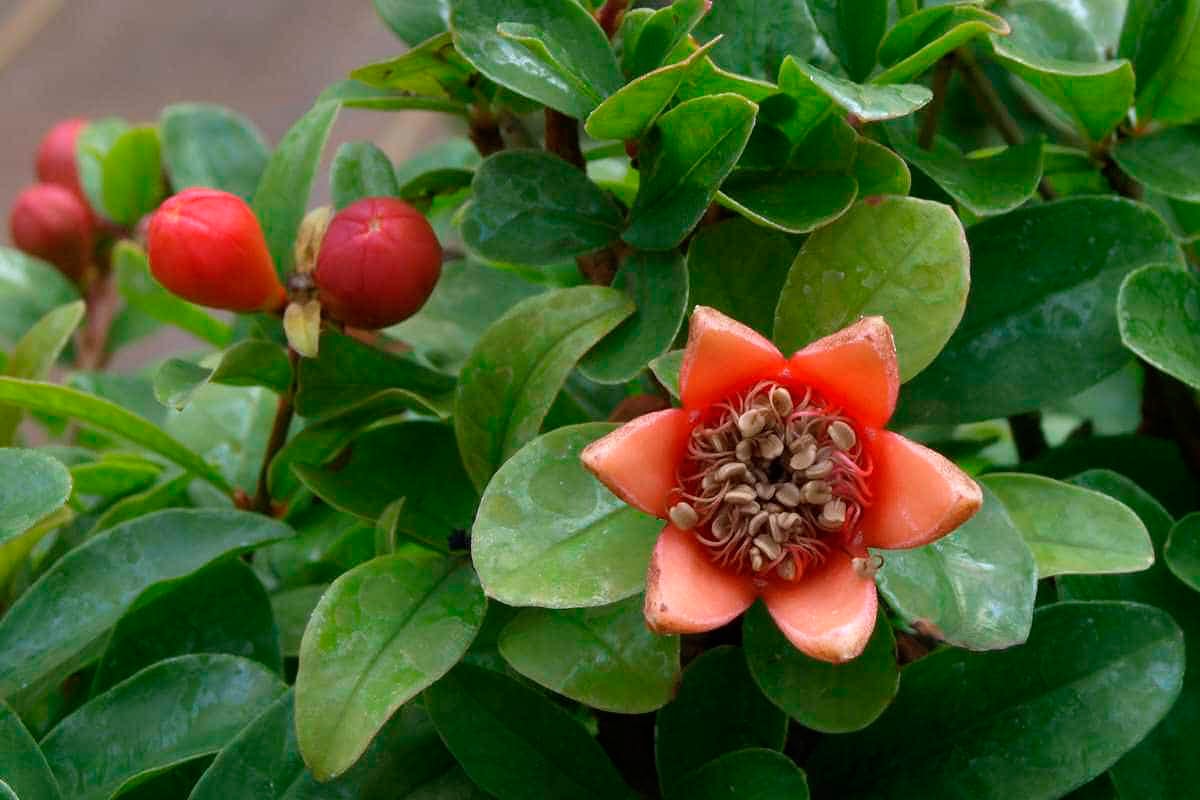
The leaves are simple, entire, opposite, shortly petiolate, with an
oblong lanceolate to elliptic lamina about 2-5 cm long and 1-2 cm wide,
with an attenuated base, smooth, leathery, bright green on the upper
side, and paler or with yellowish tints on the underside.
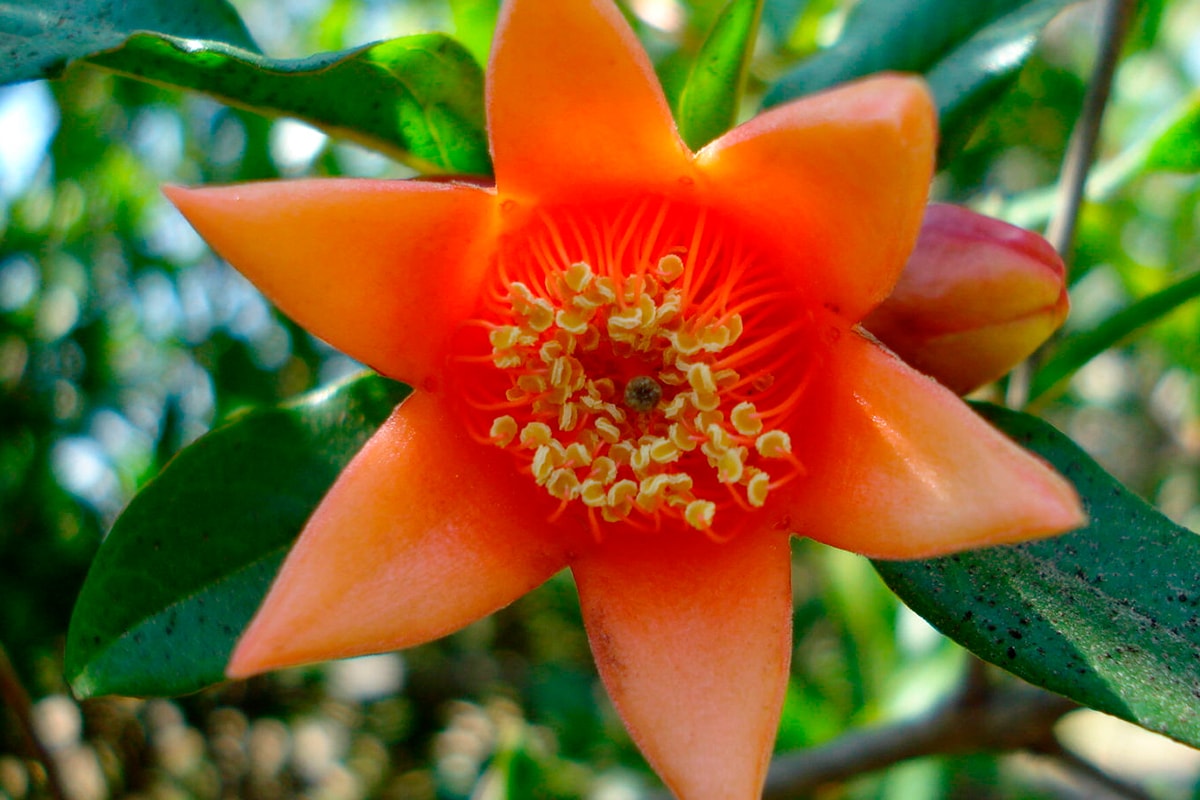
Its showy red flowers, about 4 cm wide, grow on the terminal part of the branches, solitary or in clusters of two or three.
They have a very fleshy bell-shaped calyx, which finally opens into 5-7 lobes, forming a sort of papillose star, and a corolla about 3-4 cm in diameter with 5-7 thin, rough, reddish-orange petals alternating with the sepals.
The stamens are very numerous, with long, free, reddish, reddish filaments and bilocular yellow anthers, among which protrudes a thick filiform style topped by a capitate stigma.
Its showy red flowers, about 4 cm wide, grow on the terminal part of the branches, solitary or in clusters of two or three.
They have a very fleshy bell-shaped calyx, which finally opens into 5-7 lobes, forming a sort of papillose star, and a corolla about 3-4 cm in diameter with 5-7 thin, rough, reddish-orange petals alternating with the sepals.
The stamens are very numerous, with long, free, reddish, reddish filaments and bilocular yellow anthers, among which protrudes a thick filiform style topped by a capitate stigma.

When ripe they produce a large spherical fruit, about 5-12 cm in
diameter, crowned by the persistent calyx, formed by a large number of
hard prismatic seeds, wrapped in a juicy translucent reddish-coloured
pulp, and grouped in irregular compartments separated from each other by
a thin yellowish membrane, all wrapped in a thick, leathery rind,
greenish at first and intensely red later on, of such a characteristic
shade that it has given its name to a colour, the so-called garnet red.
Flowering takes place in the spring months and the fruit ripens at the end of the summer.
It reproduces by seed, by cuttings or by basal shoots.
Flowering takes place in the spring months and the fruit ripens at the end of the summer.
It reproduces by seed, by cuttings or by basal shoots.


