Canary flora > Exotic and ornamental
Bougainvillea spectabilis

Bougainvillea spectabilis Willd.
Bougainvillea, Great bougainvillea
A woody, evergreen climbing plant with numerous robust branches with
straight spines that help it to climb on other plants or structures such
as fences, walls, pergolas, arbours, etc. It can reach a height of
several metres.
Its leaves are deep green and up to 12 cm long, simple, alternate, ovate, entire, tomentose on the underside and very often also on the upper side..
Its leaves are deep green and up to 12 cm long, simple, alternate, ovate, entire, tomentose on the underside and very often also on the upper side..

Its very colourful flowers are arranged in inflorescences located in the
last third of the branches.
Each flower forms a particular structure, called a triflorous dicasium, made up of three small individual flowers surrounded by three large pink, red or purple bracts, up to 3-4 cm long and with a papery texture, which take on the role of petals, but are in fact modified leaves, as the flora has no corolla.
The individual flower is formed by a long and very narrow tubular calyx, with greenish-purple ribs that extend to end in a small yellowish star.
When ripe they produce fruits in the form of achenes.
Each flower forms a particular structure, called a triflorous dicasium, made up of three small individual flowers surrounded by three large pink, red or purple bracts, up to 3-4 cm long and with a papery texture, which take on the role of petals, but are in fact modified leaves, as the flora has no corolla.
The individual flower is formed by a long and very narrow tubular calyx, with greenish-purple ribs that extend to end in a small yellowish star.
When ripe they produce fruits in the form of achenes.
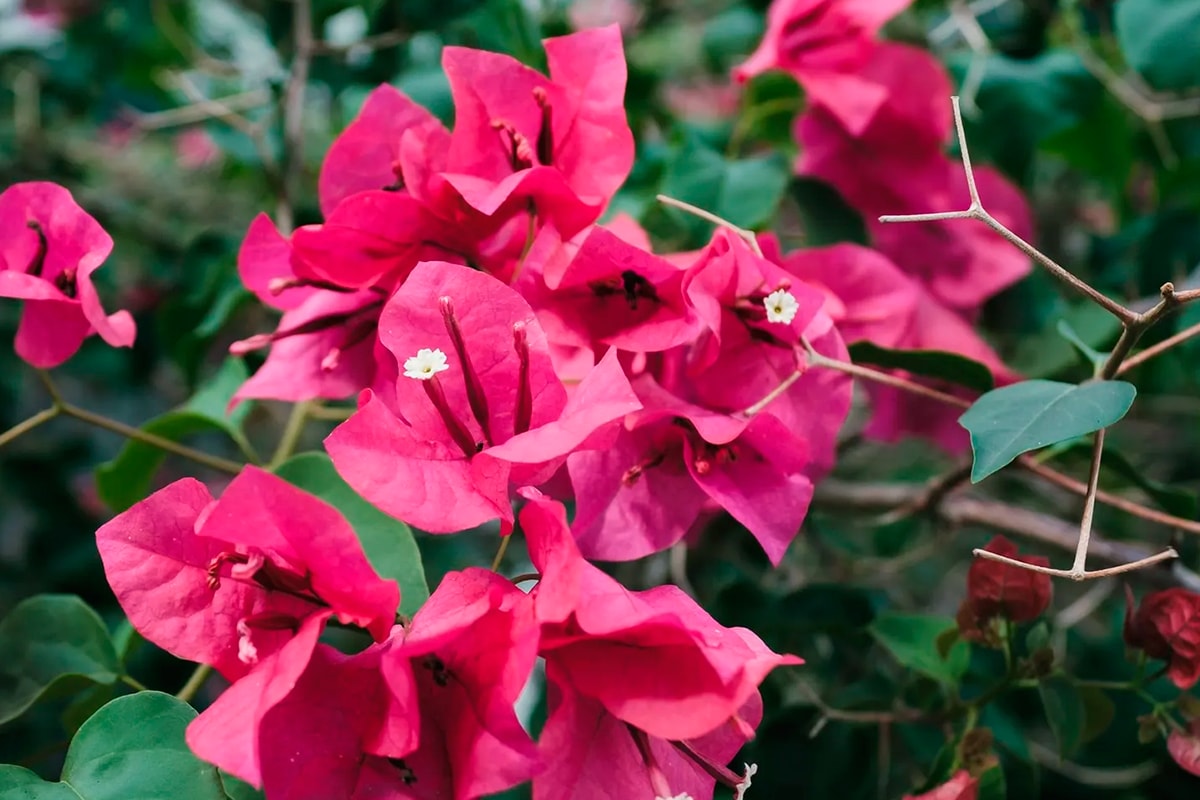
Its abundant and spectacular flowering, which sometimes covers the plant
almost completely, takes place from early spring to late autumn,
although in temperate climates it can flower almost all year round.
It reproduces by seed, but more quickly and easily by woody cuttings in winter, or semi-woody cuttings in spring and summer. It can also be propagated by air layering.
It reproduces by seed, but more quickly and easily by woody cuttings in winter, or semi-woody cuttings in spring and summer. It can also be propagated by air layering.


