Canary flora > Exotic and ornamental
Spathodea campanulata

Spathodea campanulata P.Beauv.
African tulip tree, Fountain tree, Nile flame, Squirt tree
Fast-growing evergreen tree, which normally reaches a height of 10-15 m,
although in its places of origin specimens can be found up to 30 metres
high. It has a small, rounded crown and a tall trunk, with dark bark,
longitudinally fissured and scaly over the years.
It has very large, dark green leaves, up to 60 cm long, long petiolate, imparipinnate, with 7-17 leaflets up to 15 cm long, ovate to elliptic, with entire or spreading margin, acute or acuminate apex, and covered with a rusty down, denser on the underside; the terminal leaflet is generally larger and somewhat unequal to the others.
It has very large, dark green leaves, up to 60 cm long, long petiolate, imparipinnate, with 7-17 leaflets up to 15 cm long, ovate to elliptic, with entire or spreading margin, acute or acuminate apex, and covered with a rusty down, denser on the underside; the terminal leaflet is generally larger and somewhat unequal to the others.
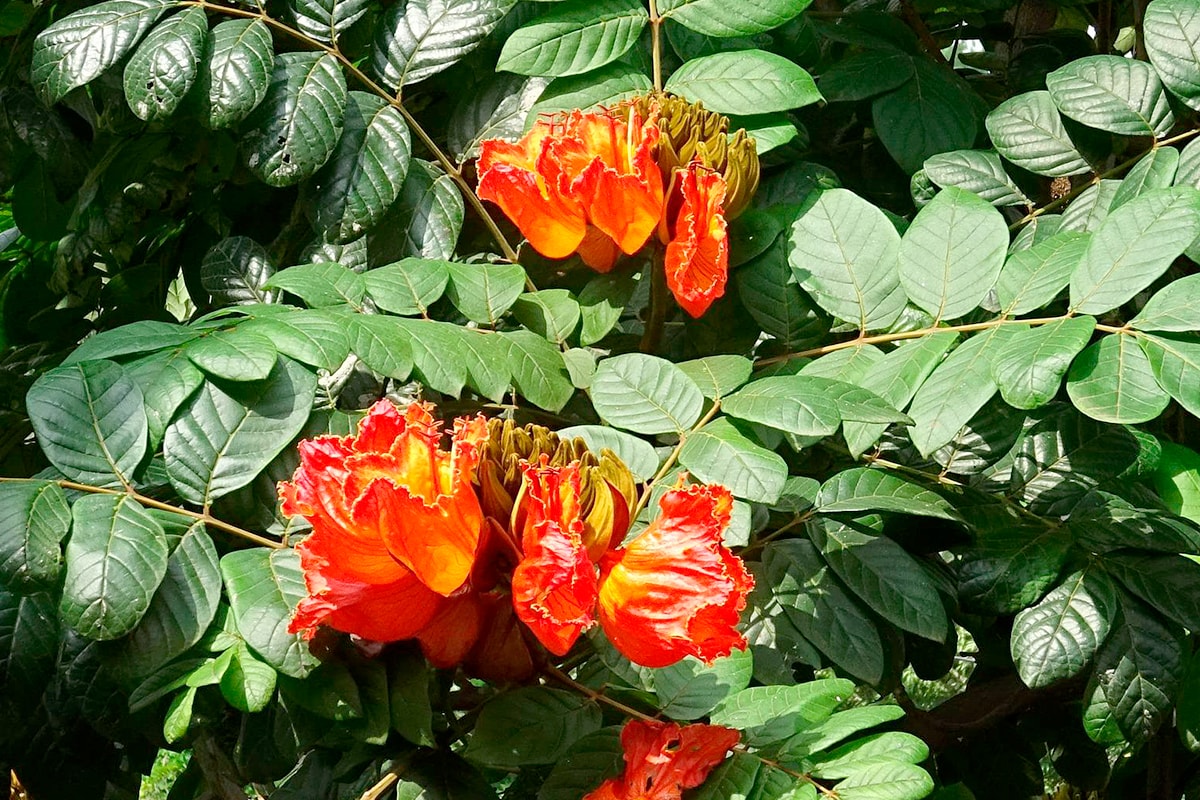
Its very showy flowers are arranged in erect terminal racemes, with
lanceolate bracts, and two bractlets at the base of each flower.
They have a calyx 3-6 cm long, tapering to a curved tip, glabrous, somewhat pubescent or tomentose, sometimes with longitudinal ribs, and a corolla narrow at the base and broadly flared at the top, orange, with red curled margins, sometimes entirely yellow, glabrous on the outside and sparsely pubescent on the inside.
They have a calyx 3-6 cm long, tapering to a curved tip, glabrous, somewhat pubescent or tomentose, sometimes with longitudinal ribs, and a corolla narrow at the base and broadly flared at the top, orange, with red curled margins, sometimes entirely yellow, glabrous on the outside and sparsely pubescent on the inside.

The fruits are long, dark-coloured, up to 25 cm long by 6 cm wide,
oblong to elliptical, erect, glabrous or tomentose, semi-woody capsules
when young. When ripe, they open in two valves to release a large number
of small, thin, membranaceous, transparent seeds with membranous wings.
It flowers at the end of summer and autumn, although in temperate areas specimens can be seen flowering almost all year round.
It reproduces by seeds, cuttings and air layering.
It flowers at the end of summer and autumn, although in temperate areas specimens can be seen flowering almost all year round.
It reproduces by seeds, cuttings and air layering.


