Canary flora > Exotic and ornamental
Nerium oleander

Nerium oleander L.
Rose Bay, Rose Laurel, Dog Bane, South Sea Rose, Sweet Oleander
Evergreen shrub, about 3-4 m high, fast-growing, abundantly branched,
with branches covered with smooth, ash-brown bark.
Its leaves, deep green in colour, are long and narrow, simple, short stalked, linear lanceolate to narrowly elliptic, opposite or whorled in clusters of 3-4, entire, leathery, with a very marked white midrib from which numerous branches branch out to the edge.
Its leaves, deep green in colour, are long and narrow, simple, short stalked, linear lanceolate to narrowly elliptic, opposite or whorled in clusters of 3-4, entire, leathery, with a very marked white midrib from which numerous branches branch out to the edge.
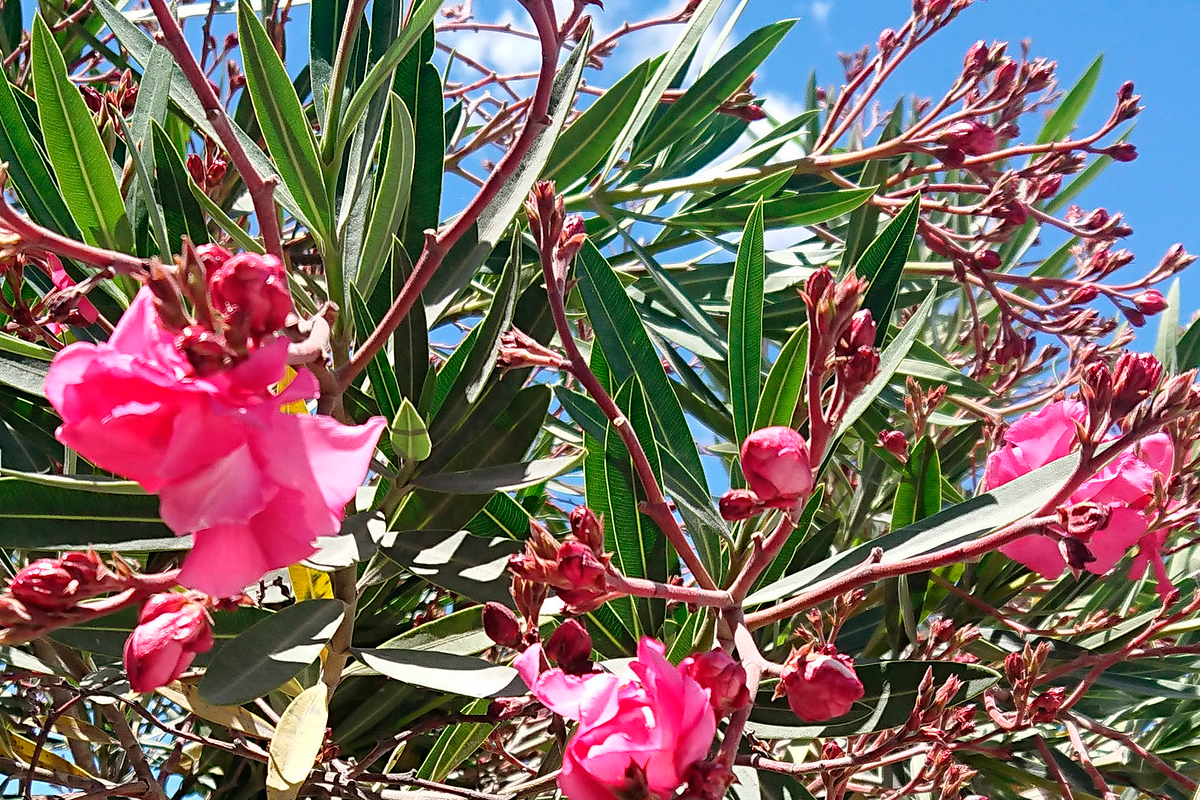
The flowers are bracteate and pedicellate, with the calyx more or less
reddish, with lanceolate, acute lobes, with glandular hairs on the inner
side, slightly welded at the base.
The corolla is usually pink, with a multifid crown of the same colour, and the stamens, with straight filaments, are glabrous, with sagittate anthers, densely pubescent on the back, with a small tooth on the lower part of the ventral side that joins the base of the stigma.
The fruits are paired fusiform follicles, brownish in colour and between 8-16 cm long, which remain attached until dehiscence. They contain a large number of small, conical, densely hairy, brownish seeds with a terminal pappus of the same colour.
The corolla is usually pink, with a multifid crown of the same colour, and the stamens, with straight filaments, are glabrous, with sagittate anthers, densely pubescent on the back, with a small tooth on the lower part of the ventral side that joins the base of the stigma.
The fruits are paired fusiform follicles, brownish in colour and between 8-16 cm long, which remain attached until dehiscence. They contain a large number of small, conical, densely hairy, brownish seeds with a terminal pappus of the same colour.

Numerous hybrids and cultivars have been obtained from the wild species
with flowers of very different colouring, from white to yellow, orange,
lilac or intense red, as well as double flowers.
Flowering takes place during the summer, although in warm, sunny places you can find flowering specimens almost all year round.
It multiplies easily by seed and by terminal semi-woody cuttings.
It is native to Europe and the Middle East, reaching as far as India and subtropical Asia, but today it can be found in different parts of the world, where it has been introduced for ornamental purposes.
Flowering takes place during the summer, although in warm, sunny places you can find flowering specimens almost all year round.
It multiplies easily by seed and by terminal semi-woody cuttings.
It is native to Europe and the Middle East, reaching as far as India and subtropical Asia, but today it can be found in different parts of the world, where it has been introduced for ornamental purposes.


