Canary flora > Exotic and ornamental
Delonix regia
Delonix regia (Hook.) Raf.
Flamboyant, Flame Tree, Royal Poinciana
The flamboyant flamboyant is one of the most striking and colourful
trees in the world with its red or orange flowers and bright, deep green
foliage.
In addition, its elegant, sun-shaped canopy makes it a highly desirable choice for gardens and green spaces, as it is not only beautiful but also provides pleasant, cooling shade.
In addition, its elegant, sun-shaped canopy makes it a highly desirable choice for gardens and green spaces, as it is not only beautiful but also provides pleasant, cooling shade.
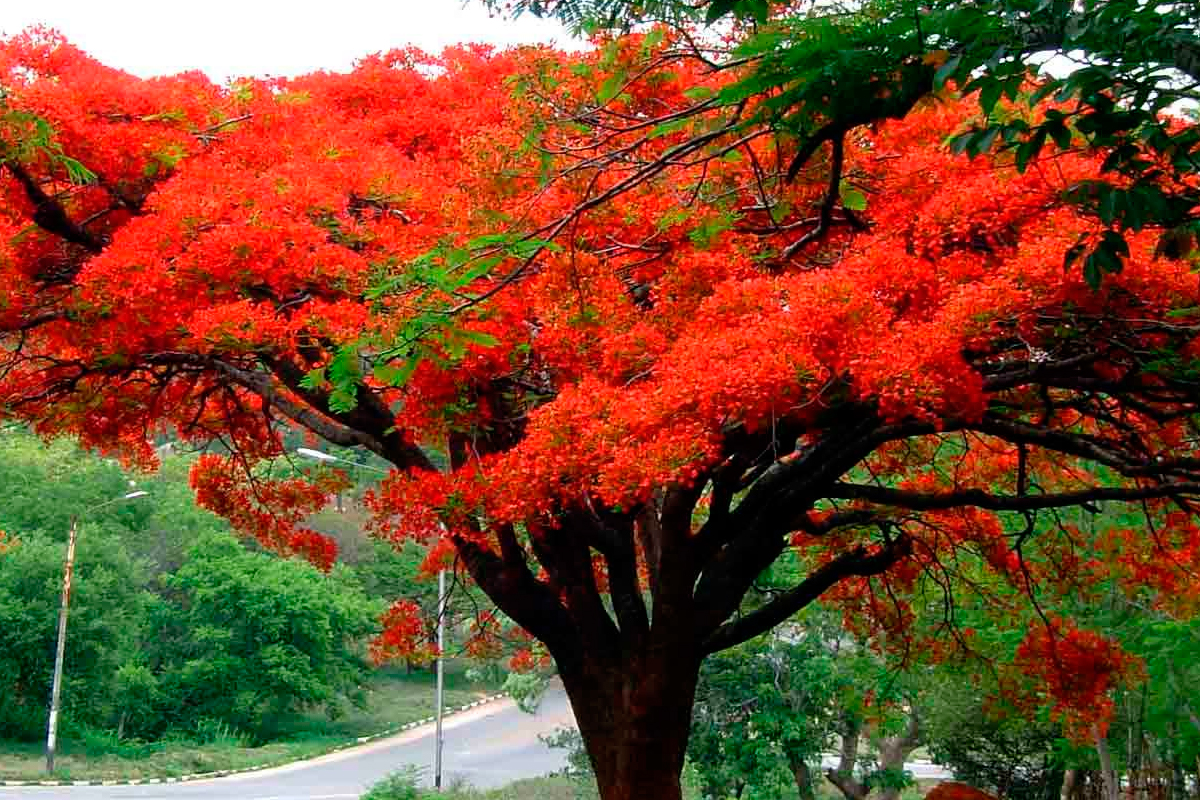
It is a deciduous tree about 8-12 m high, with a thick trunk, covered
with brown, thin, somewhat smooth, sometimes cracked bark, with abundant
lenticels. The branches are long, wide, almost horizontal, forming a
wide, flattened crown.
Its leaves, 30-50 cm long, are alternate, bipinnate, with 10-25 pairs of pinnae 5-12 cm long, each with 12-40 pairs of small leaflets.
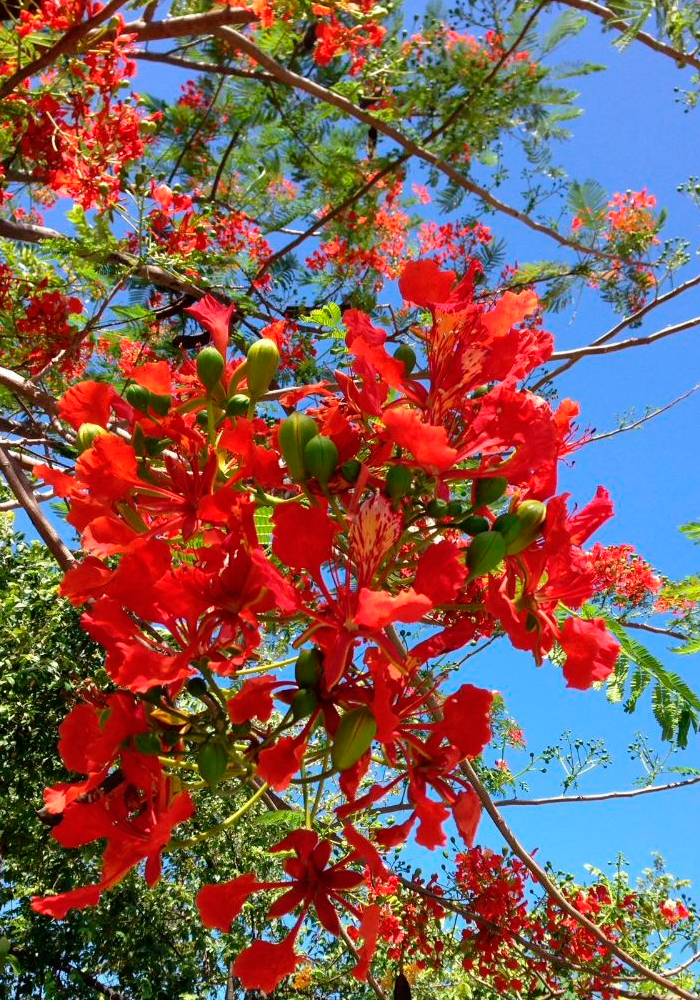
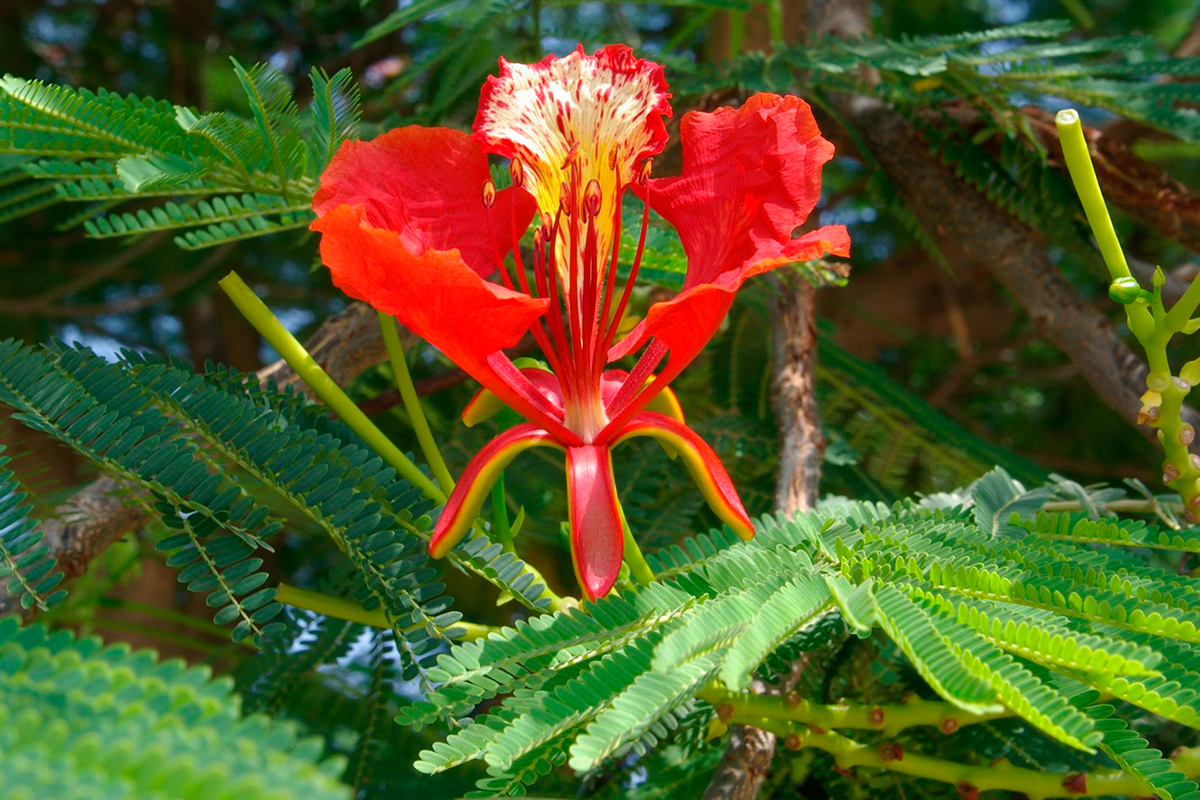
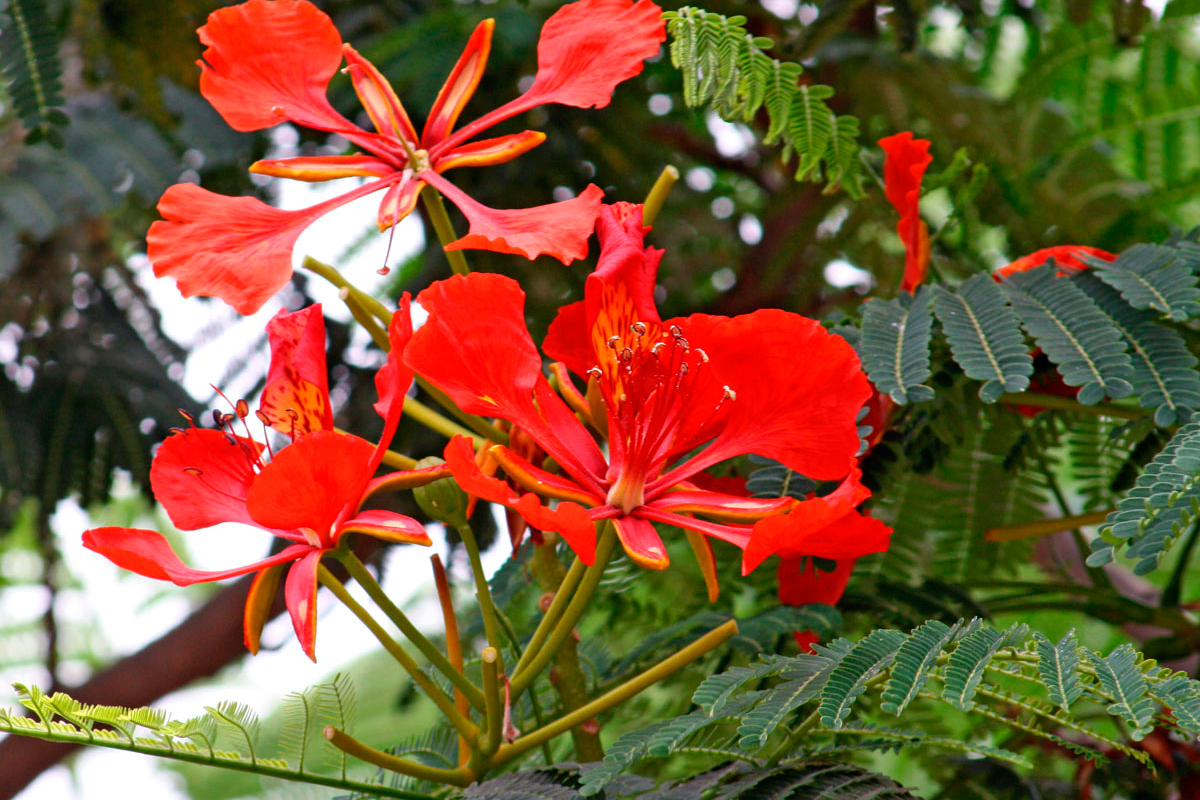
Its very showy red or orange flowers appear when the tree is leafless, and are arranged in large clusters laterally located near the end of the twigs. They are large, with four petals that can be up to 8 cm long, and a fifth petal called the standard, which is longer and spotted with yellow and white.
Its leaves, 30-50 cm long, are alternate, bipinnate, with 10-25 pairs of pinnae 5-12 cm long, each with 12-40 pairs of small leaflets.
Its very showy red or orange flowers appear when the tree is leafless, and are arranged in large clusters laterally located near the end of the twigs. They are large, with four petals that can be up to 8 cm long, and a fifth petal called the standard, which is longer and spotted with yellow and white.
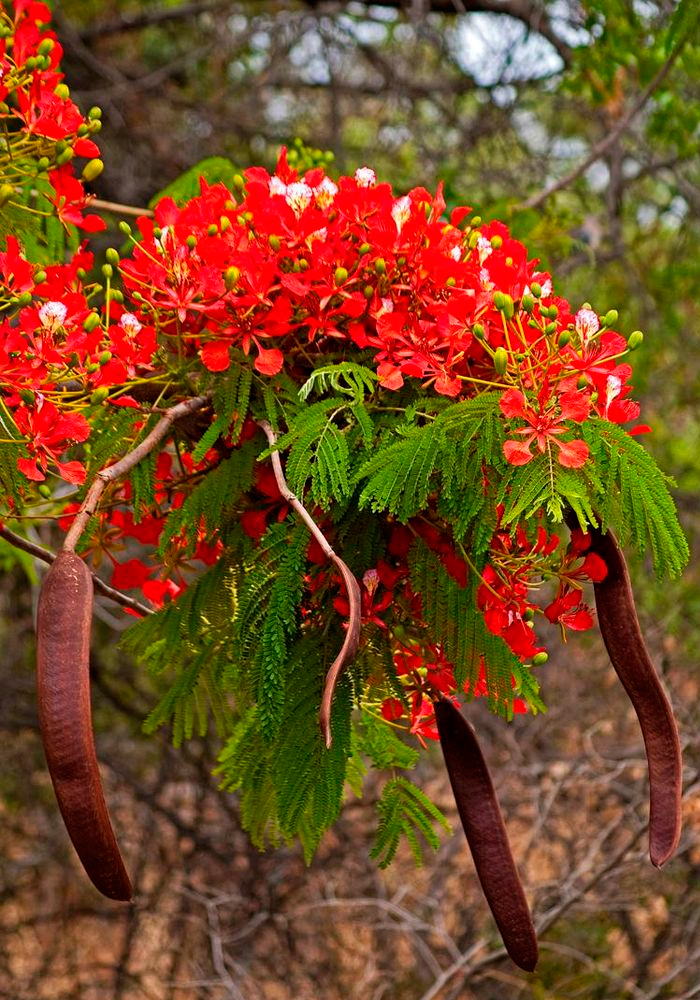
The fruit is a dark brown woody legume, about 30-50 cm long and 5 cm
wide, containing numerous cylindrical seeds, 1.5-2.5 cm long, light
brown with dark spots, with a waxy cuticle that fragments over time.
After ripening, the pods remain hanging on the tree for a whole year.
Flowering occurs between March and June, fruiting between July and October.
This species is native to Madagascar, from where it has spread to many parts of the world, such as the United States, Puerto Rico, Mexico, Central America, Cuba, Colombia, Venezuela, Peru, etc. It has also naturalised in many parts of Australia, and is very common in Spain.
After ripening, the pods remain hanging on the tree for a whole year.
Flowering occurs between March and June, fruiting between July and October.
This species is native to Madagascar, from where it has spread to many parts of the world, such as the United States, Puerto Rico, Mexico, Central America, Cuba, Colombia, Venezuela, Peru, etc. It has also naturalised in many parts of Australia, and is very common in Spain.