Canary flora > Exotic and ornamental
Senna didymobotrya

Senna didymobotrya (Fresen.) H. S. Irwin & Barneby
African senna, Popcorn senna, Candelabra tree, Peanut butter
Very ornamental shrub, with a rounded or expanded shape, fast growing,
with abundant branching covered with intense green leaves and showy
yellow flowers, arranged in large erect clusters.
The whole plant gives off a smell of roasted corn, more intense if its leaves and flowers are rubbed.
The whole plant gives off a smell of roasted corn, more intense if its leaves and flowers are rubbed.
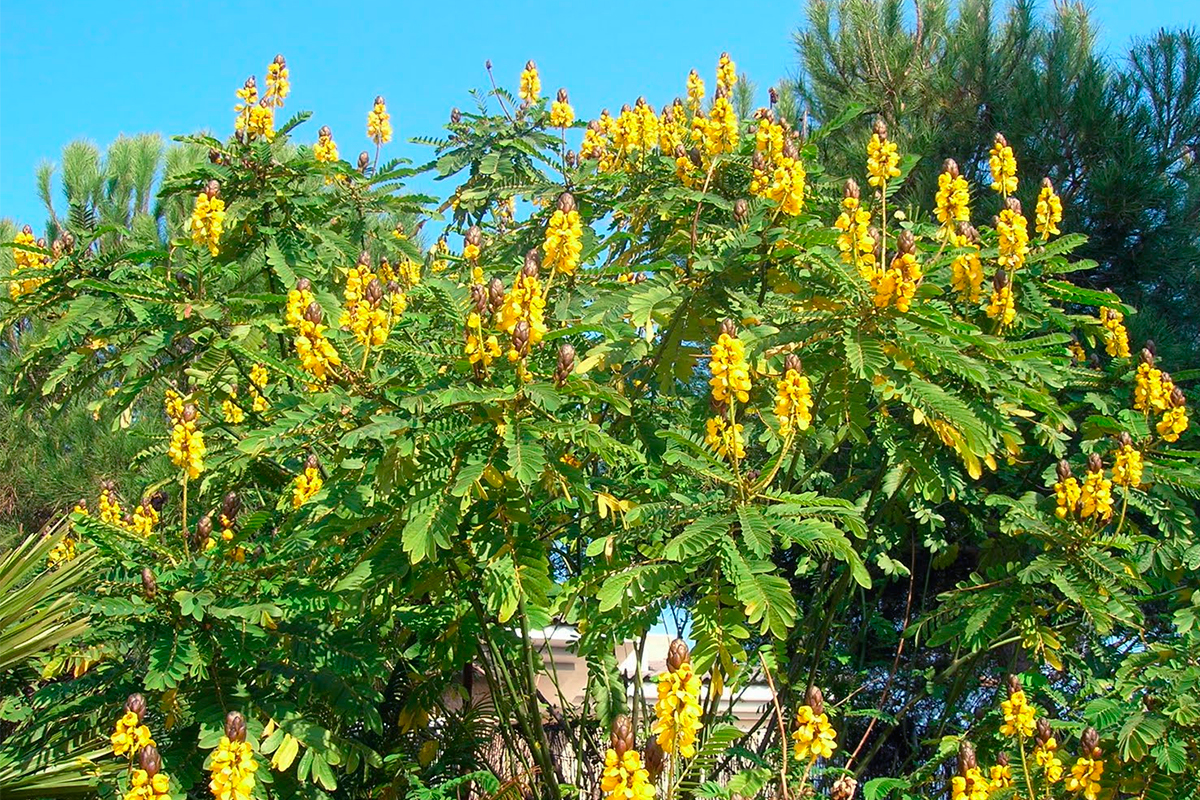
It is an evergreen shrub up to 3 m high, with thin, woody, brittle
branches covered with a flexible, dark green bark.
The leaves are large, up to 40 cm long and greenish in colour, arranged alternately, and with their lamina divided into numerous leaflets up to 5 cm long, slightly hairy, very shortly petiolate, broadly oval in outline, rounded at the apex, but topped by a short, thin mucro.
Its showy yellow flowers are arranged in dense, erect terminal spikes up to 30 cm long.
Each flower is protected by a blackish-brown, papery-looking bract, which is detached when the calyx, made up of five sepals, identical in appearance and colour to the bracts, opens, leaving a beautiful corolla with five free, intense yellow, finely veined petals in the air.
The leaves are large, up to 40 cm long and greenish in colour, arranged alternately, and with their lamina divided into numerous leaflets up to 5 cm long, slightly hairy, very shortly petiolate, broadly oval in outline, rounded at the apex, but topped by a short, thin mucro.
Its showy yellow flowers are arranged in dense, erect terminal spikes up to 30 cm long.
Each flower is protected by a blackish-brown, papery-looking bract, which is detached when the calyx, made up of five sepals, identical in appearance and colour to the bracts, opens, leaving a beautiful corolla with five free, intense yellow, finely veined petals in the air.

The fruits are pods about 10 cm long, containing a large number of
small, hard, shiny, black seeds.
A species originally from the eastern countries of Central Africa, from where it has spread as an ornamental species to many tropical and subtropical countries. In the Canary Islands it is frequently cultivated in coastal gardens, as it needs warm, sunny places for its development.
Flowering occurs in the winter and spring months, although in sheltered places specimens can be seen in flower almost all year round.
It reproduces by seed, but much more easily by cuttings.
A species originally from the eastern countries of Central Africa, from where it has spread as an ornamental species to many tropical and subtropical countries. In the Canary Islands it is frequently cultivated in coastal gardens, as it needs warm, sunny places for its development.
Flowering occurs in the winter and spring months, although in sheltered places specimens can be seen in flower almost all year round.
It reproduces by seed, but much more easily by cuttings.


