Canary flora > Exotic and ornamental
Euphorbia pulcherrima

Euphorbia pulcherrima Willd. ex Klotzsch.
Poinsettia, Christmas Blossom, Cardinal
Shrub or sapling up to more than 4 m high, densely branched from the
base, with a thick, woody trunk and thin, semi-erect branches covered
with fine, smooth, light brown bark.
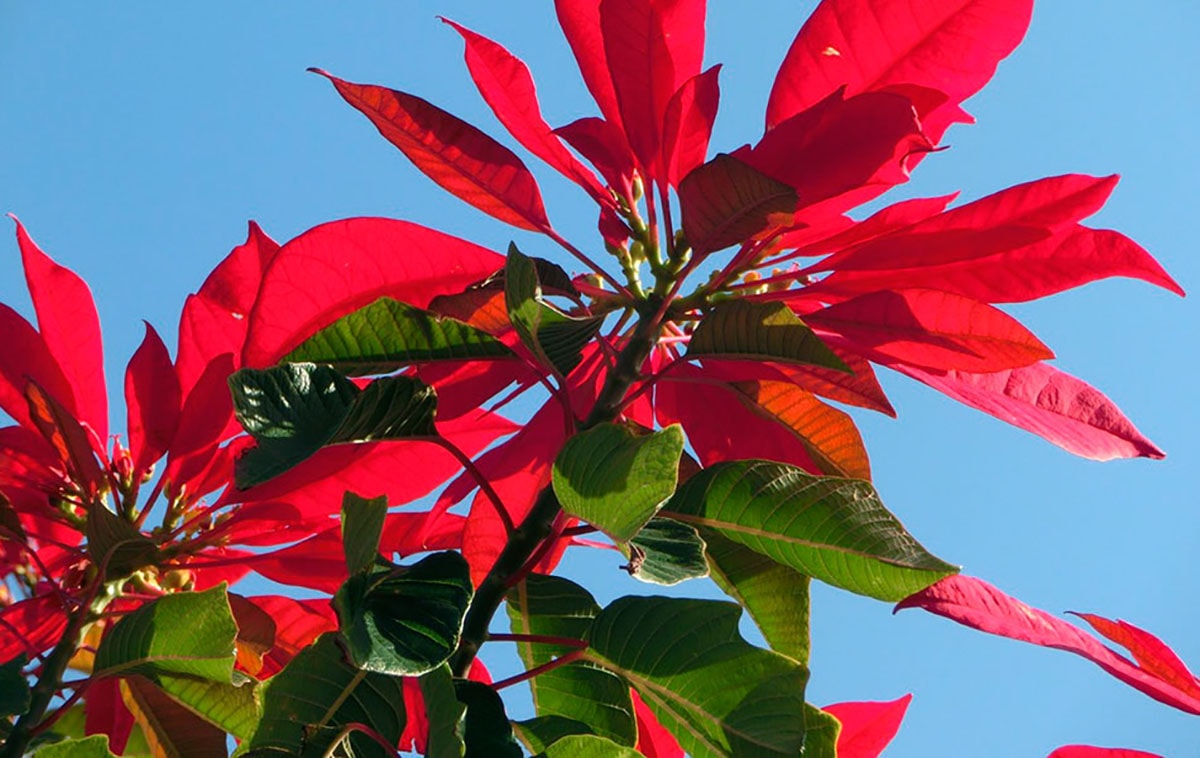
Its leaves, dark green in colour and markedly veined, are large, between 10-20 cm long, and very variable in outline, generally lanceolate to broadly oval. They are simple, alternate, entire, acute at the tip, tapering at the base, pale and somewhat hairy on the underside, and supported by long reddish petioles.
The flowers are tiny and are sheltered in small cup-shaped receptacles called cyathia, which are grouped, in turn, in umbelliform inflorescences surrounded by large and showy bracts of a very bright red colour, although in some cultivars these bracts are whitish, yellowish or pinkish.
Its leaves, dark green in colour and markedly veined, are large, between 10-20 cm long, and very variable in outline, generally lanceolate to broadly oval. They are simple, alternate, entire, acute at the tip, tapering at the base, pale and somewhat hairy on the underside, and supported by long reddish petioles.
The flowers are tiny and are sheltered in small cup-shaped receptacles called cyathia, which are grouped, in turn, in umbelliform inflorescences surrounded by large and showy bracts of a very bright red colour, although in some cultivars these bracts are whitish, yellowish or pinkish.
The fruits consist of large, very hard, reddish-green, tri-valved
capsules containing three globular, black seeds, although some of the
valves are often empty.
It multiplies easily by cuttings in spring or summer.
The whole plant contains a large quantity of whitish, sticky and highly toxic latex, which burns the skin, and was therefore sometimes used to burn warts. It is therefore advisable to wear gloves when handling this plant.
It multiplies easily by cuttings in spring or summer.
The whole plant contains a large quantity of whitish, sticky and highly toxic latex, which burns the skin, and was therefore sometimes used to burn warts. It is therefore advisable to wear gloves when handling this plant.

Originally from Mexico and Guatemala, this species has been introduced
to the Canary Islands as an ornamental plant, especially outdoors,
although small specimens can be kept in pots indoors, provided they are
in warm, well-lit places.
The wild form lives in ravines and escarpments, especially in western and southern Mexico, but it is also grown in rural areas, abandoned human settlements or on roadsides and roadsides.
The wild form lives in ravines and escarpments, especially in western and southern Mexico, but it is also grown in rural areas, abandoned human settlements or on roadsides and roadsides.


