Canary flora > Exotic and ornamental
Coccoloba uvifera

Coccoloba uvifera (L.) L.
Seagrape, Horsewood, Hopwood, Jamaica kino
Evergreen, dioecious shrub or sapling, 2-9 m tall, with a spreading or
rounded crown and a stout, often twisted, low-branching trunk, with
smooth, greyish, thin bark, peeling in small sheets on large trunks,
then becoming mottled with whitish or light brown spots.
However, it should be noted that this plant varies greatly in size: from low, prostrate shrubs on windswept beaches to small, low-branching trees in areas sheltered from the air and breeze.
The branches are thick, cylindrical, woody, brittle, and covered with a thick, greyish, slightly striated bark with very marked internodes.
However, it should be noted that this plant varies greatly in size: from low, prostrate shrubs on windswept beaches to small, low-branching trees in areas sheltered from the air and breeze.
The branches are thick, cylindrical, woody, brittle, and covered with a thick, greyish, slightly striated bark with very marked internodes.
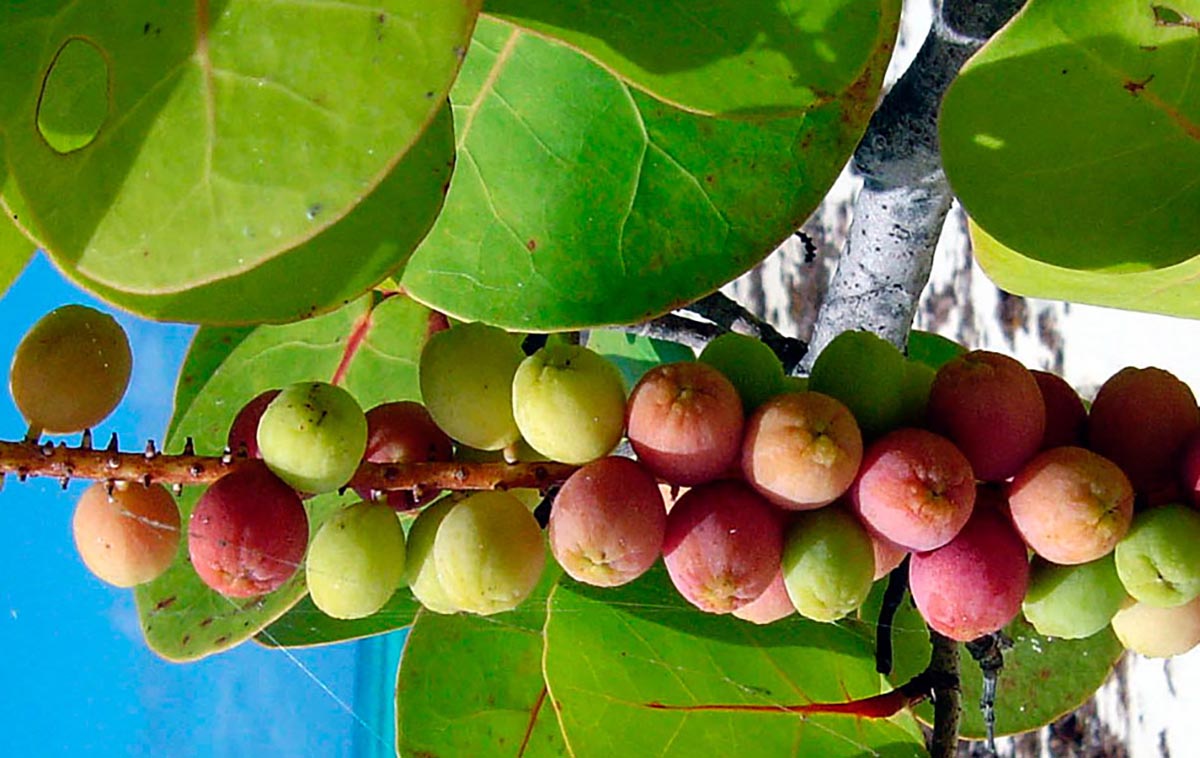
Its large leaves, green or reddish in colour and up to more than 20 cm
in diameter, are simple, alternate, short and thickly stalked, with an
almost rounded or kidney-shaped lamina, lustrous when young, leathery as
it ages and with a prominent greenish-yellow or reddish ribbing on both
sides, with 3-5 pairs of lateral nerves, forked near the margin.
New leaves are reddish or bronze in colour.
New leaves are reddish or bronze in colour.

Its tiny greenish-white flowers, barely 2-3 mm in diameter, are arranged
in long, dense terminal or lateral clusters up to more than 30 cm long,
erect at first and drooping when fruiting.
They produce globular fruits up to 2 cm in diameter and reddish-green in colour, supported by short stalks, with the calyx persisting at the apex, grouped in dense clusters vaguely reminiscent of grapes. Inside, they contain a single, smooth, thick, blackish-coloured seed.
It flowers in spring and summer, the fruit ripening in autumn and winter.
They produce globular fruits up to 2 cm in diameter and reddish-green in colour, supported by short stalks, with the calyx persisting at the apex, grouped in dense clusters vaguely reminiscent of grapes. Inside, they contain a single, smooth, thick, blackish-coloured seed.
It flowers in spring and summer, the fruit ripening in autumn and winter.


