Canary flora > Exotic and ornamental
Acokanthera oblongifolia

Acokanthera oblongifolia (Hochst.) Codd.
African wintersweet, Hottentot's poison, Dune poison bush
Perennial shrub or sapling, about 3-6 m high, with a robust trunk and
abundant branching, which forms a very dense crown with a more or less
globular shape. The branches are smooth, woody, brittle and covered with
a flexible green bark with reddish tones.
The leaves are simple, opposite, decussate, broadly elliptic to oblong, with a wedge-shaped or rounded base, an entire margin, sometimes recurved, and an obtuse to mucronate apex. Smooth and leathery in texture, they are petiolate and their colour is bright green on the upper side, with the veins not very marked, and paler and often somewhat reddish on the underside, with a prominent midrib.
The leaves are simple, opposite, decussate, broadly elliptic to oblong, with a wedge-shaped or rounded base, an entire margin, sometimes recurved, and an obtuse to mucronate apex. Smooth and leathery in texture, they are petiolate and their colour is bright green on the upper side, with the veins not very marked, and paler and often somewhat reddish on the underside, with a prominent midrib.
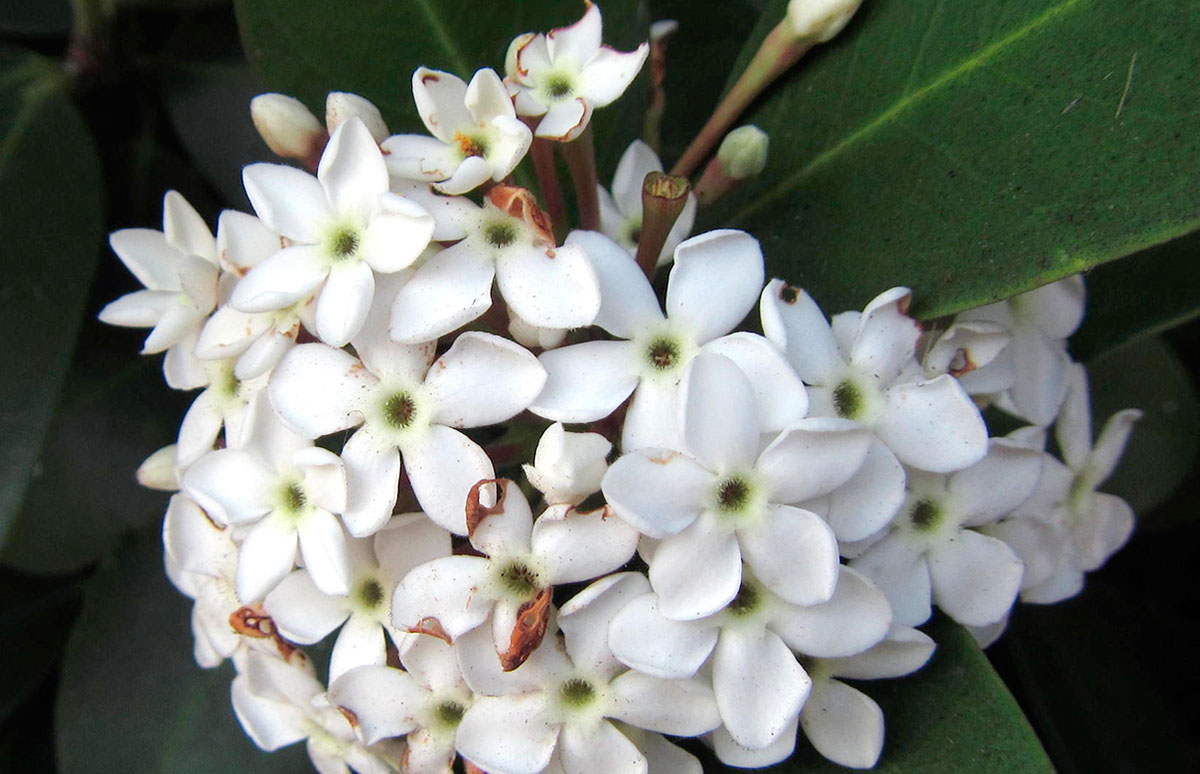
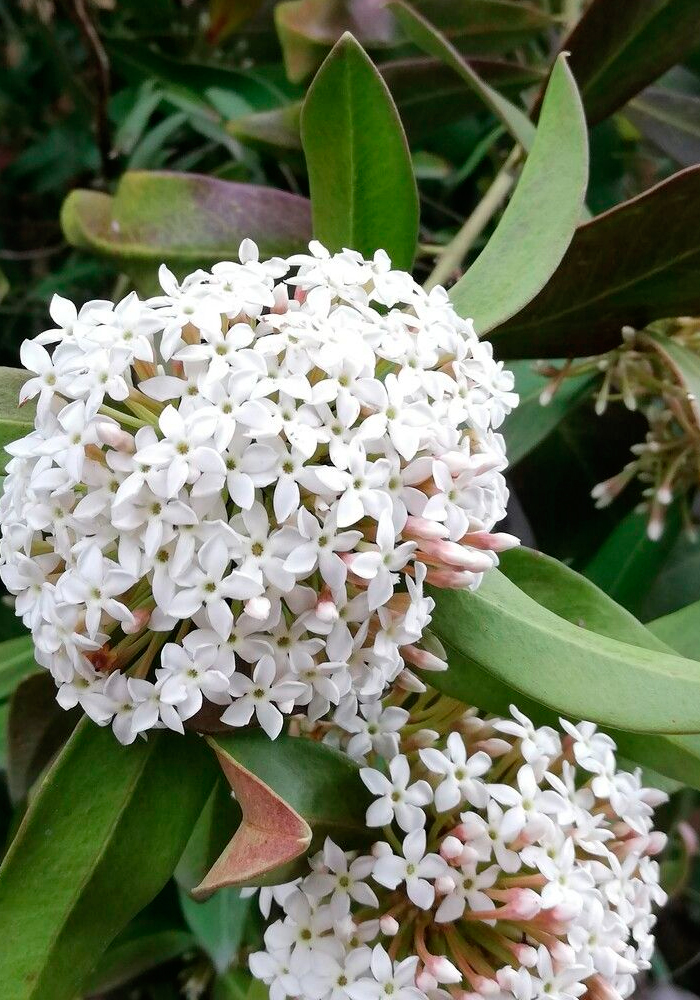
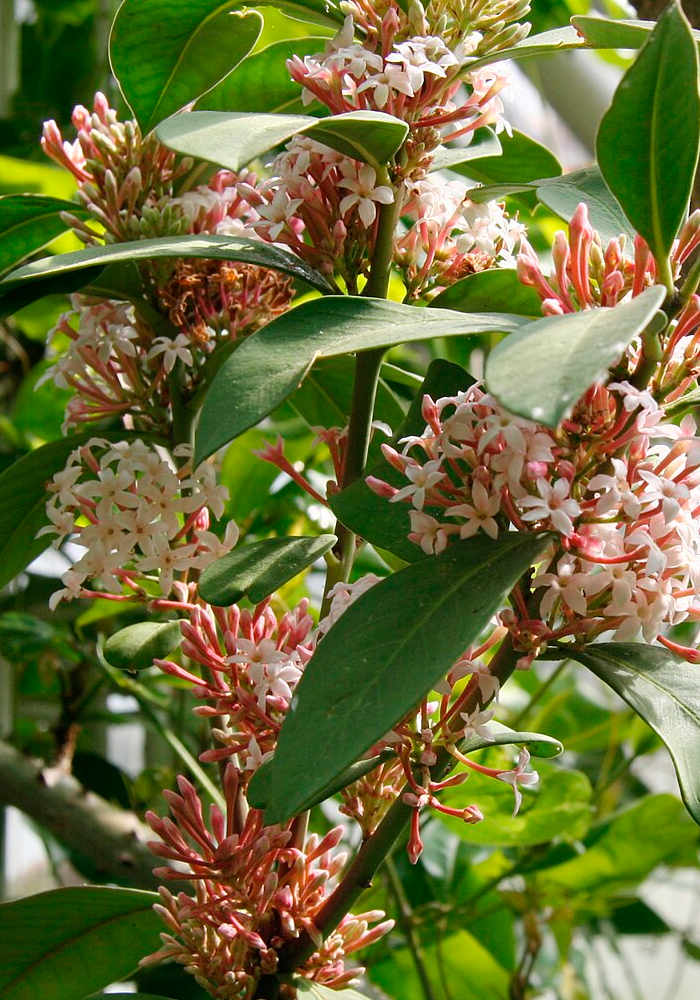
Its small, fragrant flowers are grouped in copious inflorescences up to
10 cm long, axillary or terminal, shorter than the leaves. Each flower
consists of a short greenish calyx and a long, narrow, pink, tubular
corolla, which at its terminal part divides into five deep, whitish
lobes, forming a beautiful, delicate little star. The stamens and pistil
are sheltered inside the tube, never showing outside.
The fruits are large fleshy berries the size and appearance of a large olive or a small plum, reddish green at first and black when ripe. Inside their filamentous, juicy flesh are two large, hard, smooth, ivory-coloured, hemispherical seeds.
The fruits are large fleshy berries the size and appearance of a large olive or a small plum, reddish green at first and black when ripe. Inside their filamentous, juicy flesh are two large, hard, smooth, ivory-coloured, hemispherical seeds.

In the Canary Islands, its only use is as an
ornamental plant, but it is increasingly used in gardens, squares,
roadsides, etc.
It is somewhat sensitive to cold, so it requires mild climates, rich, well-drained soils and sunny exposure, tolerating half shade and salty air in areas close to the coast.
It can be planted singly or in groups. It requires watering in the first few years, but is fairly drought resistant as an adult. It tolerates pruning quite well, being able to give it the shape of a sapling.
It is somewhat sensitive to cold, so it requires mild climates, rich, well-drained soils and sunny exposure, tolerating half shade and salty air in areas close to the coast.
It can be planted singly or in groups. It requires watering in the first few years, but is fairly drought resistant as an adult. It tolerates pruning quite well, being able to give it the shape of a sapling.