Canary flora > Exotic and ornamental
Tecomaria capensis

Tecomaria capensis (Thunb.) Spach
Cape Honeysuckle, West Indian Honeysuckle
Shrub about 3-8 m tall, with slender, woody stems, grey twigs with white
lenticels, and a wide, dense crown, almost always covered with showy
flowers.
The leaves are pinnate, opposite, about 10-15 cm long, and consist of 5-9 oblong leaflets, green on both sides, smooth-textured and with a serrated edge.
The leaves are pinnate, opposite, about 10-15 cm long, and consist of 5-9 oblong leaflets, green on both sides, smooth-textured and with a serrated edge.
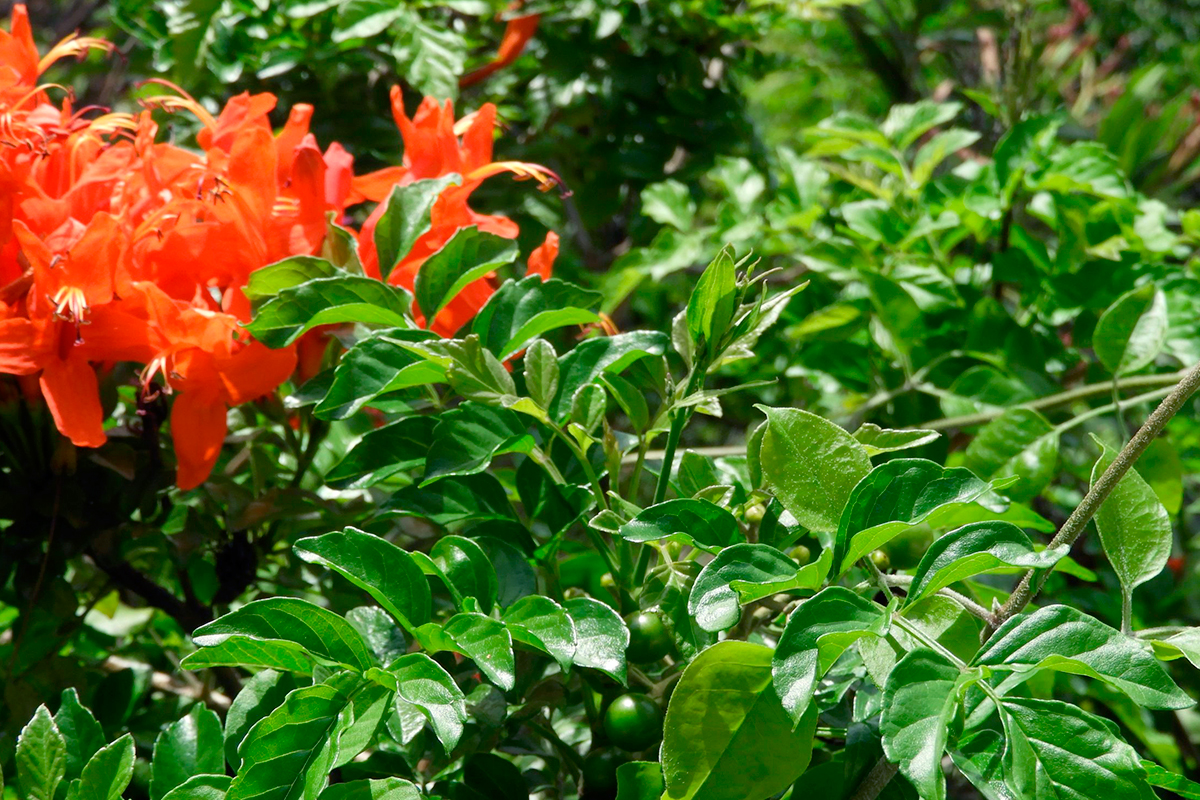
The bright red or orange flowers, with a yellowish centre, are grouped
in small terminal clusters about 12 cm long.
They are bell-shaped, about 7 cm long, formed by 5 fused petals, which create a slender tube that curves outwards, and a corolla with five rounded lobes.
The stamens develop next to the upper lobe, but curve towards the centre to facilitate the process of pollination by insects or small birds.
They are bell-shaped, about 7 cm long, formed by 5 fused petals, which create a slender tube that curves outwards, and a corolla with five rounded lobes.
The stamens develop next to the upper lobe, but curve towards the centre to facilitate the process of pollination by insects or small birds.

The fruits are thin legumes about 5 cm long, and when ripe they dry out
and turn brown, splitting open at the sides to release their very small,
thin, light brown seeds, with thin, almost transparent wings at the
ends, which allow them to be carried by the wind.
The remains of the fruits remain attached to the twigs for some time.
It is a native of South Africa, Swaziland and southern Mozambique, having spread as an ornamental in many gardens in Europe and other parts of the world.
The remains of the fruits remain attached to the twigs for some time.
It is a native of South Africa, Swaziland and southern Mozambique, having spread as an ornamental in many gardens in Europe and other parts of the world.


