Canary flora > Exotic and ornamental
Cycas revoluta

Cycas revoluta Thunb.
Sago Palms, King sago
Perennial plant, between 1-3 m high, with a short, thick, unbranched
trunk with numerous basal shoots, on which there is a slender,
fan-shaped crown of large leaves similar to those of palms or tree
ferns.
The trunk is covered with the fibrous remains of the tips of dead leaves, and the roots are fleshy and may protrude at the base.
Very old specimens can reach a trunk height of up to 6-7 m, but, given the very slow growth of this species, it can take up to 100 years to reach these dimensions. On these rare occasions the trunks may branch several times, producing multiple leaf heads.
The trunk is covered with the fibrous remains of the tips of dead leaves, and the roots are fleshy and may protrude at the base.
Very old specimens can reach a trunk height of up to 6-7 m, but, given the very slow growth of this species, it can take up to 100 years to reach these dimensions. On these rare occasions the trunks may branch several times, producing multiple leaf heads.
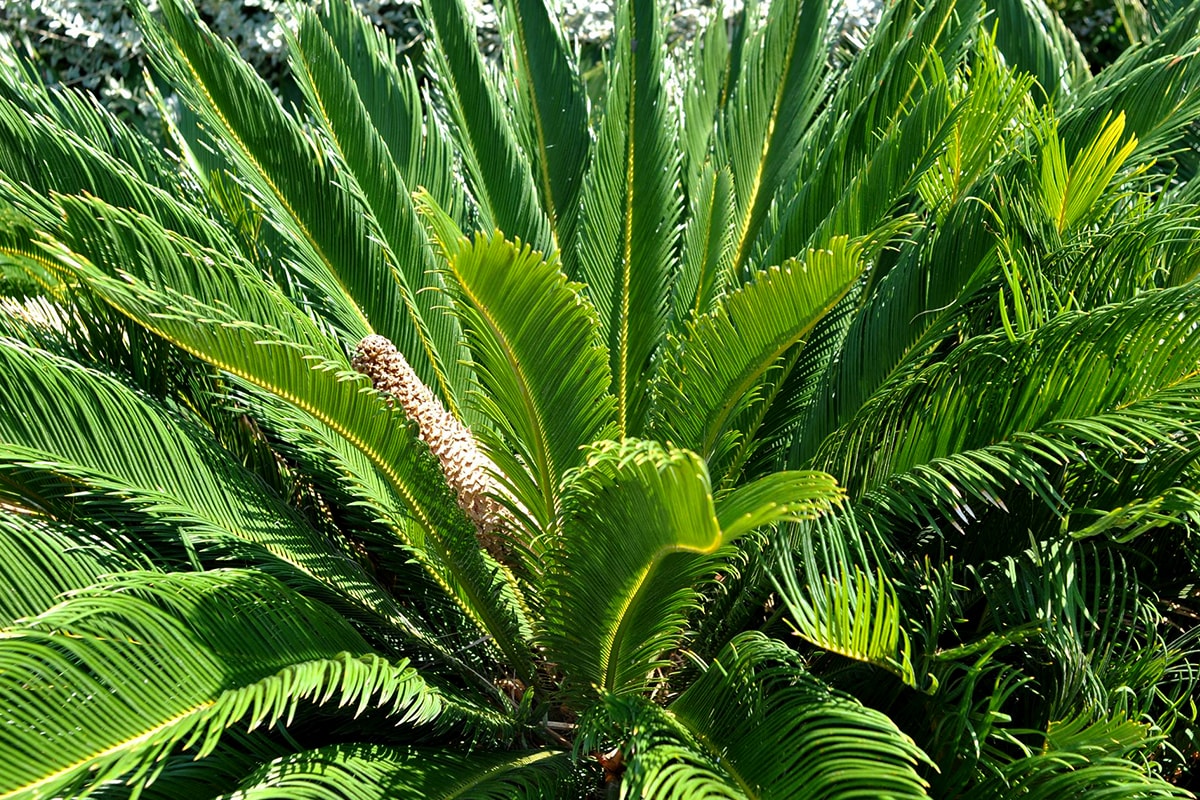
Its large leaves, up to 2 m long, are divided into many leaflets, 10-25
cm long, intense green to yellowish-green, narrowly lanceolate, rigid,
pointed, pointed, slightly rolled on their margins, and with tetragonal
petioles.

It is a dioecious plant, with male and female flowers in separate
specimens. The male inflorescences are grouped in a large
whitish-yellowish terminal cone formed by hundreds of spirally arranged
bracts, on the lower part of which there are numerous pollen sacs. The
female inflorescences form a cluster of large radially arranged carpels,
orange to deep red in colour, finely and deeply lobed, and covered with
a dense yellowish down.


