Canary flora > Exotic and ornamental
Lonicera japonica

Lonicera japonica Thunb.
Japanese honeysuckle
Climbing plant, in the form of a vine, normally between 1-4 m high,
which produces numerous sarmentose stems, branched from the base, the
youngest being pubescent and reddish in colour.
The deep green leaves are simple, opposite, short stalked, with ovate to lanceolate laminae, 3-6 cm long by 2-3 cm wide, entire, pointed, rounded or cordate at the base, and pubescent on both sides.
The deep green leaves are simple, opposite, short stalked, with ovate to lanceolate laminae, 3-6 cm long by 2-3 cm wide, entire, pointed, rounded or cordate at the base, and pubescent on both sides.
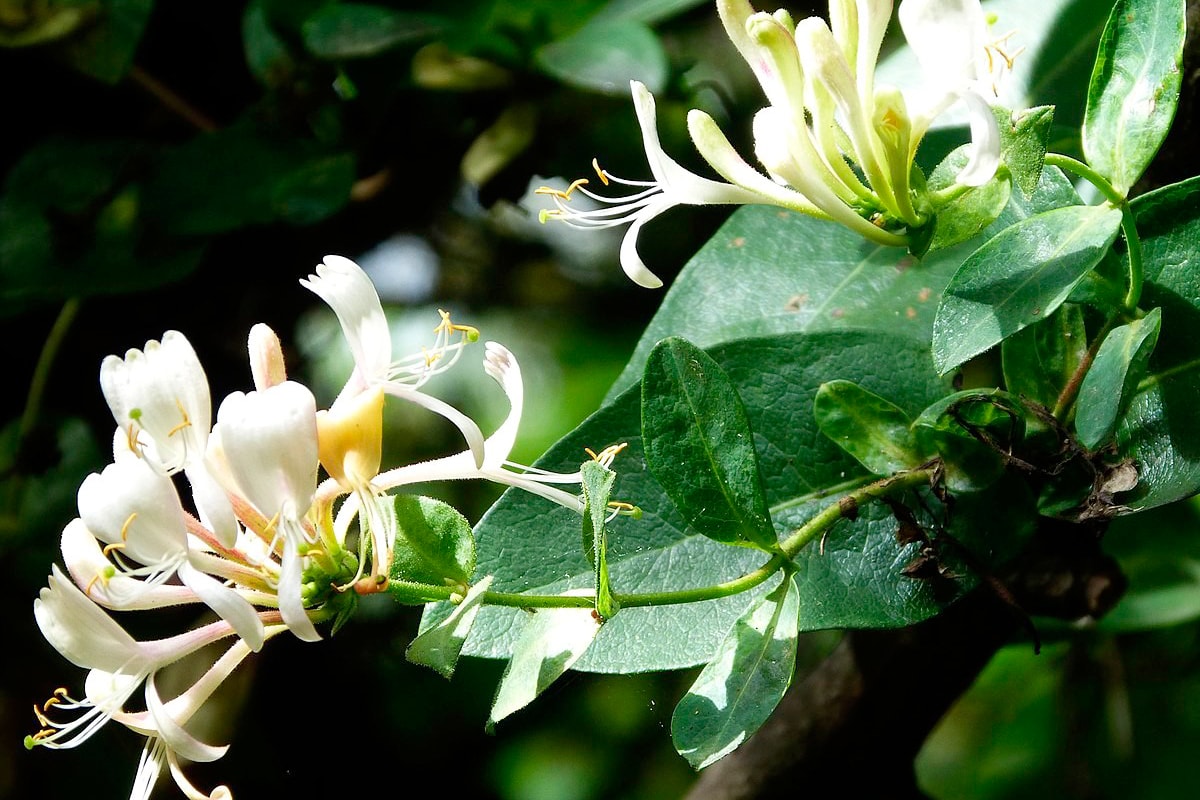
Its flowers, yellowish white at first and yellow later on, grow in pairs
on the terminal portion of the branches, supported by axillary
peduncles, and with two petiolate foliaceous bracts at their base.
They have a hairy tubular calyx about 2-4 mm long, and a bilabiate corolla about 3-4 cm long, with the upper lip divided into four lobes and the lower one recurved. The stamens are very fine and slightly longer than the petals.
The fruits are globular fleshy berries about 5-7 mm in diameter, blue at first and black when ripe, containing numerous very small seeds.
They have a hairy tubular calyx about 2-4 mm long, and a bilabiate corolla about 3-4 cm long, with the upper lip divided into four lobes and the lower one recurved. The stamens are very fine and slightly longer than the petals.
The fruits are globular fleshy berries about 5-7 mm in diameter, blue at first and black when ripe, containing numerous very small seeds.

The whole plant gives off an intense fragrance, which is especially
noticeable during the summer months.
Flowering normally takes place between May and September.
It reproduces by seed, but much more easily by cuttings or layering.
This species is native to East Asia: Japan, Korea, North and East China, Taiwan, etc. But it has spread from its areas of origin to many parts of the world, and in countries such as Argentina, Brazil, Mexico, New Zealand and the United States it has become an aggressive exotic invader that radically displaces native species.
Flowering normally takes place between May and September.
It reproduces by seed, but much more easily by cuttings or layering.
This species is native to East Asia: Japan, Korea, North and East China, Taiwan, etc. But it has spread from its areas of origin to many parts of the world, and in countries such as Argentina, Brazil, Mexico, New Zealand and the United States it has become an aggressive exotic invader that radically displaces native species.


