Canary flora > Exotic and ornamental
Tetrapanax papyrifer

Tetrapanax papyrifer (Hook.) K.Koch.
Rice paper plant
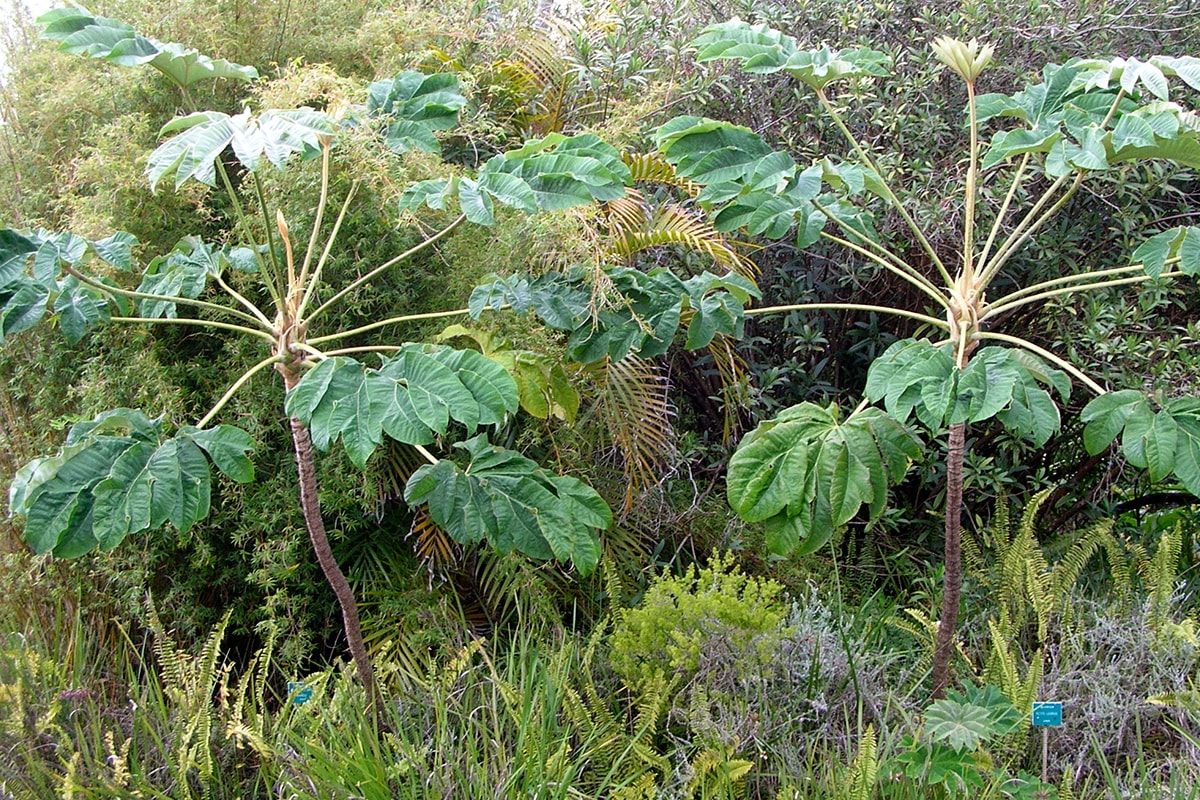
Perennial shrub up to 4 m high, covered with a stellate,
ferruginous-coloured ground cover. The stems are thick, straight, not
very woody, rough, slightly hairy and filled with a homogeneous white
pith.
The leaves are large, about 50-80 cm in diameter, simple, alternate, long stalked, with two prominent stipules at the base and palmate lamina, with oblong, pointed lobes, with an entire or slightly serrated margin, smooth and dark green on the upper side, whitish pubescent on the underside, and with prominent pinkish veins.
The leaves are large, about 50-80 cm in diameter, simple, alternate, long stalked, with two prominent stipules at the base and palmate lamina, with oblong, pointed lobes, with an entire or slightly serrated margin, smooth and dark green on the upper side, whitish pubescent on the underside, and with prominent pinkish veins.
The flowers are gathered in terminal panicles composed of globose
umbels, forming long inflorescences covered with a dense white
indumentum of stellate hairs, which protrude above the leaves. They are
very small, long pedicellate, with a calyx formed by 4 very small
sepals, not very noticeable, and a star-shaped corolla, open, with 4
free, triangular, white petals, tomentose on the underside.
The fruit is a fleshy, spherical drupe about 4 mm in diameter, slightly flattened, very dark purple, almost black when ripe, with smooth, laterally compressed seeds.
The fruit is a fleshy, spherical drupe about 4 mm in diameter, slightly flattened, very dark purple, almost black when ripe, with smooth, laterally compressed seeds.

Its exuberant flowering occurs from mid-autumn until well into winter,
fruiting during spring and part of summer.
The flowers produce a nectar that attracts numerous pollinators, mainly bees and flies.
It reproduces by seed, but more quickly and usually by sprouting from the roots.
The flowers produce a nectar that attracts numerous pollinators, mainly bees and flies.
It reproduces by seed, but more quickly and usually by sprouting from the roots.


