Canary flora > Exotic and ornamental
Colocasia esculenta

Colocasia esculenta (L.) Schott
Taro, Cocoyam, Dasheen, Eddoe, Elephant's Ear, Keladi
Perennial herbaceous plant, 1-2.5 m high, which produces a large,
stoloniferous, underground tuber with a dark brown skin and white flesh,
which can weigh up to 6 kg and measure more than 20 cm in diameter.
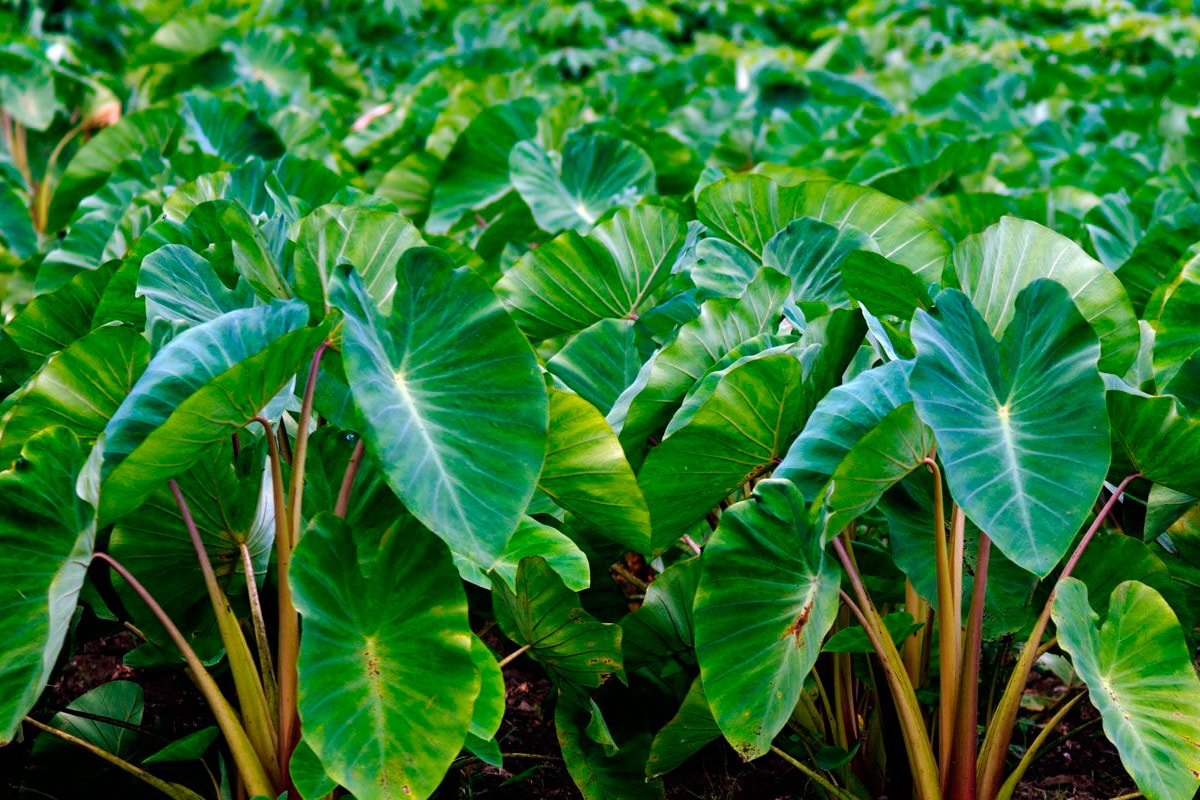
From its base sprouts a clump of about 10-20 large leaves, 60-100 cm long and 30-50 cm wide, sometimes even larger.
They are simple, alternate, supported by thick petioles that form a sheath at the bottom, cordate at the base and with a more or less heart-shaped blade of an intense green colour with reddish-purple tones near the ends, and very marked venation.
From its base sprouts a clump of about 10-20 large leaves, 60-100 cm long and 30-50 cm wide, sometimes even larger.
They are simple, alternate, supported by thick petioles that form a sheath at the bottom, cordate at the base and with a more or less heart-shaped blade of an intense green colour with reddish-purple tones near the ends, and very marked venation.
Its tiny flowers, of a more or less intense yellow colour, are arranged
on a spadix ending in the shape of a club and surrounded by a whitish or
yellowish spathe that partially envelops it.
The flowers are unisexual, with the male and female flowers located in different sections of the spadix, separated by a crown of sterile flowers.
The fruits are small bright red berries, grouped in clusters, containing tiny ovoid seeds about 1-1.5 mm long.
The flowers are unisexual, with the male and female flowers located in different sections of the spadix, separated by a crown of sterile flowers.
The fruits are small bright red berries, grouped in clusters, containing tiny ovoid seeds about 1-1.5 mm long.

Its flowering period normally occurs in the spring and summer months.
It reproduces by seed, but more easily and quickly by division of the tuber, taking care to leave at least one bud on each cut.
This species is native to the tropical areas of Asia and Africa, and it is believed to have spread from there to many areas of the world since ancient times. There is evidence of its cultivation for more than 5,000 years, becoming over time one of the staple foods of the peoples located in tropical areas, especially of many Asian and Polynesian cultures.
It reproduces by seed, but more easily and quickly by division of the tuber, taking care to leave at least one bud on each cut.
This species is native to the tropical areas of Asia and Africa, and it is believed to have spread from there to many areas of the world since ancient times. There is evidence of its cultivation for more than 5,000 years, becoming over time one of the staple foods of the peoples located in tropical areas, especially of many Asian and Polynesian cultures.


