Canary flora > Exotic and ornamental
Plumeria alba
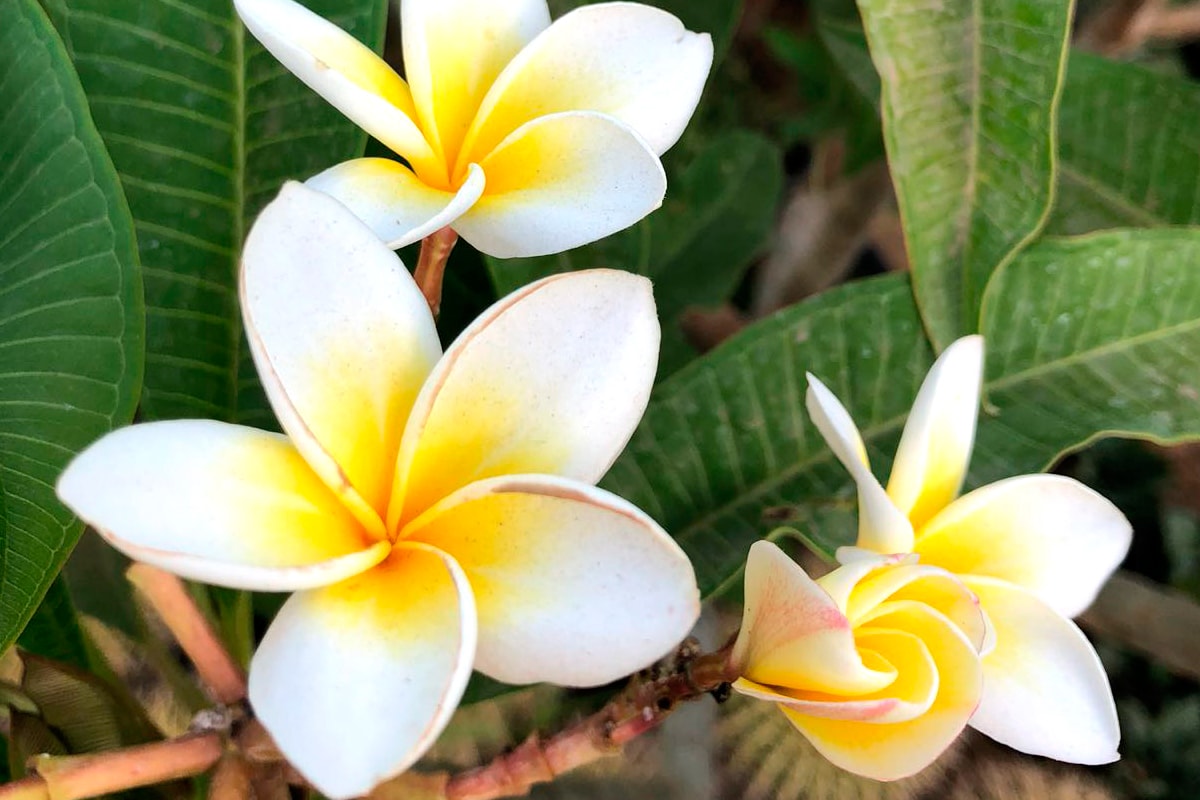
Plumeria alba L.
White frangipani, Pigeon wood, Caterpillar tree, Nosegay tree
Evergreen tree about 2-5 m high, with a thickened stem to facilitate the
accumulation of water, and abundant dichotomous branching, with thick,
erect branches, covered with greyish bark in the older parts, smooth and
green in the terminal part, giving rise to a wide, more or less
sun-shaped crown.

Its leaves are large, about 20-50 cm long and bright green on the upper
side, simple, alternate, leathery, lanceolate to oblanceolate, entire
and pointed.
They are grouped in the terminal portion of the branches and fall off in dry weather, leaving large scars on the branches.
Its showy, aromatic flowers, white with a yellowish base, are grouped in corymbose terminal inflorescences. Each flower consists of a calyx with reduced sepals and a corolla with five petals forming a kind of pinwheel.
They are grouped in the terminal portion of the branches and fall off in dry weather, leaving large scars on the branches.
Its showy, aromatic flowers, white with a yellowish base, are grouped in corymbose terminal inflorescences. Each flower consists of a calyx with reduced sepals and a corolla with five petals forming a kind of pinwheel.

The fruits are two large, narrow follicles up to 25 cm long, joined at
the base and dark brown in colour, containing a number of flat, winged,
dark brown seeds.
Flowering occurs in spring, but specimens can be seen in flower almost all year round.
It multiplies in spring, both by seed and cuttings.
This species is native to warm regions of America, being distributed from southern Mexico to the West Indies, being abundant in dry soils and in forests with limestone soils.
From there it has spread to many tropical and subtropical areas of the world, where it is cultivated as an ornamental plant in gardens and parks, both for the beauty of its flowers and the ease with which it can reproduce and the little care it requires.
Flowering occurs in spring, but specimens can be seen in flower almost all year round.
It multiplies in spring, both by seed and cuttings.
This species is native to warm regions of America, being distributed from southern Mexico to the West Indies, being abundant in dry soils and in forests with limestone soils.
From there it has spread to many tropical and subtropical areas of the world, where it is cultivated as an ornamental plant in gardens and parks, both for the beauty of its flowers and the ease with which it can reproduce and the little care it requires.


