

Zone supracanario
From an altitude of 2,000
metres onwards, climatic conditions become considerably harsher, and the
pine forest gives way to a shrubby scrubland adapted to these heights: the
‘retamar-codesar’, a type of vegetation in which the dominant species are
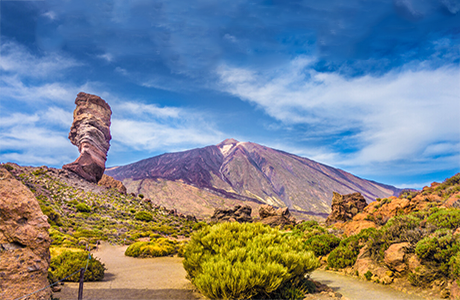
broom and the summit codeso. It is in this zone that the ‘supracanario’
vegetation zone, also known as the high-mountain zone, is found. This zone
is only present on the islands of Tenerife and La Palma, as they are the
only ones whose peaks exceed this altitude. Las Cañadas del Teide, in
Tenerife, and La Caldera de Taburiente, in La Palma, the two places where
this vegetation zone is at its most striking, particularly in Las Cañadas
del Teide, owing to its greater altitude and environmental diversity.
The influence of storms does not usually reach these high altitudes, so
annual rainfall is low, at around 350–450 mm per year; it occurs almost
entirely during the autumn and winter months, and much of it falls as snow,
which can remain on the ground for several months, covering part of the
vegetation.

As the intense daytime
sunshine causes evaporation in excess of 2,000 mm per year, the air is very
dry, with relative humidity levels ranging between 30–50 per cent. Average
annual temperatures are around 11 °C, and sub-zero temperatures are common
during the coldest months. Frosts are frequent during the winter, and the
diurnal temperature variation is considerable, with a difference of up to
15°C between day and night.
The air, which comes from
the north-west, is dry and largely cloudless, meaning that solar radiation
is very strong and particularly rich in ultraviolet rays. Winds blow almost
constantly and are often very strong, with gusts exceeding 80 km per hour.
These harsh climatic conditions, combined with the geographical isolation of
these areas, have contributed to the establishment in this mountainous
region of a very distinctive flora, largely derived from the vegetation
dominant at lower altitudes, but which has had to evolve by adopting various
mechanisms that have enabled it to survive in these harsh climatic
conditions, such as the predominance of shrub-like growth, the expansion of
the root system, cushion-like growth, and foliar adaptations designed to
minimise water loss through transpiration.

The air, which comes from
the north-west, is dry and largely cloudless, meaning that solar radiation
is very intense and particularly rich in ultraviolet rays. Winds blow almost
constantly and are often very strong, with gusts exceeding 80 km per hour.
These harsh climatic conditions, combined with the geographical isolation of
these areas, have contributed to the establishment in this mountainous
region of a very distinctive flora, largely derived from the vegetation
dominant at lower altitudes, but which has had to evolve by adopting various
mechanisms that have enabled it to survive in these harsh climatic
conditions, such as the predominance of shrub-like growth, the expansion of
the root system, cushion-like growth, or foliar adaptations designed to
minimise water loss through transpiration.
The
tree species found here are limited almost exclusively to the Canary Island
cedar (Juniperus cedrus), of which only a very small number of specimens
remain, situated in extremely rugged and almost inaccessible locations due
to the excessive felling this species suffered over the centuries to exploit
its highly prized timber.
The dominant shrub
communities – broom and codeso thickets – are characterised by an abundance
of legumes, such as the Teide broom (Spartocytisus supranubius), on the
peaks of Tenerife, or the summit codeso (Adenocarpus viscosus) on those of
La Palma, where broom is found only on the steep slopes of the Caldera de
Taburiente.

Echium wildpretii
Both the broom
thickets and the codesar scrub are accompanied by a wide variety of species
endemic to this area, which are notable for the profusion of flowers they
produce to increase the likelihood that some of their seeds will have the
chance to germinate in such extreme conditions. These include catmint
(Nepeta teydea), Teide wallflower (Erysimum scoparium), Descurainia
bourgeauana, summit scrophularia (Scrophularia glabrata), rabbit’s-ear
(Pterocephalus lasiospermus), the Teide daisy (Argyranthemum tenerifae), the
Teide ‘cabezón’ (Cheirolophus teydis), the ‘malpaís’ flower (Tolpis webii),
and the iconic red tajinaste (Echium wildpretii), which adorns the
landscapes of Mount Teide in a unique way with its impressive
inflorescences, up to two metres high, formed by thousands of small, deep
red flowers.

Viola palmensis
The peaks of La Palma are home to valuable populations of the beautiful mountain pansy (Viola palmensis), the blue tajinaste (Echium gentianoides) and the pink tajinaste (Echium wildpretii ssp. trichosiphon), as well as the threatened mountain broom (Genista benehaovensis). Other species, such as the silver thistle (Stemmacantha cynaroides) and the Las Cañadas rock rose (Helianthemum juliae), are two species found exclusively in the high mountains of Tenerife and are currently threatened with extinction.


Canariavision
Visual Guide to the Canary Islands
Visualcuba
 Visual Guide to Cuba
Camaravision
 Digital Art Photography