

Orocanarian zone
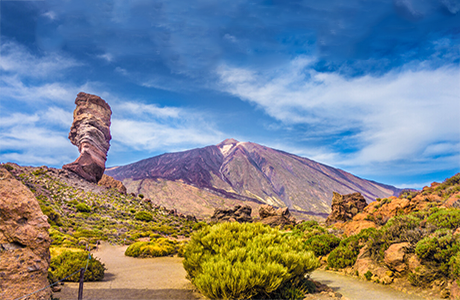
The Orocanario zone is
found only on the island of Tenerife, at altitudes above 3,100 metres and up
to the summit of Mount Teide, which rises to 3,718 metres above sea level,
making it the highest point in the Canary Islands and in Spain.
In this area, the soil is very poor and rocky, and the climate is relatively
cold, with predominantly dry south-westerly winds and annual rainfall of
less than 400 mm, generally in the form of snow. This results in very dry
summers and long, harsh winters, with average temperatures of around 10°C in
summer, and around 6°C below zero in winter, although temperatures as low as
20°C below zero can be recorded during this period.

Viola cheiranthifolia
These extreme soil and climatic conditions mean that, from an altitude of approximately 3,000 metres onwards, the shrubs typical of the vegetation in the lower zone begin to disappear, including species that are highly resistant to extreme weather such as the broom (Spartocytisus supranubius).
From this point onwards, only a few small herbaceous species can thrive on the rocks and scree of the volcanic cone, such as the small and pretty Teide violet (Viola cheiranthifolia), which also thrives amongst certain rocks in lower areas of Mount Teide, the silver thistle (Stemmacantha cynaroides), the Teide campion (Silene nocteolens), or the Teide laphangium (Laphangium teydeum).

Stemmacantha cynaroides


Canariavision
Visual Guide to the Canary Islands
Visualcuba
 Visual Guide to Cuba
Camaravision
 Digital Art Photography