
Zone infracanarian
The infracanarian zone, also
known as the basal zone or arid mesocanarian zone, is found in all coastal
areas of the Canary Islands, but is most prevalent in Lanzarote and
Fuerteventura, as these are the flattest and driest islands. It is situated
at altitudes of approximately 0–300 metres on the north-facing slopes of the
more mountainous islands, and 0–500 metres in dry southern areas, with these
limits depending on the degree of exposure to the trade winds.
Precipitation is scarce at this altitude, except on the windward slopes of
some islands, such as Tenerife, La Gomera and La Palma. The average is
around 100–300 mm per year, with a distribution throughout the year very
similar to that of the Mediterranean climate; in very dry areas and during
particularly unfavourable periods, there may be no rainfall at all for
several years, as is the case in some parts of Lanzarote or Fuerteventura.
The average annual temperature is quite high, at around 19–22°C, with mild
winters where the coldest month ranges between 11 and 16°C.

These climatic factors, together with the characteristics of the soil and the terrain, determine the type of vegetation in this area, which is characterised by a general absence of tree species and a predominance of herbaceous plants and medium-sized shrubs, which are particularly well-adapted to withstand this harsh climate thanks to the development of various mechanisms for adapting to the environment, such as succulence, reduced foliage, extensive root systems, and spiny stems and leaves, amongst others. On the eastern islands, Lanzarote and Fuerteventura, where the climate is even drier than elsewhere, the vegetation is dominated by herbaceous species that are highly resistant to water scarcity, particularly those of the genera Suaeda and Salsola, such as Salsola divaricata and Suaeda vera, and thorny shrubs such as gorse (Launaea arborescens).
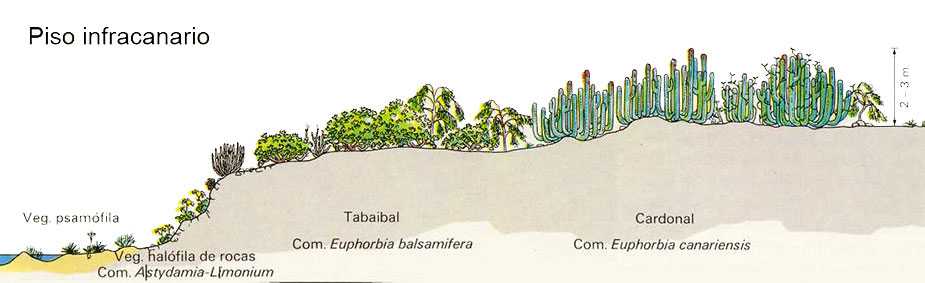
The typical vegetation of
the sub-Canarian zone consists of cardonales and tabaibales, characterised
by the predominant presence of species from the Euphorbiaceae family:
cardones and tabaibas, which together form one of the most characteristic
plant communities of the Canary Islands, known as the cardonal-tabaibal.
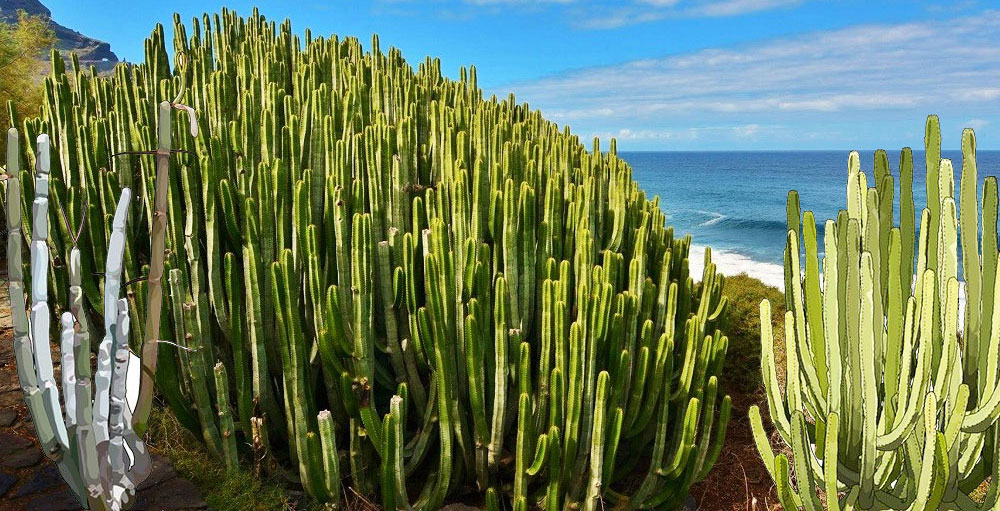
Cardonals thrive best on rocky slopes and in ravines, and within these, the
dominant species—and the one that gives the habitat its name—is the cardón
(Euphorbia canariensis), a species with a distinctive appearance that is
emblematic of the Canarian flora. It stands out from the rest of the
vegetation due to its cactus-like appearance and its large, fleshy,
quadrangular stems of an intense green colour; in well-developed specimens,
these can reach heights of over 2 m and cover areas of several square
metres. Cardonales can be regarded as the optimal form of vegetation in the
driest coastal areas with the poorest soils on the islands, where specimens
often grow on young volcanic soil, having to make use of the cracks in the
lava to establish their roots.

Tabaibales are found in a wider variety of locations along the coastline and are characterised by the predominant presence of several species of tabaiba, particularly the sweet tabaiba, (Euphorbia balsamifera ssp. balsamifera), a plant of great biogeographical interest in relation to the origin of the coastal flora of the Canary Islands, as it has very close relatives on the African coasts opposite our islands (Morocco, the Sahara, Mauritania…), as well as in isolated locations in East Africa. The shape and size of the sweet tabaiba vary greatly, particularly depending on the type of soil and the intensity of the prevailing winds where its populations grow; it can appear as specimens almost lying flat on the ground, barely one or two palmos tall, or form large, highly branched shrubs reaching over 2 m in height and taking on more or less globular shapes.
The tabaibales and
cardonales are accompanied by a rather distinctive flora comprising a large
number of herbaceous plants and small shrubs, including numerous species
endemic to the Canary Islands, mainly from the genera Ceropegia, Aeonium,
Echium, Sempervivum, Tolpis, Chrysanthemum, etc. Some of these are quite
rare, such as the cardoncillos (Ceropegia fusca, Ceropegia dichotoma…),
which stand out against the volcanic soil with their whitish colour, the
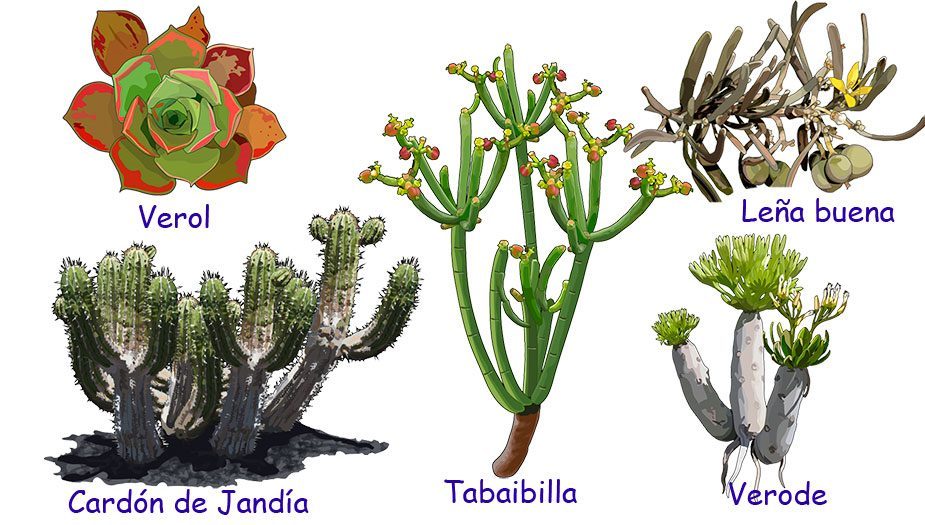
rare cuernúas (Caralluma burchardii), the small tabaibilla (Euphorbia
aphylla), or the very spiny Jandía cardón (Euphorbia handiensis).
Species from the group
known as ‘bejeques’ or ‘verodes’ (Aeonium hierrense, Aeonium lancerottense,
Aeonium gomerense, Aeonium percarneum, Aeonium ciliatum, Aeonium haworthii,
Aeonium davidbramwellii…) are very common, as is the verode (Kleinia
neriifolia), the ‘leña buena’ (Neochamaelea pulverulenta), and various types
of viper’s bugloss (Echium decaisnei, Echium brevirame, Echium aculealum and
Echium leucophaeum) and daisies (Argyranthemum frutescens, Argyranthemum
gracile, Argyranthemum haouarytheum…). There are also some plants which, due
to their ease of dispersal, germination and low water requirements, become
dominant when the natural vegetation is destroyed, such as the balo (Plocama
pendula), which, together with the bitter tabaiba (Euphorbia lamarckii), can
be abundant both on the unstable, porous substrates of ravines and on the
edges of cultivated land in arid areas; and others that specialise in
colonising new land, such as the moonwort (Rumex lunaria).
In the areas closest to the sea, halophilic species can be found, such as
sea lettuce (Astydamia latifolia), sea grape (Tetraena fontanesii) and sea
everlasting (Limonium pectinatum), which are particularly common in salt
marshes. And in the sandy areas of the eastern islands, we find species
adapted to this very poor soil, such as the balancón (Traganum moquinii),
the lechetrezna (Euphorbia paralias), the centidonia (Polygonum maritimum),
the camellera (Heliotropium ramosissimum), the salado (Schizogyne sericea),
etc.
The cardonal-tabaibal also harbours an
interesting associated invertebrate fauna, including numerous endemic
species, such as the cardón beetle (Lepromoris gibba), whose larvae develop
exclusively inside the dead stems of the cardón cacti.
Furthermore, the large cardón cacti, which can cover areas of several square
metres, provide shelter for a significant group of plant species, protecting
them from predation by goats.
In heavily degraded areas
of cardonales and tabaibales, it is quite common to find certain species
that were introduced for agricultural purposes and have subsequently become
naturalised, such as prickly pears (Opuntia maxima, Opuntia dillenii,
Opuntia tomentosa) or piteras (Agave americana), and others that have
reached the Canary Islands through non-natural means and are now spreading
rapidly as invasive species that destroy natural vegetation, such as cat’s
tail (Pennisetum setaceum).
This vegetation layer has
suffered a significant degree of destruction at the hands of humans, both
through the development of farmland for crops such as bananas and tomatoes,
and through the construction of large residential areas intended primarily
for tourism.
Even so, all the islands still have
tabaibales in an acceptable state of conservation; indeed, even on the
island of Lobos and on La Graciosa there are interesting examples of
tabaibas. As for the cardonales, their current distribution is limited to
the central and western islands, where very well-preserved examples of this
type of vegetation can be found, such as in the Malpaís de Güímar in
Tenerife, and some remnants remain in Fuerteventura, such as on Montaña
Jandía or Montaña Cardones, but they are absent from Lanzarote and the
islets of Lobos and La Graciosa, where it is thought they may have existed
in ancient times.

Frutos del cardón
This vegetation layer has
suffered a significant degree of destruction at the hands of humans, both
through the development of farmland for crops such as bananas and tomatoes,
and through the construction of large residential areas intended primarily
for tourism.
Even so, all the islands still have
tabaibales in an acceptable state of conservation; indeed, on the islands of
Lobos and La Graciosa there are some interesting examples of tabaibas. As
for the cardonales, their current distribution is limited to the central and
western islands, where very well-preserved examples of this type of
vegetation can be found, such as in the Malpaís de Güímar on Tenerife, and
some remnants remain on Fuerteventura, such as on Montaña Jandía or Montaña
Cardones, but they are absent from Lanzarote and the islets of Lobos and La
Graciosa, where it is thought they may have existed in ancient times.


Canariavision
Visual Guide to the Canary Islands
Visualcuba
 Visual Guide to Cuba
Camaravision
 Digital Art Photography