

Cardonal-tabaibal
The cardonal-tabaibal is a mixed vegetation
formation typical of the low-lying and coastal areas of the Canary Islands,
characterised primarily by the presence of cardones and tabaibas, succulent
plants of the Euphorbiaceae family.
It is found on the slopes and lower plains of the islands, mainly in the warmest and driest areas, occurring clearly defined between 0 and 300–400 metres above sea level on north-facing slopes, and between 0 and 600–700 metres above sea level on the southern and south-western slopes, with these limits depending on the extent to which the terrain is exposed to the trade winds.

The prevailing climate in this area is warm and dry, with an average temperature of around 20°C and annual rainfall of between 100 and 350 mm, concentrated mainly in autumn and winter. There is a very high level of sunshine and the humidity is usually moderate. The soils found in the cardonal-tabaibal habitat are varied: more or less developed soils, stony ground, lava fields (malpaíses), etc. In areas very close to the sea, sand may be the predominant feature, forming what are known as ‘jables’; in these areas, the vegetation consists of sand-dwelling species, i.e. those adapted to living in loose sand.
This plant community is characterised by its adaptations to arid conditions; since annual rainfall is far lower than evaporation, the species living in this environment are subjected to constant water stress, which is why they have developed a wide range of adaptive mechanisms to make the most of the scarce water available, such as:
Succulence. During the rainy season, the roots absorb as much water as they can and store it in large parenchyma cells located in the stems, which thicken considerably, becoming veritable reservoirs of liquid and giving the plant that succulent appearance typical of plants living in xeric environments. This mechanism is utilised by species such as cardons, verodes, tabaibas and cardoncillos.
Leaf reduction. Many species reduce the size of their leaves to minimise water loss through transpiration. For example, the ‘leña buena’ has linear leaves, those of the ‘balo’ are thread-like, and the cardón and tabaibilla have almost no leaves at all. Other species shed almost all their foliage during the driest months to prevent water loss.
Waxy coating. Some species are covered in a thin layer of whitish wax that protects them from intense solar radiation, as is the case with cardoncillos.
Extension of the root system. The roots are very long, shallow and spread out in all directions, thereby covering a large area of the ground to make the most of all available moisture. This adaptation makes these plants excellent at stabilising the soil, preventing erosion.
Open-formation growth. The plants grow quite far apart from one another, leaving more or less extensive areas of soil exposed. Plant density is lower in drier areas and increases in places where moisture supply – whether from direct rainfall or the humid influence of the trade winds – is greater.
In the driest coastal areas, tabaiba thickets are found, characterised by the presence of the sweet tabaiba (Euphorbia balsamifera ssp. balsamifera). This species is of great biogeographical interest in relation to the origin of the coastal flora of the Canary Islands, as it has more or less close relatives on the African coast (Morocco, the Sahara, Mauritania, etc.), as well as in isolated locations in East Africa.

Quite frequently, tabaibales can be found intermingled with cardonales, which are characterised primarily by the dominance of the cardón (Euphorbia canariensis). Cardonales are communities with a high degree of diversity in terms of flora; they also harbour an associated fauna that is equally varied and of great interest, with numerous endemic species. However, cardon plants can grow individually and reach considerable dimensions in terms of height and area, in the past covering more than 100 square metres.
Much of the original cardonal-tabaibal habitat has suffered severe anthropogenic degradation, having been destroyed by the construction of tourist complexes or agro-industrial facilities (banana plantations, greenhouses, etc.). Even so, cardonales and tabaibales in a good state of conservation can still be found across all the islands, including the islets of Lobos and Graciosa.
In the past, the cardonal-tabaibal landscape was mainly used for grazing. The ‘tabaiba majorera’ (Euphorbia atropurpurea) gets its name from the belief – still held by the island’s goat herders – that this plant improved the quality of the milk and meat and was beneficial to the animals’ health. The cardon cacti and tabaiba plants were used as fuel and to extract their latex for therapeutic purposes.
Flora
The predominant species in the cardonal-tabaibal habitat are the cardón (Euphorbia canariensis) and several species of tabaiba: sweet tabaiba (Euphorbia balsamifera ssp. balsamifera), bitter tabaiba (Euphorbia lamarckii), tabaibilla (Euphorbia aphylla), Jandía cardón (Euphorbia handiensis) and red tabaiba (Euphorbia atropurpurea). Cardón cacti are important in this type of vegetation, as they provide shelter from livestock for a range of species that often grow entangled in their stems, such as cornicales (Periploca laevigata), asaigos (Rubia fruticosa) and asparagus (Asparagus spp.), etc.
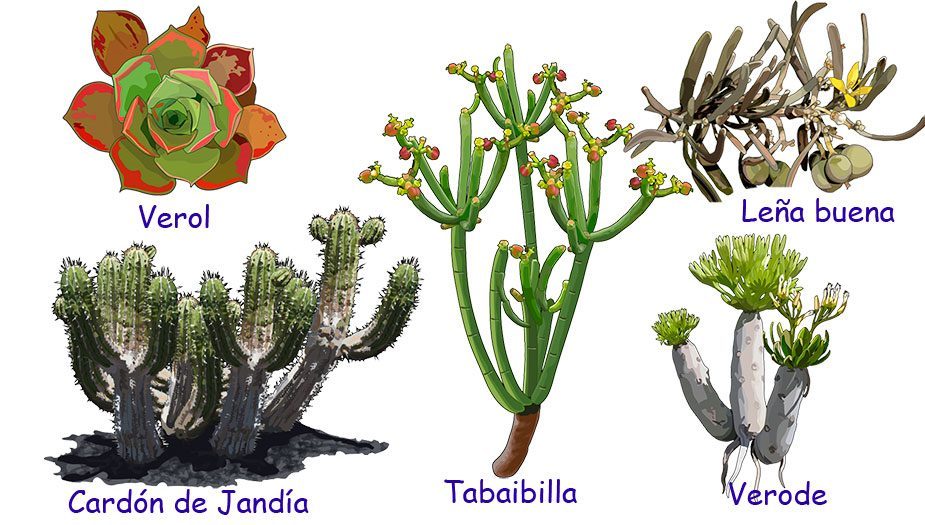
Alongside these grows a diverse array of endemic species, including the verode (Kleinia neriifolia), the leña buena (Neochamaelea pulverulenta), the cardoncillos (Ceropegia fusca and Ceropegia dichotoma), the balo (Ploclama pendula), the gorse (Launaea arborescens), the moon-leaved sorrel (Rumex lunaria), the coastal echium (Echium brevirame), the sea rosemary (Campylanthus salsoloides), the magarzas (Argyranthemum frutescens), the Canary Islands lavender (Lavandula canariensis), silky schizogyne (Schizogyne sericea), sea thyme (Frankenia ericifolia), heart-leaved lotus (Lottus sessilifolius) or, in deeper soils, broom (Retama rhodorhizoides).

Also prominent in this habitat are numerous species of the genus Aeonium, commonly known as ‘verodes’, ‘veroles’ or ‘bejeques’, such as Aeonium davidbramwelli, Aeonium ciliatum, Aeonium nobile, Aeonium urbicum, Aeonium arboreum, etc. In some places, large areas are occupied by ‘barrillas’ (Mesembryanthemum crystallinum and Mesembryanthemum nodiflorum).
Also notable in this area is the abundant presence of numerous introduced species that behave as invasive plants, exhibiting varying degrees of aggressiveness towards the native flora, such as prickly pears (Opuntia maxima, Opuntia dillenii), the American agave (Agave americana), aloe (Aloe vera, Aloe arborescens), cat’s tail (Pennisetum setaceum), etc.

The species found in the cardonal-tabaibal form a wide variety of combinations, giving rise to many different plant communities that depend on soil type, salinity levels and the aspect of the land.
Although the cardonal-tabaibal is not a particularly suitable habitat for fungal flora, it is possible to spot some fungi from time to time, especially after rainfall. These include Montanea arenaria, Inonotus tamaricis, Battarea stevenii, Tulustoma brumale, Lycoperdon perlatum, Astraeus hygrometricus, Vascellum pratense, etc.
The lichen flora is well represented, with numerous communities colonising lava and volcanic rocks, including species such as Caloplaca gloria, Xanthoria resendei, Ramalina bourgeana, Rhizocarpon viridiatrum, Roccelletum canariensis, Lecanora sulphurella, etc.
Fauna
The fauna of the Cardonal Tabaibal is poor in vertebrates, with only a few birds and reptiles standing out, although these are not exclusive to this ecosystem. However, insects are very well represented, with endemic species associated with cardon cacti and tabaiba plants being common.
The most abundant reptiles are lizards: the tizón lizard (Gallotia galloti) in the Western Islands, the Canarian lizard (Gallotia stehlini) in Gran Canaria, and the Haría lizard (Gallotia atlantica) in Lanzarote and Fuerteventura. Less common are the tarantulas (Tarentola spp.) and the skinks (Chalcides spp.).

Among the birds, three distinctive species are worth mentioning: the houbara bustard, the sandgrouse and the Canary Island wheatear. The houbara bustard (Chlamydotis undulata) inhabits the vast, arid plains of Fuerteventura and Lanzarote. It is naturally found across parts of North Africa and South Asia, and the Canarian population constitutes a subspecies endemic to these islands. The sandgrouse (Cursorius cursor) has a similar distribution and habitat to the hubara. Like the hubara, its colouring blends in perfectly with its surroundings and, if it feels threatened, it crouches down and goes unnoticed; its feet have just three toes, enabling it to run at great speed. Both the sandgrouse and the hubara nest on the ground. The Canary Island stonechat (Saxicola dacotiae) is endemic to the Canary Islands and is found only on the island of Fuerteventura, where it nests amongst the rocks or at the base of bushes.

Other birds found in this habitat include the Barbary partridge (Alectoris barbara), the stone curlew (Burhinus oedicnemus), the sandgrouse (Pterocles orientalis), the turtle dove (Streptopelia turtur), the trumpeter finch or Moorish bird (Rhodopechys githaginea), the marsh lark or calandra lark (Calandrella rufescens), and the Berthelot’s pipit (Anthus berthelotii), found only in the Canary Islands and Madeira.
The great grey shrike (Lanius excubitor) is a skilled hunter of small reptiles, rodents and small birds; as it lacks strong talons, it pins its prey to thorny bushes and tears them apart with its beak. The very abundant common kestrel (Falco tinnunculus), and the very rare Egyptian vulture (Neophron percnopterus) and Barbary falcon (Falco peregrinoides) are among the birds of prey that soar over these landscapes.

The most notable insects are those directly associated with cardon cacti and tabaiba cacti: for example, the larvae of the longhorn beetles (Lepromoris gibba, Stenidea albida) develop in the dead parts of these species, and the caterpillars of the sphinx moth (Hyles euphorbiae), which feed exclusively on the leaves and stems of tabaibas.
It is found on the slopes and lower plains of the islands, mainly in the warmest and driest areas, occurring clearly defined between 0 and 300–400 metres above sea level on north-facing slopes, and between 0 and 600–700 metres above sea level on the southern and south-western slopes, with these limits depending on the extent to which the terrain is exposed to the trade winds.
The prevailing climate in this area is warm and dry, with an average temperature of around 20°C and annual rainfall of between 100 and 350 mm, concentrated mainly in autumn and winter. There is a very high level of sunshine and the humidity is usually moderate. The soils found in the cardonal-tabaibal habitat are varied: more or less developed soils, stony ground, lava fields (malpaíses), etc. In areas very close to the sea, sand may be the predominant feature, forming what are known as ‘jables’; in these areas, the vegetation consists of sand-dwelling species, i.e. those adapted to living in loose sand.
This plant community is characterised by its adaptations to arid conditions; since annual rainfall is far lower than evaporation, the species living in this environment are subjected to constant water stress, which is why they have developed a wide range of adaptive mechanisms to make the most of the scarce water available, such as:
Succulence. During the rainy season, the roots absorb as much water as they can and store it in large parenchyma cells located in the stems, which thicken considerably, becoming veritable reservoirs of liquid and giving the plant that succulent appearance typical of plants living in xeric environments. This mechanism is utilised by species such as cardons, verodes, tabaibas and cardoncillos.
Leaf reduction. Many species reduce the size of their leaves to minimise water loss through transpiration. For example, the ‘leña buena’ has linear leaves, those of the ‘balo’ are thread-like, and the cardón and tabaibilla have almost no leaves at all. Other species shed almost all their foliage during the driest months to prevent water loss.
Waxy coating. Some species are covered in a thin layer of whitish wax that protects them from intense solar radiation, as is the case with cardoncillos.
Extension of the root system. The roots are very long, shallow and spread out in all directions, thereby covering a large area of the ground to make the most of all available moisture. This adaptation makes these plants excellent at stabilising the soil, preventing erosion.
Open-formation growth. The plants grow quite far apart from one another, leaving more or less extensive areas of soil exposed. Plant density is lower in drier areas and increases in places where moisture supply – whether from direct rainfall or the humid influence of the trade winds – is greater.
In the driest coastal areas, tabaiba thickets are found, characterised by the presence of the sweet tabaiba (Euphorbia balsamifera ssp. balsamifera). This species is of great biogeographical interest in relation to the origin of the coastal flora of the Canary Islands, as it has more or less close relatives on the African coast (Morocco, the Sahara, Mauritania, etc.), as well as in isolated locations in East Africa.
Quite frequently, tabaibales can be found intermingled with cardonales, which are characterised primarily by the dominance of the cardón (Euphorbia canariensis). Cardonales are communities with a high degree of diversity in terms of flora; they also harbour an associated fauna that is equally varied and of great interest, with numerous endemic species. However, cardon plants can grow individually and reach considerable dimensions in terms of height and area, in the past covering more than 100 square metres.
Much of the original cardonal-tabaibal habitat has suffered severe anthropogenic degradation, having been destroyed by the construction of tourist complexes or agro-industrial facilities (banana plantations, greenhouses, etc.). Even so, cardonales and tabaibales in a good state of conservation can still be found across all the islands, including the islets of Lobos and Graciosa.
In the past, the cardonal-tabaibal landscape was mainly used for grazing. The ‘tabaiba majorera’ (Euphorbia atropurpurea) gets its name from the belief – still held by the island’s goat herders – that this plant improved the quality of the milk and meat and was beneficial to the animals’ health. The cardon cacti and tabaiba plants were used as fuel and to extract their latex for therapeutic purposes.
Flora
The predominant species in the cardonal-tabaibal habitat are the cardón (Euphorbia canariensis) and several species of tabaiba: sweet tabaiba (Euphorbia balsamifera ssp. balsamifera), bitter tabaiba (Euphorbia lamarckii), tabaibilla (Euphorbia aphylla), Jandía cardón (Euphorbia handiensis) and red tabaiba (Euphorbia atropurpurea). Cardón cacti are important in this type of vegetation, as they provide shelter from livestock for a range of species that often grow entangled in their stems, such as cornicales (Periploca laevigata), asaigos (Rubia fruticosa) and asparagus (Asparagus spp.), etc.
Alongside these grows a diverse array of endemic species, including the verode (Kleinia neriifolia), the leña buena (Neochamaelea pulverulenta), the cardoncillos (Ceropegia fusca and Ceropegia dichotoma), the balo (Ploclama pendula), the gorse (Launaea arborescens), the moon-leaved sorrel (Rumex lunaria), the coastal echium (Echium brevirame), the sea rosemary (Campylanthus salsoloides), the magarzas (Argyranthemum frutescens), the Canary Islands lavender (Lavandula canariensis), silky schizogyne (Schizogyne sericea), sea thyme (Frankenia ericifolia), heart-leaved lotus (Lottus sessilifolius) or, in deeper soils, broom (Retama rhodorhizoides).
Also prominent in this habitat are numerous species of the genus Aeonium, commonly known as ‘verodes’, ‘veroles’ or ‘bejeques’, such as Aeonium davidbramwelli, Aeonium ciliatum, Aeonium nobile, Aeonium urbicum, Aeonium arboreum, etc. In some places, large areas are occupied by ‘barrillas’ (Mesembryanthemum crystallinum and Mesembryanthemum nodiflorum).
Also notable in this area is the abundant presence of numerous introduced species that behave as invasive plants, exhibiting varying degrees of aggressiveness towards the native flora, such as prickly pears (Opuntia maxima, Opuntia dillenii), the American agave (Agave americana), aloe (Aloe vera, Aloe arborescens), cat’s tail (Pennisetum setaceum), etc.
The species found in the cardonal-tabaibal form a wide variety of combinations, giving rise to many different plant communities that depend on soil type, salinity levels and the aspect of the land.
Although the cardonal-tabaibal is not a particularly suitable habitat for fungal flora, it is possible to spot some fungi from time to time, especially after rainfall. These include Montanea arenaria, Inonotus tamaricis, Battarea stevenii, Tulustoma brumale, Lycoperdon perlatum, Astraeus hygrometricus, Vascellum pratense, etc.
The lichen flora is well represented, with numerous communities colonising lava and volcanic rocks, including species such as Caloplaca gloria, Xanthoria resendei, Ramalina bourgeana, Rhizocarpon viridiatrum, Roccelletum canariensis, Lecanora sulphurella, etc.
Fauna
The fauna of the Cardonal Tabaibal is poor in vertebrates, with only a few birds and reptiles standing out, although these are not exclusive to this ecosystem. However, insects are very well represented, with endemic species associated with cardon cacti and tabaiba plants being common.
The most abundant reptiles are lizards: the tizón lizard (Gallotia galloti) in the Western Islands, the Canarian lizard (Gallotia stehlini) in Gran Canaria, and the Haría lizard (Gallotia atlantica) in Lanzarote and Fuerteventura. Less common are the tarantulas (Tarentola spp.) and the skinks (Chalcides spp.).
Among the birds, three distinctive species are worth mentioning: the houbara bustard, the sandgrouse and the Canary Island wheatear. The houbara bustard (Chlamydotis undulata) inhabits the vast, arid plains of Fuerteventura and Lanzarote. It is naturally found across parts of North Africa and South Asia, and the Canarian population constitutes a subspecies endemic to these islands. The sandgrouse (Cursorius cursor) has a similar distribution and habitat to the hubara. Like the hubara, its colouring blends in perfectly with its surroundings and, if it feels threatened, it crouches down and goes unnoticed; its feet have just three toes, enabling it to run at great speed. Both the sandgrouse and the hubara nest on the ground. The Canary Island stonechat (Saxicola dacotiae) is endemic to the Canary Islands and is found only on the island of Fuerteventura, where it nests amongst the rocks or at the base of bushes.
Other birds found in this habitat include the Barbary partridge (Alectoris barbara), the stone curlew (Burhinus oedicnemus), the sandgrouse (Pterocles orientalis), the turtle dove (Streptopelia turtur), the trumpeter finch or Moorish bird (Rhodopechys githaginea), the marsh lark or calandra lark (Calandrella rufescens), and the Berthelot’s pipit (Anthus berthelotii), found only in the Canary Islands and Madeira.
The great grey shrike (Lanius excubitor) is a skilled hunter of small reptiles, rodents and small birds; as it lacks strong talons, it pins its prey to thorny bushes and tears them apart with its beak. The very abundant common kestrel (Falco tinnunculus), and the very rare Egyptian vulture (Neophron percnopterus) and Barbary falcon (Falco peregrinoides) are among the birds of prey that soar over these landscapes.
The most notable insects are those directly associated with cardon cacti and tabaiba cacti: for example, the larvae of the longhorn beetles (Lepromoris gibba, Stenidea albida) develop in the dead parts of these species, and the caterpillars of the sphinx moth (Hyles euphorbiae), which feed exclusively on the leaves and stems of tabaibas.


Canariavision
Visual Guide to the Canary Islands
Visualcuba
 Visual Guide to Cuba
Camaravision
 Digital Art Photography