

Retamar-codesar
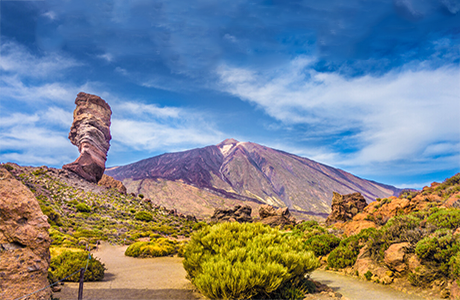
From an altitude of 2,000 metres onwards, weather conditions become
considerably harsher, and the pine forest gives way to a shrubby scrubland
adapted to these heights: the ‘retamar-codesar’, a type of vegetation in
which the dominant species are broom and mountain codeso.
The influence of storms does not usually reach these high altitudes, so annual rainfall is low (between 350 and 450 mm) and occurs almost entirely during the autumn and winter months. As the intense sunshine causes evaporation exceeding 2,000 mm per year, the air is very dry, with relative humidity levels varying between 30–50 per cent. Temperature fluctuations are another important factor, with frequent temperatures below 0°C. During the winter, snow and frequent frosts also shape life in this habitat.
Only the islands of Tenerife and La Palma exceed 2,000 metres in altitude; consequently, Las Cañadas del Teide, on Tenerife, and La Caldera de Taburiente, on La Palma, are the two areas where this high-altitude ecosystem is at its most striking, particularly in Las Cañadas del Teide, due to its greater altitude and environmental diversity.
In these mountainous landscapes, there is an open, shrubby plant community dominated by two legumes: broom (Spartocytisus supranubius) and summit codeso (Adenocarpus viscosus). The predominance of these species has given rise to the name by which this scrubland is known: the retamar-codesar. Accompanying this vegetation type are a range of shrubby and herbaceous plants, saxicolous lichens (which grow on rocks) and mosses, which are distributed across the terrain according to their different ecological requirements.

The species found in the retamar-codesar share the common feature that they have all had to adapt to the harsh environmental conditions prevailing at these altitudes. To this end, they have developed a series of mechanisms – some general in nature and others specific to each species – which enable them to survive in this environment. For example:
Predominance of a bushy growth. Plant size tends to decrease, as a shrub-like growth habit offers clear advantages over a tree-like one in the face of water and nutrient shortages. The climatic conditions that occur throughout the year (cold, frost, and environmental and soil dryness) prevent trees from developing properly, and there is not enough time for growth and the accumulation of reserves. Pine needles, for example, do not mature and their cuticle does not reach the necessary thickness and hardness. When sunlight increases, the needles lose excessive amounts of water through transpiration and dry out; nor can they withstand winter frosts. This is why pine forests have an altitudinal limit beyond which small shrubs, which are much less demanding, dominate the landscape. As their water and nutrient requirements are lower, they are able to complete their annual cycle of growth and reproduction, whilst also accumulating sufficient reserves for the period of vegetative dormancy.
Expansion of the root system. The roots are highly developed and contrast with the small size of the above-ground part. This characteristic, together with the open arrangement of the scrub, is consistent with the prevailing water scarcity, and makes the structure of this vegetation formation similar to that of the cardonal-tabaibal, where water availability is also very low.
Padded handle. Many species develop a very low, dense, cushion-like or stocky growth habit. This enables them to withstand the wind and intense sunlight, and prevents rapid evaporation of water from the soil, creating a more humid microclimate within the plant. Winter snow also provides protection by covering them and acting as a thermal insulator, maintaining a temperature higher than that outside.
Foliar adaptations. In many species, adaptations have evolved to minimise water loss through transpiration (small leaves, a reduced number of stomata, and hairiness on aerial parts).

Flora
Broom (Spartocytisus supranubius) and codeso (Adenocarpus viscosus) clearly predominate in this ecosystem. The broom, which can grow up to 2,700 m, is more abundant than the codeso, particularly as one ascends in altitude. These two species, like all legumes, contribute nitrogen to the soil thanks to a symbiotic relationship with a bacterium (Rhizobium) found in their root nodules, which is capable of fixing atmospheric nitrogen.
The broom-and-codeso scrub is enriched by a flora that is richer and more varied in Tenerife than in La Palma. There are widely distributed species, such as the straw grass (Descurainia bourgeauana), the Teide wallflower (Erysimum scoparium), the summit herb (Scrophularia glabrata), the rabbit’s-ear herb (Pterocephalus lasiospermus), the Teide daisy (Argyranthemum tenerifae) and the Teide headwort (Cheirolophus teydis), all of which are small shrubs.

Perennial herbs such as catmint (Nepeta teydea) and the ‘malpaís’ flower (Tolpis webii) are also widespread. The red tajinaste (Echium wildpretii), a symbol of the Canarian mountain flora, is common in the Cañadas del Teide but rare in the Caldera de Taburiente, where a few specimens of the trichosiphon subspecies survive; even rarer is the prickly viper’s bugloss (Echium auberianum), whose meagre populations are found exclusively in the pumice fields of Las Cañadas del Teide.
Within this National Park, the walls of the caldera form the oldest and most altered terrain in the area, boasting a rich variety of flora. Notable examples include the scarce Canary Island cedar (Juniperus cedrus) and the very rare Las Cañadas bencomia (Bencomia exstipulata), both species also found on La Palma, as well as the malpica (Carlina xeranthemoides) and the Las Cañadas rockrose (Cistus osbeckiifolius). Among the cracks and hollows of the escarpments grow rock-dwelling plants such as the rock aeonium (Aeonium smithii), the short-stemmed monanthes (Monanthes brachycaulos), the white parsley (Pimpinella cumbrae), the woolly thyme (Micromeria lasiophylla) and the turgayte (Senecio palmensis), the latter three also found on the peaks of La Palma.
But only one small plant is capable of reaching the very summit of Mount Teide: the Teide violet (Viola cheiranthefolia), which holds the altitude record for Spanish flowering plants, growing at altitudes between 2,400 and 3,600 metres. At the highest elevations, it grows alongside the rare Teide edelweiss (Laphangium teydeum), a small, pale-coloured plant with yellow flowers that thrives on the hot ground affected by the water vapour emanating from the fumaroles. The cliffs of the Caldera de Taburiente are also home to another endemic violet, the summit pansy (Viola palmensis).

The peaks of La Palma are home to valuable populations of the threatened mountain broom (Genista benehaovensis). The silver thistle (Stemmacantha cynaroides) and the Las Cañadas rock rose (Helianthemum juliae) are two endangered species found in the high mountains of Tenerife.
The lichen flora features a number of species typical of these areas, similar to those found in other mountainous regions around the world, such as Xanhtoria elegans, Lassalia pustulata, Lecida atrobrunnea, Acarospora oxytorra, Parmelia delisei, etc.
Fauna
The fauna typical of the high peaks is very scarce, and only a few invertebrates are considered to be specific to these regions. The longhorn beetle (Hesperophanes roridus) and the butterfly (Cyclirius webbianus) are associated with the broom-codesar scrub. The arachnid (Bunochelis spinifera) lives near the fumaroles of Mount Teide.

Among vertebrates, the Gallotia lizard (Gallotia galloti) is very common. During the summer, some birds from lower-altitude habitats, such as the blue chaffinch (Fringilla teydea), the blue tit (Cyanistes caeruleus), the Berthelot’s pipit (Anthus berthelotii) and the Barbary partridge (Alectoris barbara), frequent these areas. It is also possible to spot the wild canary (Serinus canaria), the rock pigeon (Columba livia canariensis), the kestrel (Falco tinnunculus canariensis) and the raven (Corvus corax tingitanus).

Bats and the Canarian shrew are the only native terrestrial mammals in the Canary Islands. All others, including the Algerian hedgehog (Atelerix algirus), are considered to have been introduced by humans. As for bats, species such as the lesser noctule (Nyctalus leisleri), the mountain pipistrelle (Pipistrellus savii), the Madeira pipistrelle (Pipistrellus maderensis) and the long-tailed bat (Tadarida teniotis) can be seen in the high mountains of the Canary Islands.
The influence of storms does not usually reach these high altitudes, so annual rainfall is low (between 350 and 450 mm) and occurs almost entirely during the autumn and winter months. As the intense sunshine causes evaporation exceeding 2,000 mm per year, the air is very dry, with relative humidity levels varying between 30–50 per cent. Temperature fluctuations are another important factor, with frequent temperatures below 0°C. During the winter, snow and frequent frosts also shape life in this habitat.
Only the islands of Tenerife and La Palma exceed 2,000 metres in altitude; consequently, Las Cañadas del Teide, on Tenerife, and La Caldera de Taburiente, on La Palma, are the two areas where this high-altitude ecosystem is at its most striking, particularly in Las Cañadas del Teide, due to its greater altitude and environmental diversity.
In these mountainous landscapes, there is an open, shrubby plant community dominated by two legumes: broom (Spartocytisus supranubius) and summit codeso (Adenocarpus viscosus). The predominance of these species has given rise to the name by which this scrubland is known: the retamar-codesar. Accompanying this vegetation type are a range of shrubby and herbaceous plants, saxicolous lichens (which grow on rocks) and mosses, which are distributed across the terrain according to their different ecological requirements.
The species found in the retamar-codesar share the common feature that they have all had to adapt to the harsh environmental conditions prevailing at these altitudes. To this end, they have developed a series of mechanisms – some general in nature and others specific to each species – which enable them to survive in this environment. For example:
Predominance of a bushy growth. Plant size tends to decrease, as a shrub-like growth habit offers clear advantages over a tree-like one in the face of water and nutrient shortages. The climatic conditions that occur throughout the year (cold, frost, and environmental and soil dryness) prevent trees from developing properly, and there is not enough time for growth and the accumulation of reserves. Pine needles, for example, do not mature and their cuticle does not reach the necessary thickness and hardness. When sunlight increases, the needles lose excessive amounts of water through transpiration and dry out; nor can they withstand winter frosts. This is why pine forests have an altitudinal limit beyond which small shrubs, which are much less demanding, dominate the landscape. As their water and nutrient requirements are lower, they are able to complete their annual cycle of growth and reproduction, whilst also accumulating sufficient reserves for the period of vegetative dormancy.
Expansion of the root system. The roots are highly developed and contrast with the small size of the above-ground part. This characteristic, together with the open arrangement of the scrub, is consistent with the prevailing water scarcity, and makes the structure of this vegetation formation similar to that of the cardonal-tabaibal, where water availability is also very low.
Padded handle. Many species develop a very low, dense, cushion-like or stocky growth habit. This enables them to withstand the wind and intense sunlight, and prevents rapid evaporation of water from the soil, creating a more humid microclimate within the plant. Winter snow also provides protection by covering them and acting as a thermal insulator, maintaining a temperature higher than that outside.
Foliar adaptations. In many species, adaptations have evolved to minimise water loss through transpiration (small leaves, a reduced number of stomata, and hairiness on aerial parts).
Flora
Broom (Spartocytisus supranubius) and codeso (Adenocarpus viscosus) clearly predominate in this ecosystem. The broom, which can grow up to 2,700 m, is more abundant than the codeso, particularly as one ascends in altitude. These two species, like all legumes, contribute nitrogen to the soil thanks to a symbiotic relationship with a bacterium (Rhizobium) found in their root nodules, which is capable of fixing atmospheric nitrogen.
The broom-and-codeso scrub is enriched by a flora that is richer and more varied in Tenerife than in La Palma. There are widely distributed species, such as the straw grass (Descurainia bourgeauana), the Teide wallflower (Erysimum scoparium), the summit herb (Scrophularia glabrata), the rabbit’s-ear herb (Pterocephalus lasiospermus), the Teide daisy (Argyranthemum tenerifae) and the Teide headwort (Cheirolophus teydis), all of which are small shrubs.
Perennial herbs such as catmint (Nepeta teydea) and the ‘malpaís’ flower (Tolpis webii) are also widespread. The red tajinaste (Echium wildpretii), a symbol of the Canarian mountain flora, is common in the Cañadas del Teide but rare in the Caldera de Taburiente, where a few specimens of the trichosiphon subspecies survive; even rarer is the prickly viper’s bugloss (Echium auberianum), whose meagre populations are found exclusively in the pumice fields of Las Cañadas del Teide.
Within this National Park, the walls of the caldera form the oldest and most altered terrain in the area, boasting a rich variety of flora. Notable examples include the scarce Canary Island cedar (Juniperus cedrus) and the very rare Las Cañadas bencomia (Bencomia exstipulata), both species also found on La Palma, as well as the malpica (Carlina xeranthemoides) and the Las Cañadas rockrose (Cistus osbeckiifolius). Among the cracks and hollows of the escarpments grow rock-dwelling plants such as the rock aeonium (Aeonium smithii), the short-stemmed monanthes (Monanthes brachycaulos), the white parsley (Pimpinella cumbrae), the woolly thyme (Micromeria lasiophylla) and the turgayte (Senecio palmensis), the latter three also found on the peaks of La Palma.
But only one small plant is capable of reaching the very summit of Mount Teide: the Teide violet (Viola cheiranthefolia), which holds the altitude record for Spanish flowering plants, growing at altitudes between 2,400 and 3,600 metres. At the highest elevations, it grows alongside the rare Teide edelweiss (Laphangium teydeum), a small, pale-coloured plant with yellow flowers that thrives on the hot ground affected by the water vapour emanating from the fumaroles. The cliffs of the Caldera de Taburiente are also home to another endemic violet, the summit pansy (Viola palmensis).
The peaks of La Palma are home to valuable populations of the threatened mountain broom (Genista benehaovensis). The silver thistle (Stemmacantha cynaroides) and the Las Cañadas rock rose (Helianthemum juliae) are two endangered species found in the high mountains of Tenerife.
The lichen flora features a number of species typical of these areas, similar to those found in other mountainous regions around the world, such as Xanhtoria elegans, Lassalia pustulata, Lecida atrobrunnea, Acarospora oxytorra, Parmelia delisei, etc.
Fauna
The fauna typical of the high peaks is very scarce, and only a few invertebrates are considered to be specific to these regions. The longhorn beetle (Hesperophanes roridus) and the butterfly (Cyclirius webbianus) are associated with the broom-codesar scrub. The arachnid (Bunochelis spinifera) lives near the fumaroles of Mount Teide.
Among vertebrates, the Gallotia lizard (Gallotia galloti) is very common. During the summer, some birds from lower-altitude habitats, such as the blue chaffinch (Fringilla teydea), the blue tit (Cyanistes caeruleus), the Berthelot’s pipit (Anthus berthelotii) and the Barbary partridge (Alectoris barbara), frequent these areas. It is also possible to spot the wild canary (Serinus canaria), the rock pigeon (Columba livia canariensis), the kestrel (Falco tinnunculus canariensis) and the raven (Corvus corax tingitanus).
Bats and the Canarian shrew are the only native terrestrial mammals in the Canary Islands. All others, including the Algerian hedgehog (Atelerix algirus), are considered to have been introduced by humans. As for bats, species such as the lesser noctule (Nyctalus leisleri), the mountain pipistrelle (Pipistrellus savii), the Madeira pipistrelle (Pipistrellus maderensis) and the long-tailed bat (Tadarida teniotis) can be seen in the high mountains of the Canary Islands.


Canariavision
Visual Guide to the Canary Islands
Visualcuba
 Visual Guide to Cuba
Camaravision
 Digital Art Photography