Flora canaria > Especies silvestres
Amaranthus retroflexus
Amaranthus retroflexus L.
Familia
AMARANTHACEAE
Bledo
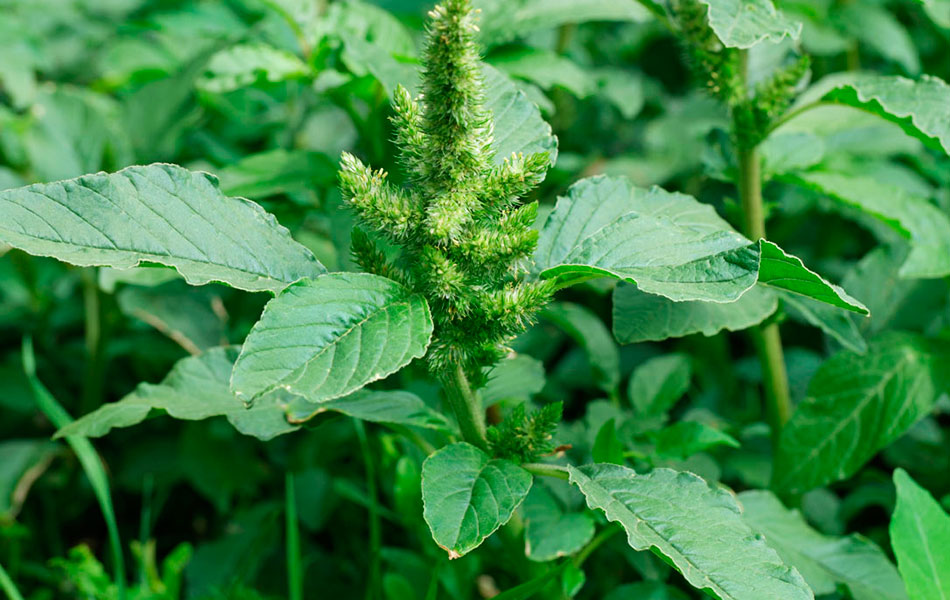
Amaranthus retroflexus, commonly known as pigweed, wild amaranth or redroot weed, is an annual herbaceous plant belonging to the Amaranthaceae family. Although native to North and Central America, it has become naturalised almost worldwide and often grows spontaneously in cultivated fields, vegetable gardens, along paths and on disturbed land.
It is an erect plant that can reach between 30 and 100 cm in height, with sturdy, branched stems that are usually hairy at the top.
It has a distinctive reddish or pinkish taproot, a characteristic that gives it its common name in English.
Its leaves are alternate, ovate to rhomboid in shape, and have entire or wavy margins.
It develops dense, compact, spiny green spikes at the tips of its stems, composed of numerous tiny flowers that appear from summer to autumn.
It is known for being an aggressive and competitive weed in summer crops (such as maize and soya), significantly reducing agricultural yields due to its high seed production and resistance to certain herbicides.
Despite its reputation as a weed, the young leaves are edible and are eaten cooked in a similar way to spinach. Its small black seeds have also historically been used as grain.
It can accumulate high levels of soil nitrates, making it potentially toxic to livestock (particularly pigs and cattle) if consumed in large quantities.
El Hierro, Tenerife, Gran Canaria, Lanzarote