Flora canaria > Especies silvestres
Amaranthus blitoides
Amaranthus blitoides S. Watson
Familia
AMARANTHACEAE
Bledo, Cenizo, Hebreo
Amaranthus blitoides, commonly known in Spanish as bledo, bledo rojo, breo or baleo, is an annual herbaceous plant belonging to the Amaranthaceae family. It is native to North America, but is now naturalised across much of the world, including the Iberian Peninsula and the Canary Islands, where it often behaves as an invasive species.
It is a creeping or prostrate plant, highly branched from the base, which usually forms dense mats on the ground. It rarely exceeds 50 or 60 centimetres in height.
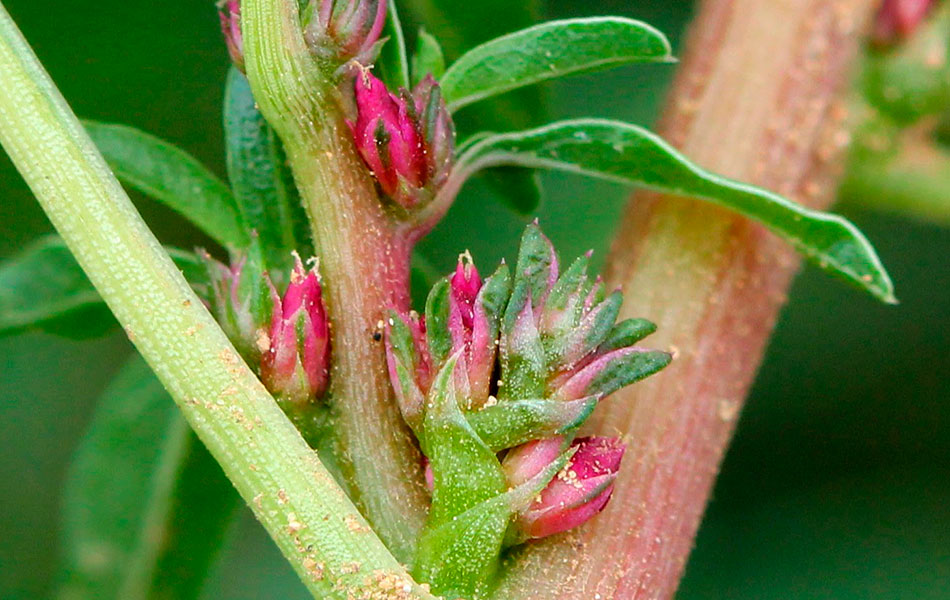
The leaves: These are small, elliptical or obovate (inverted egg-shaped), dark green on the upper surface and paler on the underside. They often have a characteristic whitish, cartilaginous margin.
The stems are hairless (glabrous) and usually range in colour from light green to reddish.
The flowers are tiny and cluster in racemes or glomerules situated in the leaf axils. They lack showy petals and flower mainly during the summer and autumn months.
This species is predominantly a ruderal and weed plant. It grows very readily in heavily disturbed, nitrogen-rich soils, along roadsides, on disturbed land, on urban plots and in cultivated fields (both rain-fed and irrigated). Owing to its hardiness and the large number of seeds it produces, it often becomes an agricultural weed that is difficult to eradicate.
Historically, Native Americans used its seeds as food. In various regions, the young leaves of wild amaranths are eaten cooked in a similar way to spinach because of their iron and vitamin content. However, if harvested for culinary purposes, it is essential to boil them first and discard the cooking water, as the plant tends to accumulate high concentrations of oxalates and nitrates, which are harmful to health if ingested in excess.
La Palma, Tenerife, Gran Canaria, Lanzarote