Flora canaria > Especies silvestres
Asphodelus ramosus
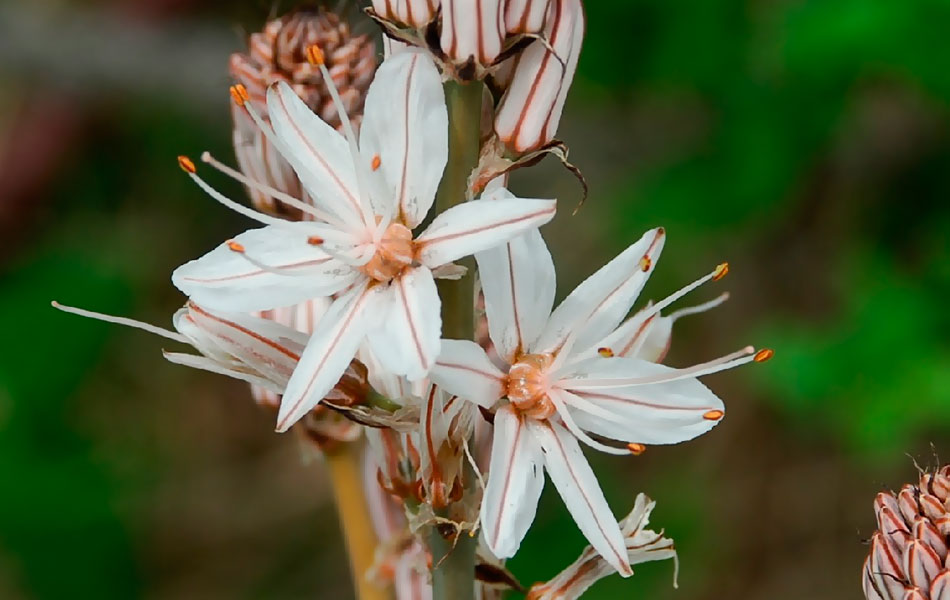
Asphodelus ramosus L. ssp. ramosus
Familia
ASPHODELACEAE
Gamón ramificado
Asphodelus ramosus, commonly known as asphodel or branched asphodel, is a perennial herbaceous plant belonging to the Asphodelaceae family. It is native to the dry, calcareous regions of central and southern Europe (widely distributed throughout the Mediterranean basin) and is currently cultivated worldwide as an ornamental plant.
It has a robust, upright growth habit, typically reaching a height of between 90 and 180 centimetres, characterised by a central flower stalk that branches profusely at its tip.
Leaves emerge directly from a basal rosette. They are numerous, elongated, ribbon-shaped, flat and light green or glaucous in colour.
The flowers have a star-shaped morphology with six white petals (tepals), each bearing a distinctive brown or reddish central line running lengthwise down the centre.
Flowering occurs mainly during the spring and summer months.
It has tuberous and rhizomatous roots rich in starch.
In ancient Greece, this species (and other closely related ones such as Asphodelus albus) was strongly associated with the funerary world. It was believed that the Fields of Asphodels were the part of the Underworld where the souls of ordinary people who deserved neither punishment nor special rewards dwelled.
Its dried stems have historically been used in traditional basketry. In times of extreme scarcity, the starch from its roots was even used to make bread or distil alcohol.
Internal consumption is not recommended due to the presence of the active compound asphodeline in its roots, which is toxic to both humans and livestock.
Tenerife, Lanzarote