Flora canaria > Especies silvestres
Dracunculus canariensis
Dracunculus canariensis Kunth
Familia
ARACEAE
Taragontía, Taraguntía, Tacoruntía, Taracontilla
A long time ago, when poverty and hunger were commonplace in many Canarian households, the rhizomes of the taragontías – which resemble small sweet potatoes – served as food for our ancestors, who would eat them after cooking and roasting them. It is even said that on the island of El Hierro, people went so far as to eat the seeds as well, after scraping off the husk and boiling them with plenty of salt. A rhizome resembling a small sweet potato. The leaves sprout from the underground stem, giving the impression that they emerge directly from the ground. Long, hollow petioles (20–40 cm). Leaves with 5–9 lobes
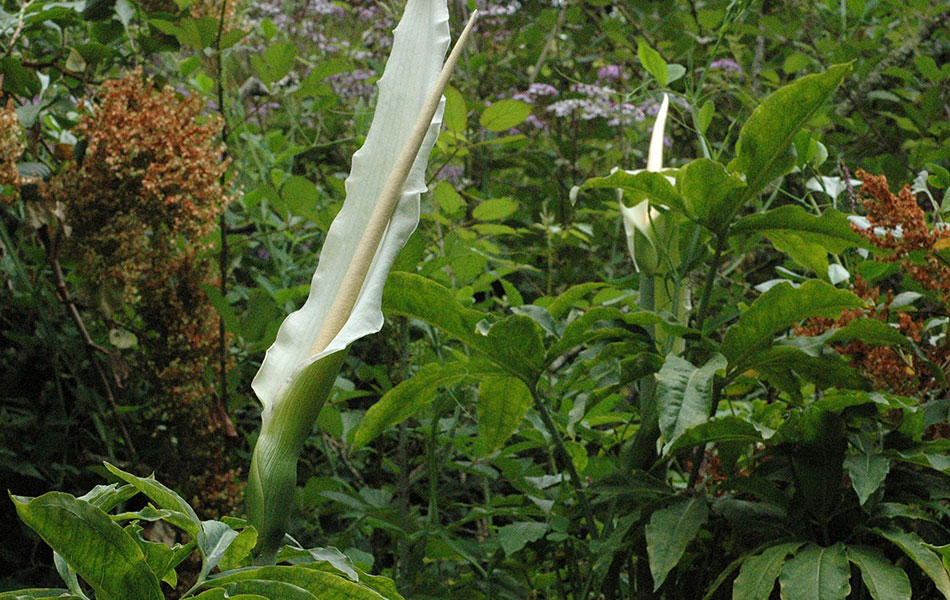
From that underground stem, which our ‘great-great-grandparents’ used to eat, a cluster of large leaves—up to 40 cm long—springs up every year, appearing to emerge directly from the earth. Their shape is unmistakable, as at the end of a very long petiole a large, palmate leaf forms, deeply lobed and of a bright, intense green colour.
The tiny, pale yellow flowers of the taragontías are arranged in a spiral along a long, fleshy stalk (spadix), which is surrounded by a modified leaf that acts as both calyx and corolla (spathe). This cream-coloured spathe can grow to over 50 cm in length and, over time, tightly envelops the cluster of small red-orange berries that constitute the fruit of this unique plant. Tiny florets arranged in a very tight spiral around a thickened axis (spadix). The spadix is surrounded by a greenish-white bract (spathe).
Habitat: Taragontía is a rare endemic species of our archipelago that prefers to grow in mid-altitude areas, although it can also be found in the Laurisilva, the Fayal-Brezal and even in the pine forest. It favours somewhat moist, shaded and nutrient-rich soils, but it is also found in open scrubland or dry grasslands. It generally seeks shelter beneath large, leafy trees, almost always growing in small groups, although it can also be found growing solitary or forming dense colonies. It grows in open areas of the Monteverde, on loose soil rich in organic matter. It is also found near the coast, outside the forest, as it only requires a few wet months. Occasionally, it is found in pine forests.
Flowering: Flowering takes place in spring, with the fruit ripening in summer.
Reproduction: By seed.
Uses: This is a toxic species containing poisonous compounds that are neutralised by cooking or drying, which has allowed the plant to be used in cooking. When they were no longer needed for human consumption, the tubers of the taragontías were used to fatten pigs. On El Hierro, the seeds were also eaten; they have a spicy flavour. The husks were lightly scraped and the seeds were boiled with salt. The seeds could be harvested in summer.
Medicinal properties: The juice from its rhizome has been used to treat tooth decay and other oral conditions. Distribution: Canary Islands.
Notes: Following the latest taxonomic review, four subspecies of this plant have been established.
Etimología: Su nombre genérico (Aeonium) proviene del griego y quiere decir eterno o que vive permanentemente.
Distribución: Endemismo canario. El Hierro, La Palma, La Gomera, Tenerife, Gran Canaria, Fuerteventura
Ecosistemas: Bosques termófilos, Laurisilva, Fayal-brezal, Pinar.
Altitud: Normalmente entre los 150-800 m s. n. m.