Flora canaria > Especies silvestres
Colocasia esculenta
Colocasia esculenta (L.) Schott
Familia
ARACEAE
Ñame, Ñamera, Oreja de elefante
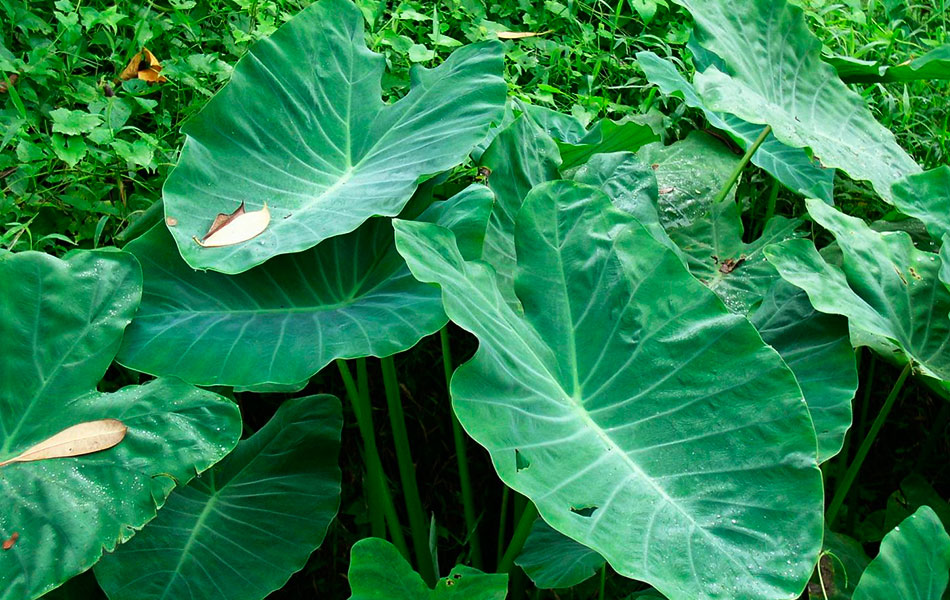
A large perennial herb, characterised by voluminous tubers that can weigh several kilograms and measure up to 20 cm in diameter. Large, heart-shaped leaves, up to more than 2 m in length, spring from its base, supported by thick petioles that form a sheath at their base; they are simple, alternate, somewhat fleshy, bright green in colour and with very prominent veins.
Its tiny, bright red flowers are arranged around a central axis (spadix) that ends in a club-like shape and is surrounded by a whitish hood-like structure (spathe) which partially encloses it. The flowers are unisexual, with the male and female flowers situated on different sections of the spadix, and both separated by a ring of sterile flowers. In cultivated specimens, it is rare to see the inflorescences.
Ecology: Native to the tropical regions of Asia and Africa, this plant was introduced to our islands a long time ago so that its tubers could be used as food. It is a plant of humid and hot areas, which is why it is common to find remnants of old crops in ravine beds, near springs or water sources, irrigation channels, etc. It is scarcely cultivated nowadays, with La Palma and La Gomera being the places where its agricultural use is most strongly maintained.
Flowering: Summer.
Propagation: In spring, by dividing the bulbs, taking care to leave at least one bud on each section.
Uses: The tubers, or ‘yams’, are rich in starch and are eaten after being thoroughly cooked, not only to soften them but also to remove the toxic compounds they contain.
Some people grow this plant as an ornamental, due to the beauty and lushness of its leaves; the chosen location should be a moist, temperate garden or a large outdoor planter.
Medicinal properties: It appears that the ‘yam’ has purgative properties, and, according to some ancient authors, its leaves, preserved in wine, constituted a good anti-scurvy remedy.
Cardonal tabaibal, Bosques termófilos, Laurislva, fayal brezal
50-1000 m
La Palma, La Gomera, Tenerife, Gran Canaria
Introducida