Flora canaria > Especies silvestres
Pancratium maritimum
Pancratium maritimum L.
Familia
AMARYLLIDACEAE
Lágrimas de virgen, Lágrimas de mar
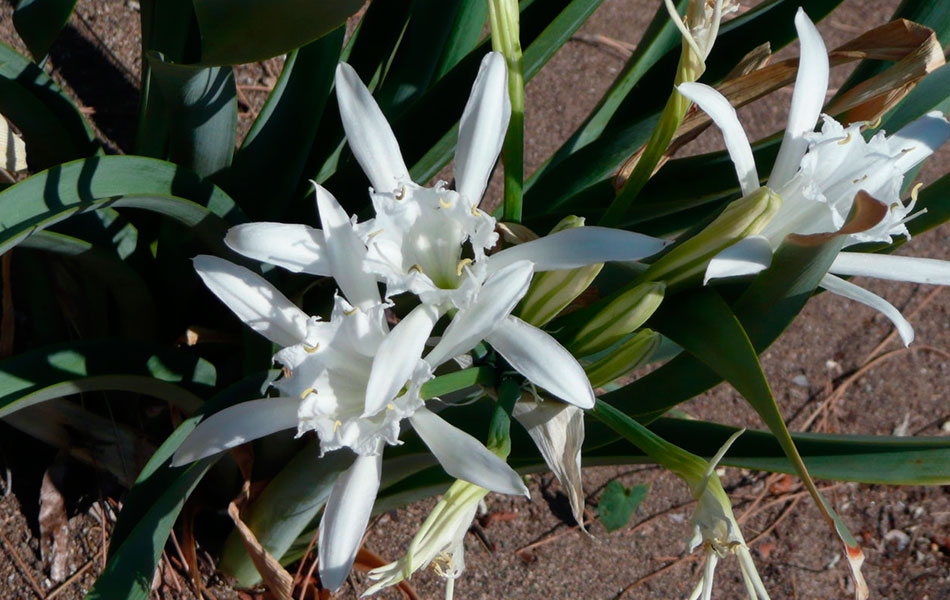
Pancratium maritimum, commonly known as the sea lily, is a bulbous, perennial plant belonging to the Amaryllidaceae family. It is notable for its remarkable ability to thrive directly on the hot sand of beaches and coastal dune systems.
This species is found exclusively along the coastlines of the Mediterranean Sea, the Atlantic Ocean, the Black Sea and in island regions such as the Balearic Islands and the Canary Islands.
Its survival in these extreme environments is due to key evolutionary adaptations:
Its bulb buries itself deeply in the sand to depths of up to 80 cm in search of coolness and moisture.
Its bluish-green leaves grow elongated to avoid being buried by the constant movement of the dunes caused by the wind.
Its corollas are trumpet-shaped to optimise the collection of morning dew.
It flowers during the hottest months of the year, generally from late June until September or October.
Interestingly, it requires a prolonged drought at the start of summer in order to flower successfully.
Its spectacular white flowers are hermaphroditic and give off a very intense fragrance. This scent is particularly pronounced at dusk and dawn to attract its pollinators, mainly the sphinx moth (Agrius convolvuli).
Following fertilisation, it produces rounded fruits containing black, sub-triangular seeds, which float easily and are dispersed by seawater.
Like other members of the Amaryllidaceae family, the entire plant is highly toxic due to the presence of alkaloids and cardiac glycosides. Its bulbs contain ungeremine, a potent acetylcholinesterase inhibitor.
As its peak flowering period coincides with the peak tourist season on the beaches, its populations suffer directly from damage caused by trampling and mechanical beach cleaning. It is included in several regional lists of protected flora and is classified as Near Threatened (NT) in regions such as Andalusia.
Fuerteventura, Lanzarote