Flora canaria > Especies silvestres
Pancratium canariense
Pancratium canariense Ker-Gawl.
Familia
AMARYLLIDACEAE
Lágrimas de Virgen, Azucena de risco, Lirio de risco
A herbaceous, perennial, bulbous plant with a tunicate bulb (like that of an onion) that is almost spherical and large, consisting of countless very thin white scales, anchored to the ground by a cluster of short, thick roots.
In autumn, a handful of somewhat fleshy, long, sword-shaped leaves with blunt tips and a bluish-green colour sprout from this bulb. They can grow up to 50 cm in length and are arranged in a basal rosette, from the centre of which the flower stalk will later emerge; this stalk is up to 80 cm long, smooth, solid, green in colour and covered with a very fine layer of whitish powder.
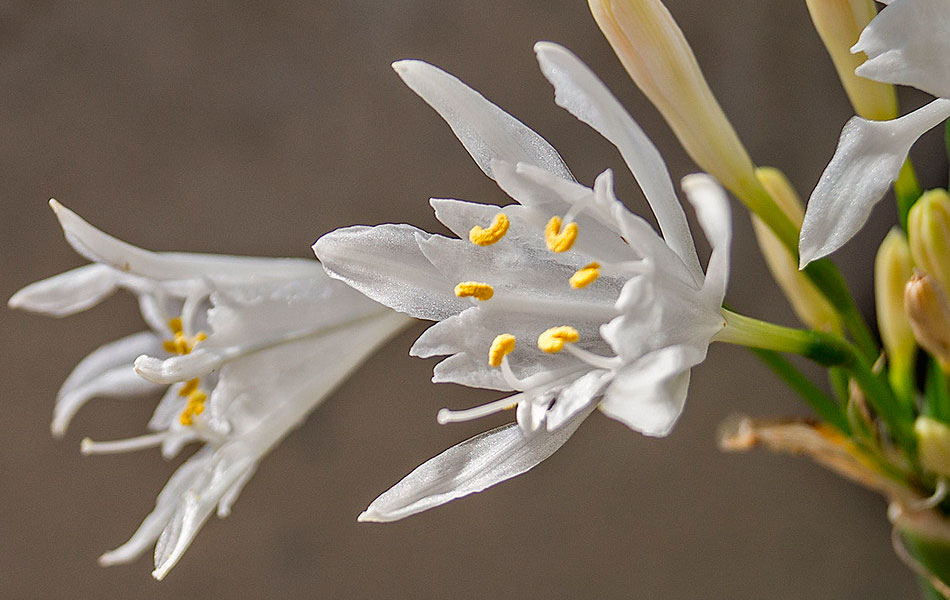
The flowers are arranged in pendulous umbel-like clusters, each containing 8–12 flowers. The perianth consists of a long tube that gradually widens towards the top, where six white tepals develop, and a corolla with twelve short teeth. Amongst these, six stamens protrude from between the teeth of the corolla; they are also whitish in colour and have kidney-shaped, yellow anthers that split lengthwise. The fruits are oval capsules containing several small, glossy black seeds.
The flowers give off a pleasant, sweet scent.
A species endemic to the Canary Islands, found in the lowlands and mid-altitude areas of all the islands in the Canary Archipelago, in areas of Cardonal-tabaibal scrub, thermophilic woodlands and pine forests, preferring scree slopes and rocky slopes on north-facing aspects, as it thrives in conditions with a certain degree of humidity.
On La Palma, it is found in places such as Mazo, La Galga and Gallegos, and more frequently in the west, in Barranco de Tenisca and Barranco de las Angustias. On Gran Canaria, it is found in Tirma, Tafira and Santa Brígida. On Tenerife, it is found on the north coast from Anaga to La Orotava, and also on the south coast, in Güímar and Guía de Isora. Flowering: Its flowering period is very short, lasting around two weeks, and generally occurs during the autumn months, shortly after the first rains of the season. Reproduction: By seeds and bulbs. Uses: It can be used as an ornamental plant, particularly suitable for rockeries, where it will flower – albeit briefly – when most other plants are going through their least favourable period.
On the islands of Lanzarote and Fuerteventura, one finds the very similar Pancratium maritimum, a species widely distributed throughout the Mediterranean region and along the Atlantic coast of the northern hemisphere, which can easily be confused with Pancratium canariense.
Etymology. The term Pancratium appears to derive from the Greek pankration (all-powerful), probably due to the plant’s ability to thrive in very dry and brackish habitats, or to its supposed medicinal properties. This would have given rise to the Latin ‘pancratium’, which was the name assigned by Pliny and Dioscorides to a plant of this family with a reddish bulb, which could be either Pancratium maritimum or Lilium candidum. The specific epithet (‘Canariensis’) refers to its exclusive occurrence in the Canary Islands.
SinonimiaBollaea canariensis, Pancratium teneriffae, Pancratium tiariflorum, Pancratium uniflorum.
Distribución: Endemismo canario. EL Hierro, La Palma, La Gomera, Tenerife, Gran Canaria, Fuerteventura, Lanzarote.
Ecosistemas: Cardonal-tabaibal, Bosques termófilos.
Altitud: Normalmente entre los 200-700 m s. n. m.