Flora canaria > Especies silvestres
Amaranthus muricatus
Amaranthus muricatus (Moq.) Hieron.
Familia
AMARANTHACEAE
Bledo, Hierba meona
Amaranthus muricatus, commonly known as ‘hierba meona’, ‘meonita’ or ‘creeping amaranth’, is a perennial herbaceous plant of the Amaranthaceae family. Although it is native to South America (mainly Argentina, Bolivia, Paraguay and Uruguay), it is now considered a naturalised and invasive alien species in various regions of the world, including southern Europe, North Africa, Australia and the United States.
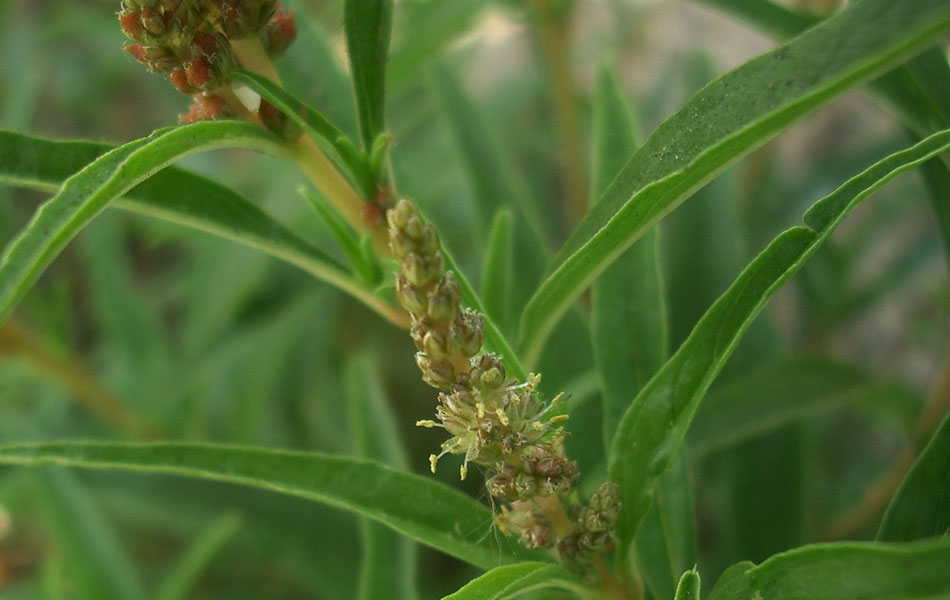
It is a creeping or prostrate herb that usually grows to between 15 and 55 cm in height. It forms dense clumps that are highly branched from the base, with slender, whitish or pinkish stems.
The leaves are narrow, linear-lanceolate in shape, alternate and dark green on the upper surface, whilst the underside is paler and has a very prominent midrib.
Very small, unisexual flowers in shades of green or pale purple. They are grouped in elongated, terminal panicle-like inflorescences. Their flowering season is very long, generally spanning from spring to autumn.
Accidentally introduced in the late 19th century via maritime trade, it is now widespread across the warmer regions of the Iberian Peninsula and the Balearic Islands, as well as in the Canary Islands.
It typically thrives in habitats that have been degraded or altered by human activity: roadsides and verges, derelict sites and urban areas, arable fields and vegetable gardens, where it is regarded as a weed harmful to agriculture due to its competition for soil resources.
La Gomera, Tenerife, Gran Canaria, Fuerteventura, Lanzarote