Flora canaria > Especies silvestres
Sesuvium portulacastrum
Sesuvium portulacastrum (L.) L.
Familia
AIZOACEAE
Verdolaga de costa, Verdolaga de mar, Vidrillo
Sesuvium portulacastrum, commonly known as beach purslane, coastal purslane or sea purslane, is a species of perennial succulent plant belonging to the Aizoaceae family. It is notable for its high resistance to extreme saline conditions and drought.
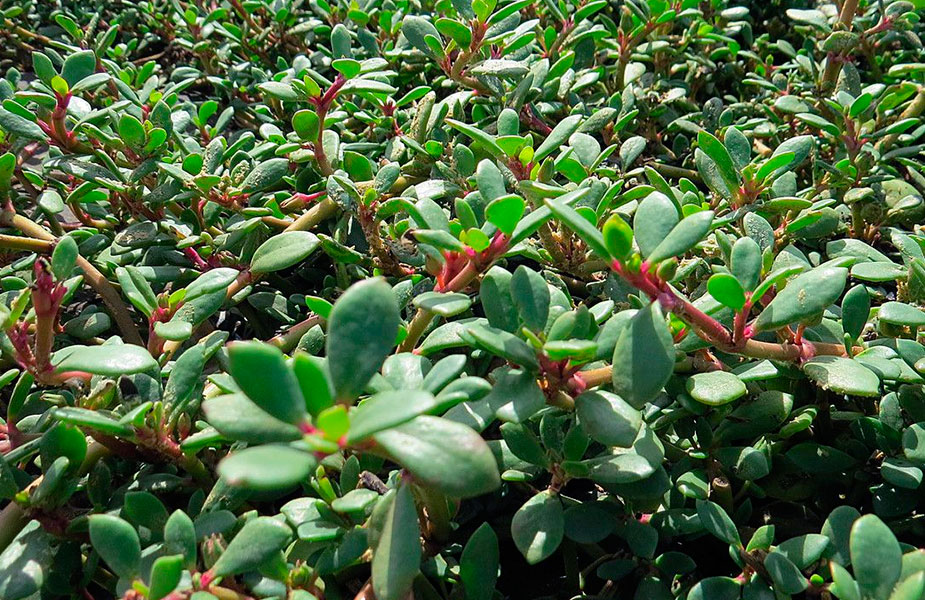
It has thick, fleshy and highly branched stems up to 1 metre in length. These stems are capable of rooting directly at the nodes, forming dense mats of vegetation that reach between 30 and 50 cm in height.
The leaves are succulent, opposite, simple and linear or lanceolate in shape (10 to 70 mm long). Their colour varies from bright green to reddish or purplish shades depending on sunlight and salinity. They store large quantities of water and salt.
The flowers are axillary, solitary and emerge from the leaf axils. They lack true petals; instead, they have five tepals that are greenish on the outside and a striking shade of pink, lilac or purple on the inside, accompanied by numerous stamens.
It is native to tropical and subtropical coastal areas throughout the world, including Africa, Asia, Australia and the coasts of the Americas. It grows mainly in coastal ecosystems such as sandy dunes, salt marshes, salt flats, tidal flats and limestone cliffs. In Spain, for example, it is classified as an introduced species in the Canary Islands.
Its ground-covering growth habit is essential for stabilising the sand and protecting dunes and coastlines from erosion caused by wind and waves.
Its leaves are edible. They have a distinctively salty flavour and are eaten fresh in salads, stir-fried or traditionally pickled, such as ‘atchara’ in the Philippines.
In cultivation, it requires little maintenance and no irrigation; watering once every three weeks is sufficient in the absence of rain. It is a highly valued plant in coastal landscaping projects.
Gran Canaria, Fuerteventura, Lanzarote