Flora canaria > Especies silvestres
Agave americana
Agave americana L.
Familia
AGAVACEAE
Pita, Pitera
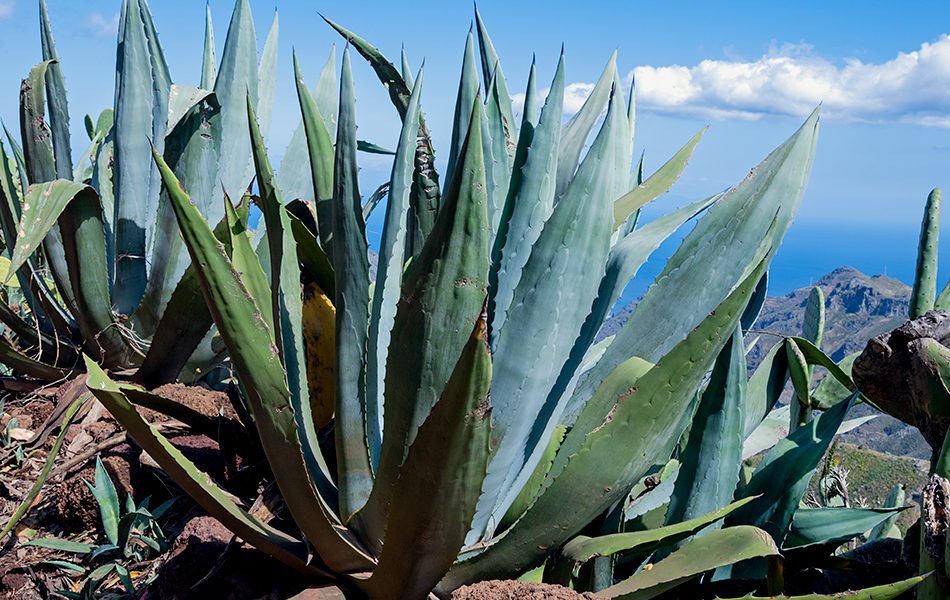
When I was little, I spent many hours watching my grandfather hollow out the dry stems of the piteras to make ‘ferret corks’. These spindles were nothing other than the enormous flower stalks produced by this species, which emerge – once the plant is several years old – from the centre of a sizeable basal rosette, formed by large, fleshy leaves that can grow to over 2 m in length. Bluish-green in colour and completely smooth, they have roughly spiny edges and a long, sharp, black spine at their apex.
Its flowers are arranged in compact clusters at the tips of the numerous twigs which, like the arms of a candelabra, are arranged alternately along the flowering stem. The greenish tepals form a sort of closed tube, which later opens to reveal numerous stamens up to 5 cm long, bearing large, golden-yellow anthers. Its fruits consist of hard capsules containing numerous flattened seeds.
This plant has long been credited with numerous medicinal properties. An infusion made from its leaves and flowers is used to reduce fever, aid digestion, heal ulcers and skin wounds, reduce inflammation of irritated gums, combat bad breath, regulate menstrual disorders,
Ecology: Native to the Americas, piteras were introduced to the Canary Islands to be cultivated as a fibre crop, the fibres of which were used to make ropes, nets, fabrics, etc. Their plantations came to cover considerable areas of the low-lying, arid regions of the islands, and remnants of these can still be seen in many places. Since cultivation ceased, they have become naturalised in coastal and mid-altitude areas, and are now such a characteristic feature of the island landscape that many people mistake them for an endemic species.
Flowering: Spring and summer. The plant flowers only once in its lifetime, after which it dies.
Reproduction: By seeds, basal shoots, and by the seedlings that form on the inflorescences and fall to the ground.
Uses: Piteras have been used as fodder and to build hedges to mark property boundaries or enclose
grazing areas. The dried flower stalks are still used to build roofs for huts and stables, and some farmers use the leaves, laid like roof tiles, to construct rudimentary gutters through which they divert water from ravines and springs into their vegetable gardens. However, the most important use of piteras is undoubtedly their roots, which play a key role in soil retention, preventing the severe erosion caused by rainfall on the steepest slopes.
DISTRIBUCIÓN: Especie introducida. Tenerife, La Palma, La Gomera, El Hierro, Gran Canaria, Lanzarote, Fuerteventura.
ECOSISTEMAS: Cardonal tabaibal, Bosques termófilos
ALTITUD: 10-700