Flora canaria > Especies silvestres
Asphodelus distalis
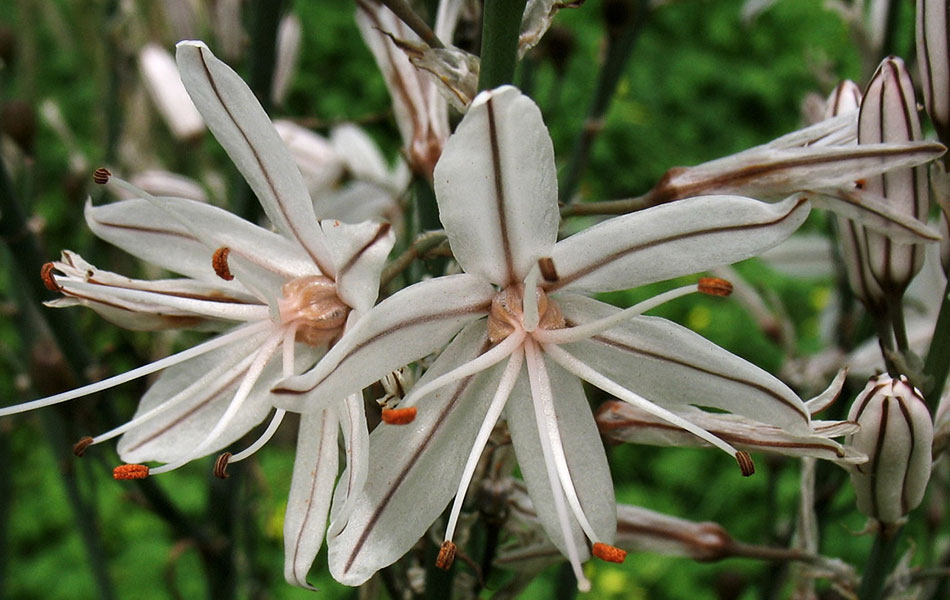
Asphodelus ramosus L. ssp. distalis Z. Díaz & Valdés
Familia
ASPHODELACEAE
Gamona, Gamón
Asphodelus ramosus ssp. distalis is a subspecies of perennial plant belonging to the Asphodelaceae family, commonly known as gamón or gamona. This variety is found mainly in the Canary Islands and in the south-west of the Iberian Peninsula.
It develops sturdy, smooth stems that can reach up to 2 metres in height.
The leaves are flat, sheathed at the base, green in colour and arranged in a distich or spiral pattern.
It bears a large inflorescence with 3 to 10 erect-spreading branches. Its flowers have white, oblong-elliptical tepals, which are noticeably larger than those of the typical subspecies. The stamens have a pale pink base.
It produces matt green, ovoid or ellipsoid capsules containing 5 to 11 transverse veins.
It is a hardy plant that is not fussy about the type of substrate. It grows best in scrub clearings, grasslands, seasonal pastures and nitrophilic ruderal areas.
In Spain, it is well represented in Western Andalusia (the south-west of the peninsula) and is widely distributed throughout the Canary Islands, having been recorded on El Hierro, La Palma, La Gomera, Tenerife, Gran Canaria, Fuerteventura and Lanzarote. Its great resilience enables it to colonise even fields of ancient lava flows and malpaís terrain.
Like other gamones, it is a heliophilous species (loving direct sunlight) and its tuberous roots enable it to regrow vigorously following fires or periods of intense drought; it is also a plant that livestock tend to avoid due to its toxicity when raw.
El Hierro, La Palma, La Gomera, Tenerife, Gran Canaria, Fuerteventura, Lanzarote