Flora canaria > Especies silvestres
Asphodelus ayardii
Asphodelus ayardii Jahand. & Maire
Familia
ASPHODELACEAE
Gamoncillo, Gamonilla florida
Asphodelus ayardii, commonly known as gamoncillo, varica de San José or cebollana, is a perennial herbaceous plant belonging to the Asphodelaceae family. It is native to the central-western Mediterranean region, growing wild in countries such as Spain (including the Canary Islands), France, Italy, Morocco and Algeria.
It has few roots and a short, thick rhizome. Its stems are erect and typically reach a height of between 50 and 150 cm.
They emerge from a dense basal rosette. The stems are numerous, circular in cross-section, hollow and with longitudinal ridges.
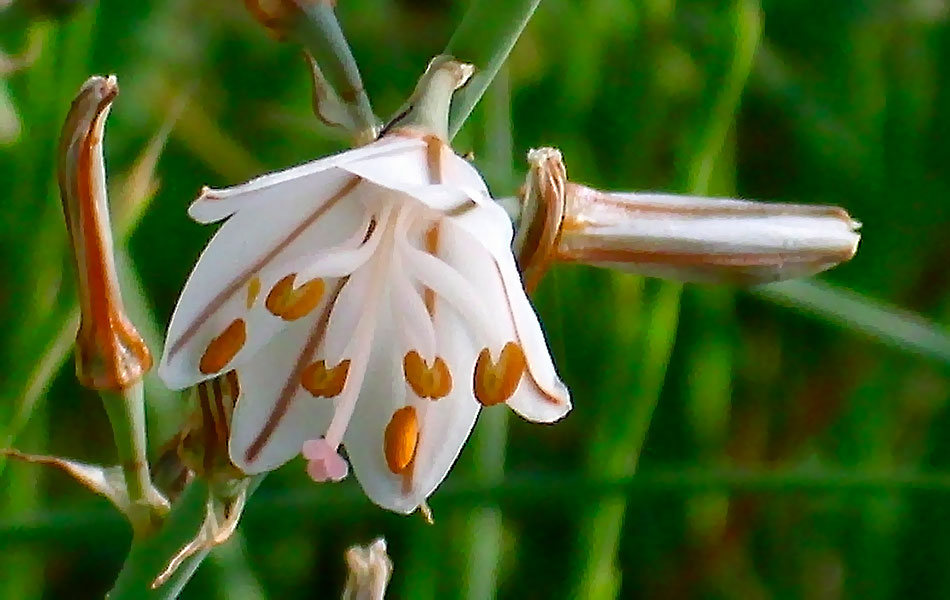
They are white in colour with a dark mid-line on the tepals, measure between 13 and 15.5 mm in diameter and are grouped in an open, loose racemose inflorescence. It flowers mainly between January and May.
It grows in semi-arid areas, steppes, grasslands, scrub clearings and dry scrublands, preferably on carbonate substrates at altitudes ranging from 200 to 1,000 metres above sea level.
In folk ethnobotany, it has been attributed with diuretic, purifying and skin-protective properties. Its traditional uses in folk medicine include: applying the pulp of cut tubers to treat skin eczema; using the ashes of the roots as a remedy for alopecia; and using the juice from fresh tubers to treat earache.
Its use is not recommended for people suffering from nephritis or gastritis.
Gran Canaria