Flora canaria > Especies silvestres
Arum italicum
Arum italicum Mill. ssp. canariense (Webb & Berthelot) P. C. Boyce
Familia
ARACEAE
Aro, Oreja de burro, Cachima, Flor de primavera, Llave del año, Tragontino
Arum italicum ssp. canariense is a perennial herbaceous plant belonging to the Araceae family, native and endemic to the Macaronesia region, and found in the archipelagos of the Canary Islands, Madeira and the Azores. In the Canary Islands, it is commonly known by names such as ‘orejaburro’, ‘regaljar’, ‘cachimba’, ‘tragontino’ or ‘llave del año’.
It is a perennial, rhizomatous plant that grows to between 25 and 40 cm in height. It develops a rosette of basal leaves with long petioles.
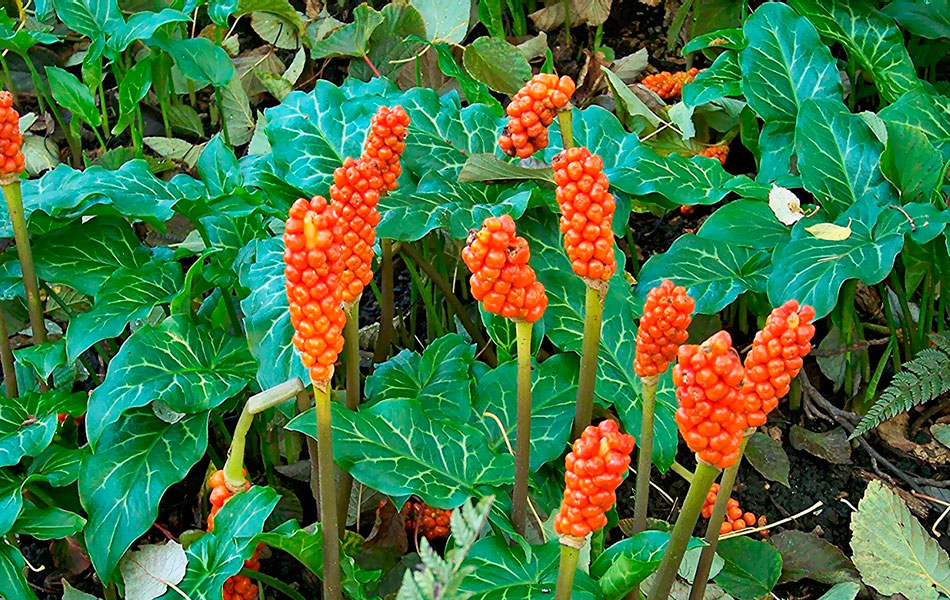
Its leaves are distinctly sagittate or hastate (shaped like the tip of an arrow or spear). They are dark green in colour, sometimes with very pronounced spots or veins, and have divergent, pointed basal lobes.
It flowers in spring (April–May). Its inflorescence is a creamy-yellow spadix enclosed by a large, modified bract called a spathe, which is whitish-green on the outside and purplish inside its basal tube.
It produces a cylindrical infructescence composed of striking, fleshy berries that turn a bright orange-red as they ripen during the summer.
This subspecies is closely associated with high-humidity, shaded environments. It grows naturally in the clearings and undergrowth of the laurel forest and in humid areas of the thermophilic zone. In the Canary Islands, it is found on the islands of Tenerife, Gran Canaria, La Palma, La Gomera, Fuerteventura and Lanzarote. It is a taxon with relatively scarce and localised populations, threatened in some areas by trampling, construction work and the use of herbicides.
Like other varieties of arum, the entire plant is highly toxic due to the presence of calcium oxalate crystals and aroin, particularly its fruits; it must therefore never be ingested.
La Palma, La Gomera, Tenerife, Gran Canaria, Fuerteventura