Flora canaria > Especies silvestres
Torilis elongata
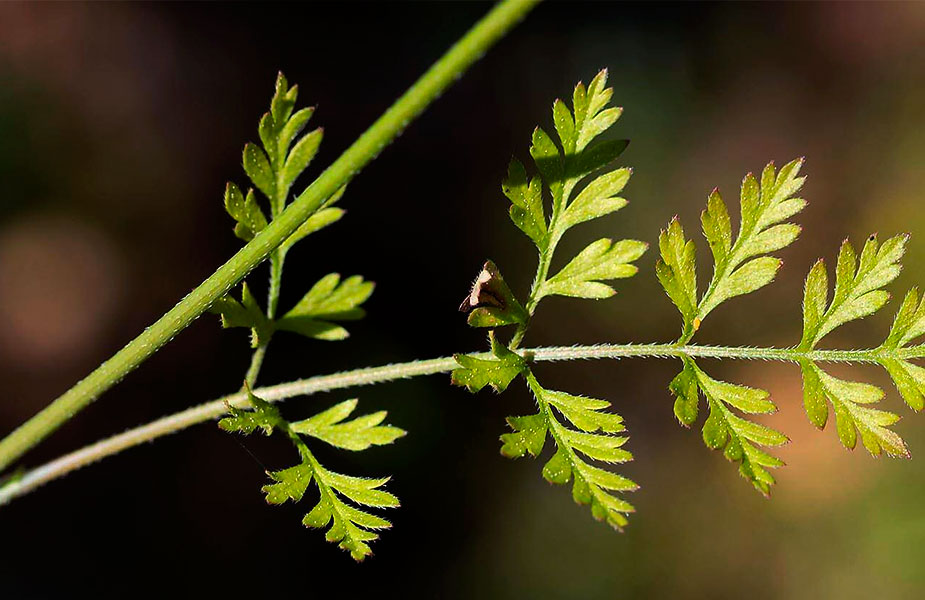
Torilis elongata (Hoffm. & Link) Samp.
Familia
APIACEAE
Cuernecillo
Torilis elongata, commonly known in some regions as ‘cuernecillo’, is a species of herbaceous plant belonging to the Apiaceae family.
It is an annual therophyte, meaning that it completes its entire life cycle during the favourable season and survives the unfavourable season in seed form.
It is small in size, usually reaching between 20 and 30 cm in height. Its stems are branched and divaricate (spreading at very wide angles).
The leaves are hairy or bristly in appearance (covered in stiff hairs) and are bi- to tripinnately divided (deeply lobed).
Its flowers are grouped in sessile umbels (without a long stalk) arranged opposite the leaves. One of its most distinctive features is that these umbels consist solely of two straight, rigid rays that spread out at a very wide angle (close to 90°).
It produces flowers with white, pink or purple petals between April and June. Its fruits are ellipsoid and covered by mericarps with stiff spines that do not follow a fixed pattern.
This species thrives mainly in therophytic grasslands, open, stony areas, nitrophilous meadows and roadside verges, usually on limestone substrates and at altitudes ranging from 200 to 1,500 metres above sea level.
Geographically, it is native to the Mediterranean and Macaronesian regions, with documented occurrences in areas such as the Canary Islands, the Balearic Islands, the Iberian Peninsula (where it is recorded both in Spain and in the Flora-On Portugal network), Albania and Algeria.
El Hierro, La Palma, La Gomera, Tenerife, Gran Canaria, Fuerteventura, Lanzarote