Flora canaria > Especies silvestres
Todaroa suaveolens
Todaroa aurea Parl. ssp. suaveolens P. Pérez
Familia
APIACEAE
Cañaheja olorosa
Todaroa aurea ssp. suaveolens, known as ‘cañaheja chica’ or ‘cañaheja olorosa’, is a herbaceous plant endemic to the Canary Islands. It belongs to the Apiaceae family and is found mainly on the western and central islands of the archipelago: El Hierro, La Palma, La Gomera, Tenerife and Gran Canaria.
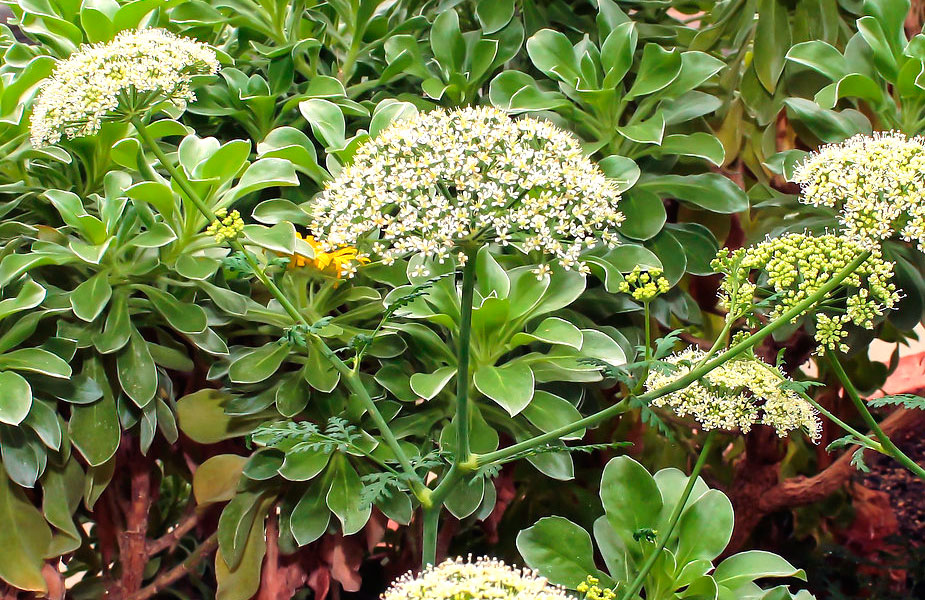
It is a perennial herbaceous plant that grows up to 1 metre in height. It has erect, branched and pubescent (covered in fine hairs) stems.
The leaves are green and hairy, deeply divided 3 to 4 times (3–4-pinnatisect). Their segments are noticeably wider than those of the typical subspecies (Todaroa aurea subsp. aurea).
They are grouped in umbel-shaped inflorescences. Unlike the aurea subspecies (which typically displays more yellowish tones), the subsp. suaveolens usually has whitish or very pale yellow petals.
Its subspecies name (suaveolens) highlights a key organoleptic characteristic: it has a mild and pleasant scent, unlike other related plants.
Flowering occurs mainly between December and April.
It grows wild in scrubland and on rocky outcrops across the islands of the archipelago. As it is an endemic species with localised populations, it is protected under the Canary Islands Government’s environmental regulations to ensure the conservation of local biodiversity.
El Hierro, La Palma, La Gomera, Tenerife, Gran Canaria