Flora canaria > Especies silvestres
Smyrnium olusatrum
Smyrnium olusatrum L.
Familia
APIACEAE
Apio caballuno
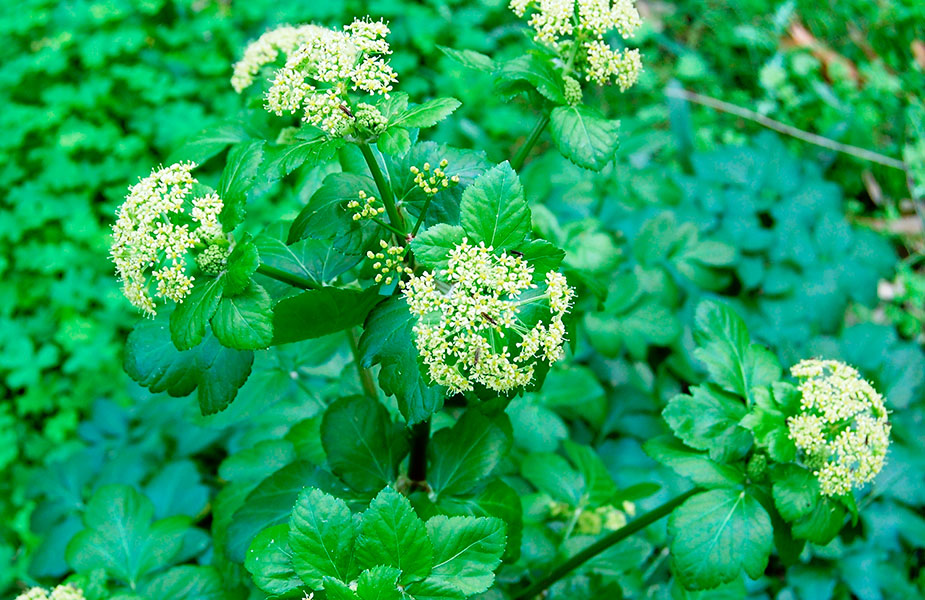
It is a robust plant that can grow to between 50 and 150 cm in height. It develops thick, striated and branched stems that tend to become hollow with age.
The leaves are a deep green colour and glossy on the upper surface. The basal leaves are large, divided into broad, toothed segments, and have a greatly enlarged, sheath-like petiole that clasp the stem.
It flowers in late winter and early spring (being one of the first umbellifers to do so). Its flowers are small and a characteristic greenish-yellow colour, grouped in compound umbels. The fruits are globose, with pronounced ridges, and turn completely black and glossy when ripe.
It grows wild in grasslands, along pathsides, streams and damp or shady areas, often in nutrient-rich (nitrophilous) soils.
Virtually the whole plant is edible. Traditionally, its leaves and tender stems have been eaten (with a flavour somewhere between celery and parsley, with resinous notes), its turnip-like roots have been cooked in winter, and its mature, ground seeds have historically been used as a substitute for pepper due to their fragrance, which is reminiscent of myrrh.
In the field of medicine, it has been credited with diuretic, anti-scorbutic (thanks to its vitamin C content) and carminative properties.
As it belongs to the Umbelliferae family, it shares habitats with highly toxic and deadly species such as hemlock (Conium maculatum) and devil’s turnip. It is distinguished from these mainly by its early flowering, its yellowish-green flowers (as opposed to the white flowers of hemlock), its black fruits when ripe and a pleasant, non-foul-smelling aroma. Even so, wild harvesting requires the utmost caution.
El Hierro, Tenerife, Gran Canaria