Flora canaria > Especies silvestres
Rutheopsis herbanica
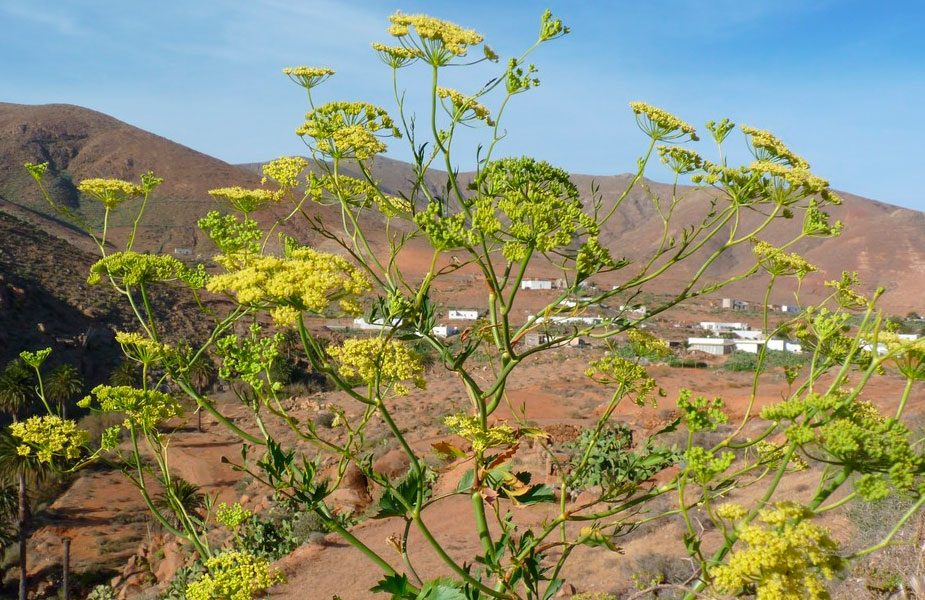
Rutheopsis herbanica (Bolle) A. Hansen & G. Kunkel
Familia
APIACEAE
Tájame
Rutheopsis herbanica, commonly known as tajame, is a species of herbaceous plant belonging to the Apiaceae family and constitutes a monotypic genus endemic to the eastern Canary Islands, Lanzarote and Fuerteventura.
It is a perennial plant that can grow up to 1.5 metres in height. It has striated stems that branch out at the top, along with a notably thickened, fibrous root with cinnamon-coloured bark.
The basal leaves are imparipinnate (with 4 or 5 pairs of ovate leaflets with serrated margins) and have a long, sheathing petiole. The upper leaves become progressively shorter and have linear segments.
It flowers mainly between April and May. It produces dense terminal umbels consisting of numerous rays (up to 50) bearing small flowers with pale yellow petals.
It grows in dry meadows, stony soils or ruderalised areas, usually as part of local communities such as the ‘tabaibal dulce’.
It is found exclusively at specific locations on the eastern islands. On Lanzarote, it has been recorded in areas such as the coast of Guatiza, Teseguite, El Castillejo, Montaña de Los Rostros and Los Ajaches.
On Fuerteventura, it can be found in areas such as Villaverde and the vicinity of Betancuria, whilst it is very rare on the Jandía peninsula.
It is classified as a protected species due to the decline in its populations. Historically, its thick roots were eaten in stews and salads during times of scarcity. However, pressure from free-roaming livestock and wild rabbits has severely depleted its natural populations, making it a botanically valuable and rare plant.
Fuerteventura, Lanzarote