Flora canaria > Especies silvestres
Pimpinella cumbrae

Pimpinella cumbrae Link
Familia
APIACEAE
Perejil de cumbre
Pimpinella cumbrae, commonly known as ‘perejil de cumbre’, is a perennial plant endemic to the Canary Islands. It belongs to the Apiaceae family and is notable for its extreme adaptation to high-mountain environments.
It is a small, woody-based perennial shrub that grows to a height of up to 50 cm. Its basal leaves are once-pinnate and covered in a greyish, velvety tomentum with abundant hairs, giving them a whitish hue that protects against solar radiation.
It produces white flowers arranged in umbels with 7 to 9 rays and no bracts. Its inflorescences usually remain dry on the plant for a long time.
Flowering occurs mainly between April and June.
Its fruits are rounded, globular and feel hairy or velvety to the touch.
This species is endemic exclusively to the islands of Tenerife and La Palma. It grows in the subalpine region, at altitudes ranging from 1,900 to 2,500 metres above sea level.
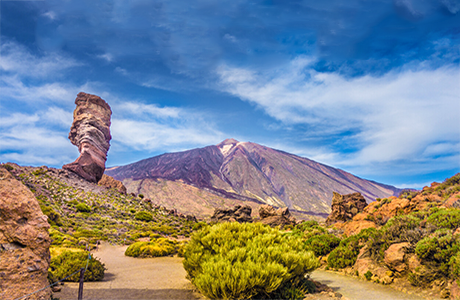
On Tenerife, it is particularly characteristic of the Circo de Las Cañadas del Teide, where it is found in crevices in cliffs, on stony slopes and in rocky areas such as La Fortaleza, Los Roques de García and Boca Tauce.
On La Palma, it is found in the highest parts of the Caldera de Taburiente, including places such as La Cumbrecita and the Roque de los Muchachos.
La Palma, Tenerife