Flora canaria > Especies silvestres
Ferula lancerottensis
Ferula lancerottensis Parl.
Familia
APIACEAE
Tajasnoyo,Cañaheja conejera
Ferula lancerotensis is a perennial herbaceous plant of the Apiaceae family, widely known in the Canary Islands by the common names ‘tajasnoyo’ or ‘cañaheja conejera’.
It is a Canarian endemic species found exclusively on the eastern islands of Lanzarote and the south of Fuerteventura. Its distribution on Lanzarote is very specific: north-western and northern areas such as the Riscos de Famara, Peñas del Chache, Haría, Los Valles and the Río viewpoint. On Fuerteventura, it occurs in small populations in the south of the island.
It grows on stony slopes, north-facing inclines and in valleys exposed to the moisture carried by the trade winds, usually at altitudes ranging from 200 to 650 metres above sea level.
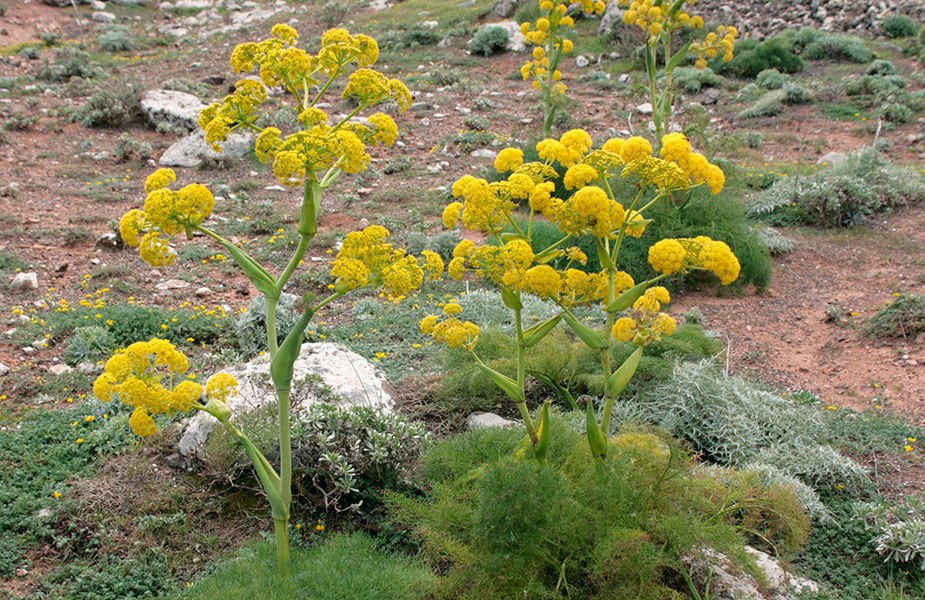
It is a robust and striking plant that can reach heights of 1.5 to 3 metres during its flowering phase.
It has large basal leaves (up to 60 cm long) that are a bright dark green colour, deeply divided (pinnatisect) into fine, fleshy segments. It has a thick, deeply buried root.
It develops a large flower stalk topped by umbrella-shaped inflorescences (umbels) up to 8 cm in diameter, composed of a multitude of small flowers with yellow petals.
It flowers regularly from December to March.
It produces elliptical fruits that are compressed dorsally, with distinct lateral wings approximately 1.5 cm long.
Lanzarote