Flora canaria > Especies silvestres
Conium maculatum
Conium maculatum L.
Familia
APIACEAE
Cicuta, Perejilón,Hediondo
Conium maculatum, commonly known as hemlock, is a biennial herbaceous plant belonging to the Apiaceae family (the same family as carrots and parsley) which is notable for being highly toxic and lethal to both humans and animals. It is famous in history because its poison caused the death of the Greek philosopher Socrates.
It is often mistaken for similar-looking edible plants, such as parsley or wild carrot. To distinguish it, one must look for three key features:
Purple spots on the stem: Its stem is erect, hollow and smooth, and is typically covered with purple or reddish spots or speckles.
Bright green, triangular and deeply lobed leaves (resembling a fern). When rubbed, they give off an unpleasant, foul odour, similar to mouse urine.
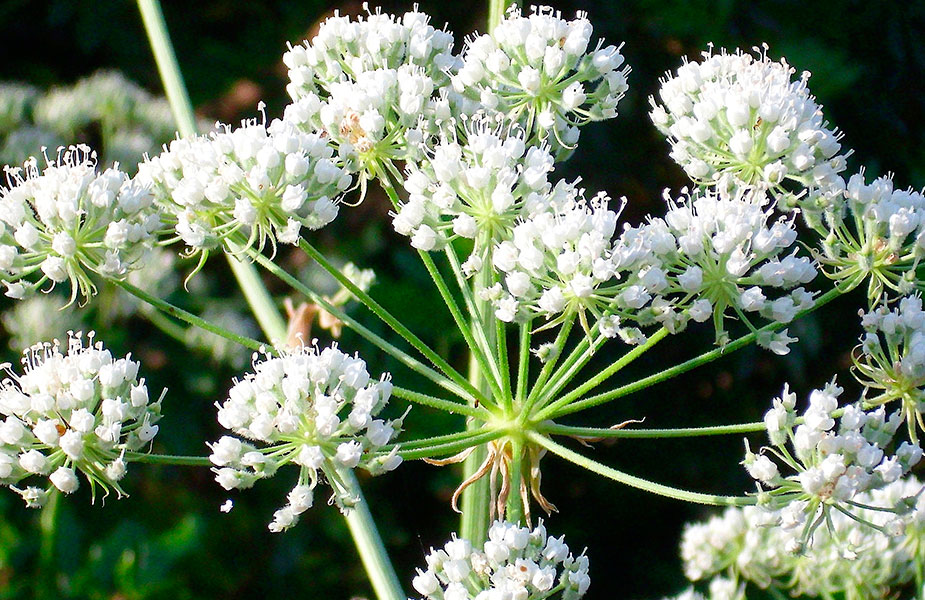
Flowers grouped in umbels (small, umbrella-shaped clusters) consisting of a multitude of very small white flowers.
It can grow to a considerable size in its second year, reaching a height of between 1.5 and 3 metres.
It is native to Europe, North Africa and temperate Asia, although it has become naturalised and been introduced to many regions of the world (such as North America), where it often behaves as a highly aggressive invasive species. It usually grows spontaneously on roadsides, wasteland, rubbish tips, riverbanks and wet areas with nitrogen-rich soils.
All parts of the plant — from the root to the seeds and flowers — contain neurotoxic alkaloids, the main one being coniine.
It blocks the peripheral nervous system and the neuromuscular junction in a similar way to curare.
The main clinical symptom is ascending muscle paralysis. It begins in the legs and progresses to affect the respiratory muscles, leading to death by asphyxiation or respiratory arrest whilst the person remains conscious.
Even a minimal amount of fresh leaves or seeds is sufficient to cause a fatal outcome.
El Hierro, La Palma, La Gomera, Tenerife, Gran Canaria