Flora canaria > Especies silvestres
Bupleurum lancifolium
Bupleurum lancifolium Hornem.
Familia
APIACEAE
Bupleurum lancifolium is an annual plant of the Apiaceae family. It is native to the Mediterranean region, Macaronesia and south-west Asia as far as Iran, although it has been introduced to other parts of the world, such as North America.
It is a herbaceous therophyte (annual) plant that usually grows to between 15 and 40 centimetres in height (though it can reach 50 cm). Its stems are erect and have a glaucous tinge.
Its leaves are deep green, 3 to 10 cm long and amplexicaul (clasping the stem). The lower leaves are ovate to oblong-lanceolate, which distinguishes it from similar species such as Bupleurum rotundifolium, which has more rounded leaves.
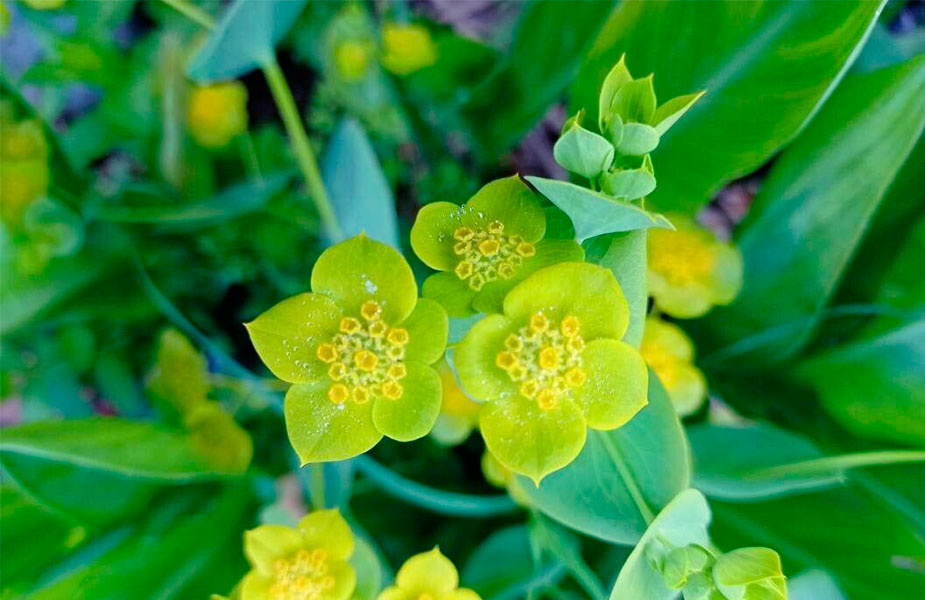
It produces an umbel-like inflorescence with 2 to 4 primary rays. The base of the umbel is surrounded by 5 broad, sub-rounded bracteoles with fine tips, which are noticeably longer than the flowers. The flowers are small and have yellow to yellow-orange petals.
Its fruits are ellipsoid or ovoid (about 3 to 5 mm long) and are characterised by being densely covered with small, whitish tubercles or protuberances.
It grows mainly in dry grasslands, cultivated fields, roadside verges and disturbed areas, from sea level up to an altitude of 1,800 metres. It flowers during spring and summer, usually between April and July. It requires full sun or partial shade to thrive.
Tenerife, Gran Canaria