Flora canaria > Especies silvestres
Apium repens
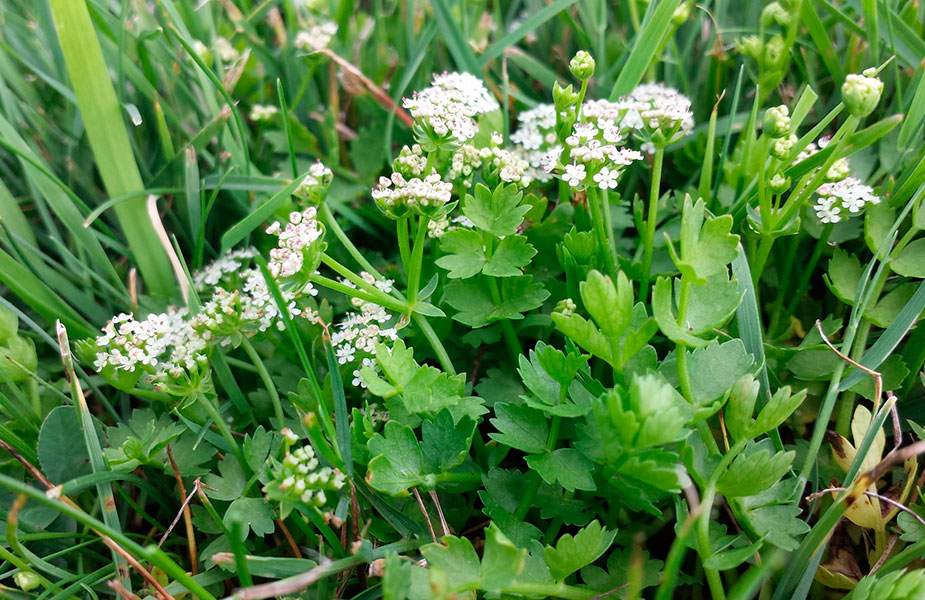
Apium repens (Jacq.) Lag.
Familia
APIACEAE
Apio rastrero
Apium repens (commonly known as creeping celery, wild celery or river celery) is a small, perennial, amphibious herbaceous plant belonging to the Apiaceae family. Also classified by the scientific community under the name Helosciadium repens, it is notable for being a highly specialised, rare species that is strictly protected under various European legal frameworks due to the disruption of its habitats.
Its stems are prostrate (lying flat on the ground) and have the unique ability to root at each node, forming a low-growing carpet. Both the leaves and the flowering stems emerge vertically from these nodes.
The leaves are once-divided (pinnatisect), typically comprising between 5 and 11 rounded or suborbicular leaflets with slightly toothed or lobed margins.
The flowers are small and white, grouped in umbrella-shaped inflorescences called compound umbels. These grow on peduncles that are usually considerably longer than the rays of the inflorescence itself.
It is extremely easy to confuse it with the common berraza (Helosciadium nodiflorum). However, creeping celery differs in that it is much smaller, its umbels have long peduncles and its stems always remain prostrate, as well as having well-defined reflexed bracts.
Tenerife