Flora canaria > Especies silvestres
Anthriscus caucalis
Anthriscus caucalis M. Bieb.
Familia
APIACEAE
Anis gitano, Ajogagatos
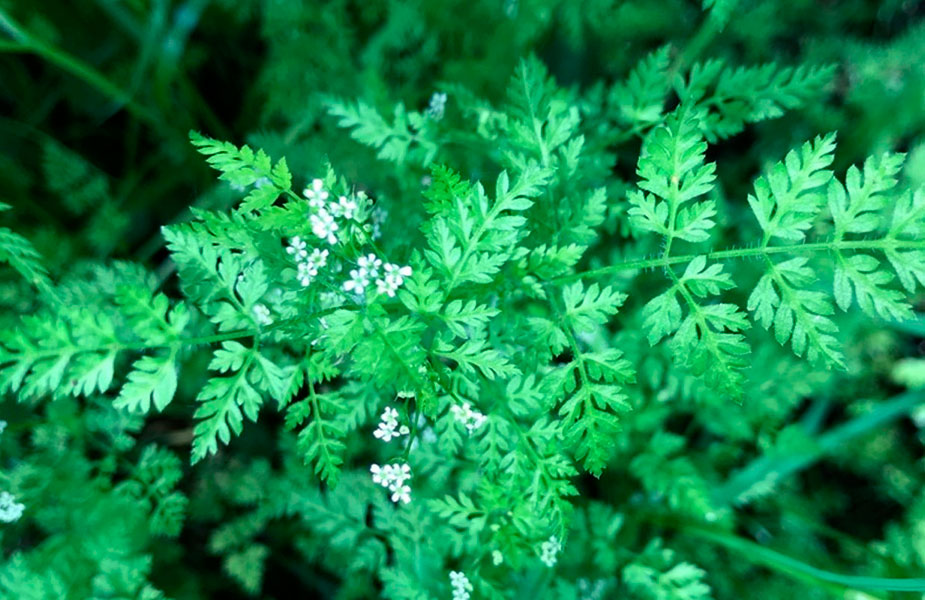
Anthriscus caucalis, commonly known as ‘ahogagatos’, ‘gypsy anise’ or ‘common antriscus’, is a species of annual herbaceous plant belonging to the Apiaceae family. It is notable for its delicate, lace-like foliage and its characteristic fruits covered in small, hooked hairs.
It is an annual herb that usually grows to a height of between 30 and 80 cm. Its stems are erect, hollow, striated and highly branched from the base.
The leaves are light green, alternate and 2–3 times pinnately lobed (deeply divided into triangular segments). They have soft, scattered hairs, particularly on the underside and on the petioles.
The flowers are grouped in small inflorescences in the form of compound umbels. The petals are tiny, white or yellowish-white, and are not particularly striking.
The fruit is ovoid in shape (about 3 mm) and typically tapers to a small point. Its most distinctive feature is that it is covered in stiff bristles or hooked hairs, which enable it to cling easily to animal fur or clothing.
It grows naturally in Europe, north-western Africa and parts of Western Asia (such as the Caucasus and Syria). It has also been introduced to North America, where it is notably found in parts of California.
It tends to colonise hyper-nitrified soils, wasteland, abandoned fields, hedgerows, verges and areas frequented by livestock or near dwellings, from sea level up to an altitude of 2,000 metres. It flowers mainly during spring and summer.
Although it was historically used in traditional medicine as a tonic or diuretic, this practice has fallen into disuse. In some European regions, it is regarded as an edible wild plant with a mild aniseed aroma.
El Hierro, Tenerife, Gran Canaria