Flora canaria > Especies silvestres
Carpobrotus acinaciformis
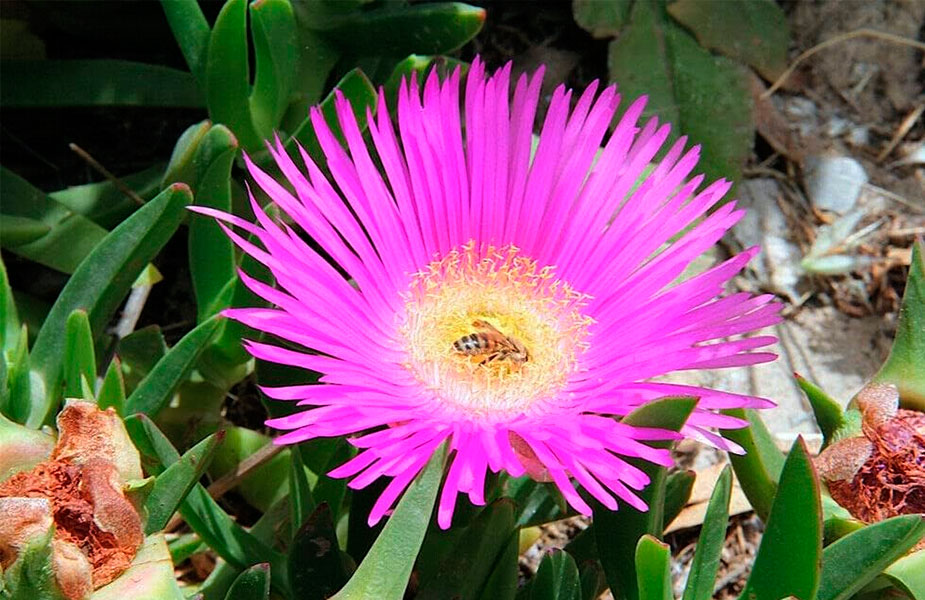
Carpobrotus acinaciformis (L.) L. Bolus
Familia
AIZOACEAE
Hierba cuchillo, Uña de gato, Uña de león, Diente de dragón
Carpobrotus acinaciformis, commonly known as the knife flower or lion’s claw, is a perennial succulent plant native to South Africa. Although it is notable for its striking magenta-coloured flowers and its great hardiness, it has become a highly impactful invasive alien species along the European Mediterranean and Atlantic coasts.
It has thick, fleshy, opposite leaves with an isosceles triangular cross-section (which helps to distinguish it from Carpobrotus edulis, whose leaves form an equilateral triangle). They can measure between 4 and 13 cm in length.
The large, solitary flowers can reach up to 12 cm in diameter. They feature numerous petaloid staminodes of an intense purple or magenta colour and yellow stamens in the centre.
It produces fleshy, fig-like structures that are edible and are traditionally used in South Africa to make tart jams.
In Spain, this plant is listed in the Spanish Catalogue of Invasive Alien Species (Royal Decree 630/2013).
Its introduction, possession, transport, trafficking and trade are strictly prohibited throughout the country, with the exception of the Canary Islands.
As a fast-growing creeping plant, it forms dense, monospecific mats that completely displace the native flora on dunes and cliffs. Furthermore, it chemically alters the soil by accumulating salts and changing the pH, preventing other species from regenerating.
Tenerife, Gran Canaria, Lanzarote